The sample copy of this report is available for access.
“Global Telehandler Market to reach a market value of USD 7,359.23 Million by 2033 growing at a CAGR of 7.1%”
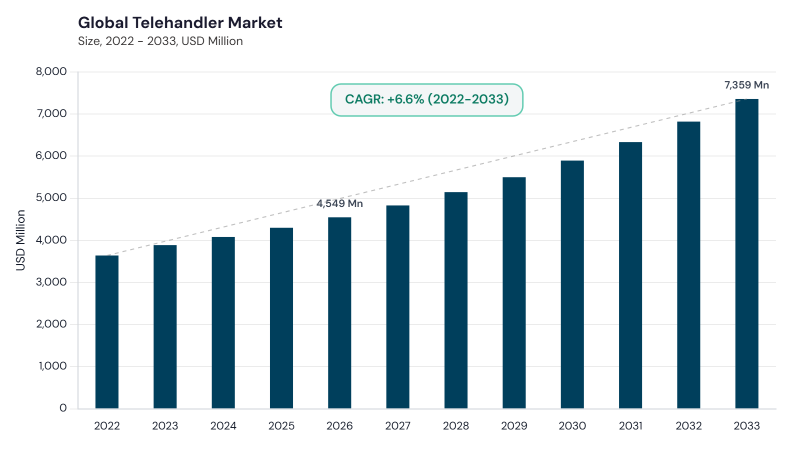
The Global Telehandler Market is expected to reach USD 7.3 billion by 2033, growing at a CAGR of 7.1% during (2026 - 2033).
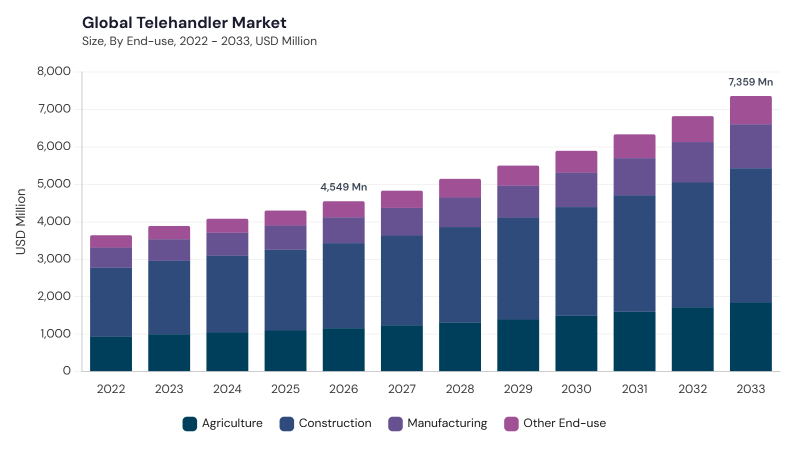
Growing need for versatile material handling, elevated load placement, efficient lifting operations, and multifunctional equipment is driving the Telehandler Market across construction, agriculture, mining, logistics, warehousing, manufacturing, and industrial worksites. Growth is further strengthened by infrastructure development, agricultural mechanization, warehouse expansion, equipment rental adoption, electric and hybrid models, higher load capacities, advanced stability systems, telematics, compact designs, and operator-assistance features.
Growth in the Telehandler Market is driven by the combined need for lifting capacity, reach, maneuverability, productivity, and safety across increasingly complex worksites. Telehandlers reduce dependence on multiple pieces of equipment by combining the functions of forklifts, cranes, loaders, and aerial handling machinery. Construction companies use them for material placement and site logistics, agriculture users deploy them for bale handling, feed movement, and farm operations, while industrial and logistics users benefit from flexible material movement. Rising rental penetration also improves equipment accessibility and supports broader adoption among contractors with project-based requirements.
The competitive environment is moderately consolidated and equipment-manufacturing-driven, with global construction equipment manufacturers, material-handling specialists, agricultural machinery suppliers, and access-equipment providers competing through product breadth, lifting performance, dealer reach, service support, rental-fleet penetration, and application coverage. JCB, Manitou, and Oshkosh form the leading group, while Merlo, Bobcat, Magni, Dieci, Terex, Caterpillar, and Liebherr strengthen the competitive field through compact, rotating, agricultural, construction, high-capacity, and specialized telehandler platforms. Future competition will be shaped by electrification, rotating-machine adoption, attachment versatility, telematics, operator safety, service-network depth, and rental ecosystem strength.
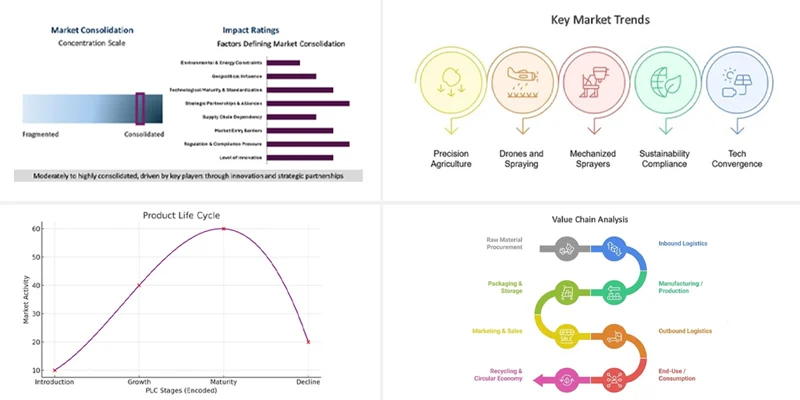

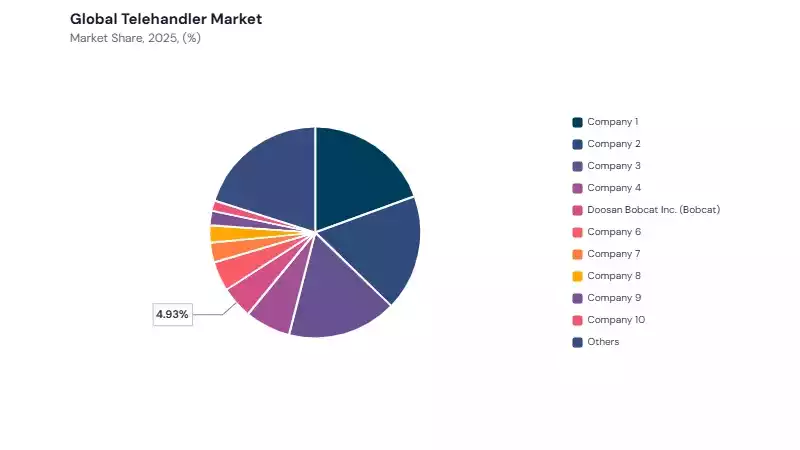
The global Telehandler Market reflects a moderately consolidated and equipment-led competitive landscape, with leadership concentrated among manufacturers that combine broad product portfolios, strong dealer networks, rental-fleet access, and construction-agriculture application coverage. JCB leads the market through its Loadall portfolio, wide global distribution, attachment ecosystem, and strong presence across construction and agriculture. Manitou follows closely with fixed, rotating, agricultural, high-capacity, compact, and electric telehandler families, while Oshkosh strengthens its position through JLG, SkyTrak, and AUSA. Merlo, Bobcat, Magni, Dieci, Terex, Caterpillar, and Liebherr compete through specialized rotating machines, compact equipment, high-reach platforms, conventional fixed-boom telehandlers, premium engineering, and established aftermarket support.
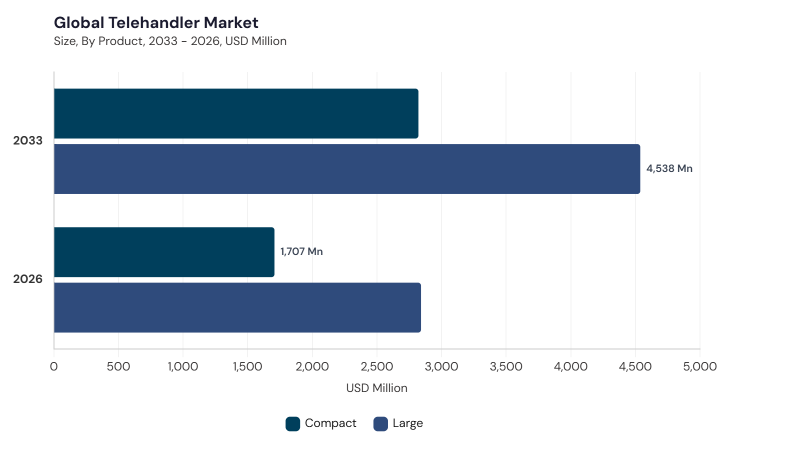
Based on Product, the market is segmented into Large and Compact. The Large market dominated the Global Telehandler Market by Product in 2025, and would continue to be a dominant market till 2033; thereby, achieving a market value of USD 4.5 billion by 2033, growing at a CAGR of 6.9 % during the forecast period. The Compact market is expected to witness a CAGR of 7.4% during (2026 - 2033).
Large telehandlers remain central to heavy-duty construction, infrastructure, industrial, agricultural, and logistics applications where higher reach, stronger load capacity, and rugged material placement are required. These models support demanding lifting tasks involving pallets, steel components, building materials, and bulk agricultural loads. Compact telehandlers are gaining adoption across confined urban worksites, warehouses, landscaping, small farms, and maintenance environments where maneuverability and ease of transport are important. Both categories are being improved through hydraulic upgrades, operator-assistance systems, load management, modular attachments, and lower-emission powertrain options.
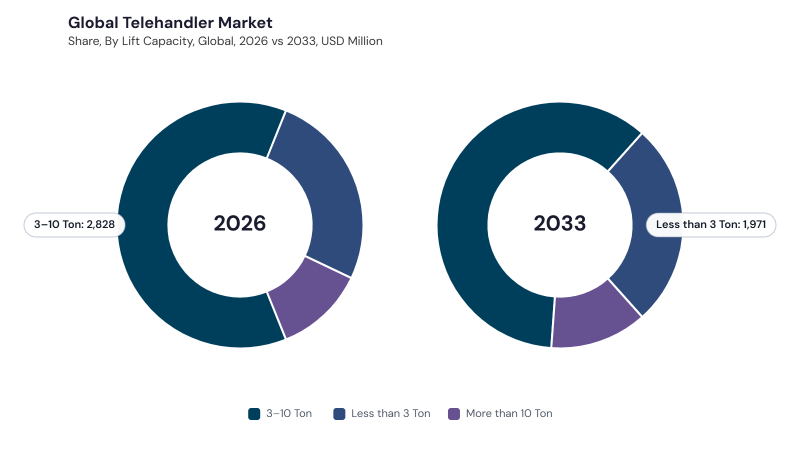
Based on Lift Capacity, the market is segmented into 3–10 Ton, Less than 3 Ton, and More than 10 Ton. The 3–10 Ton market dominated the Global Telehandler Market by Lift Capacity in 2025, and would continue to be a dominant market till 2033; thereby, achieving a market value of USD 4.4 billion by 2033, growing at a CAGR of 6.7 % during the forecast period. The Less than 3 Ton market is expected to witness a CAGR of 7.6% during (2026 - 2033). The More than 10 Ton market is expected to witness a CAGR of 8.2% during (2026 - 2033).
The 3–10 Ton segment represents the core market because it balances lifting strength, reach, mobility, and broad usability across construction, agriculture, warehouses, and industrial yards. Less than 3 Ton telehandlers serve lighter-load applications where compactness, precision, lower operating cost, and confined-space access are important, especially in urban construction, landscaping, small farms, and indoor handling. More than 10 Ton telehandlers support heavy infrastructure, industrial processing, mining, ports, and specialized material movement where maximum lifting capacity and reinforced machine design are required. Adoption across all capacity groups is supported by stability controls, hydraulic performance, safety systems, and attachment flexibility.
Based on End-use, the market is segmented into Construction, Agriculture, Manufacturing, and Other End-use. The Construction market dominated the Global Telehandler Market by End-use in 2025, and would continue to be a dominant market till 2033; thereby, achieving a market value of USD 3.5 billion by 2033, growing at a CAGR of 6.7 % during the forecast period. The Agriculture market is expected to witness a CAGR of 6.9% during (2026 - 2033). Additionally, The Manufacturing market is expected to witness highest CAGR of 7.9% during (2026 - 2033).
Construction remains the leading end-use as telehandlers support site logistics, scaffold loading, material placement, modular construction, and infrastructure work across uneven and space-constrained environments. Agriculture uses telehandlers for bale handling, feed distribution, crop movement, equipment loading, and general farm material handling, supported by rugged design and attachment versatility. Manufacturing applications rely on telehandlers for movement of raw materials, heavy components, finished products, yard logistics, and warehouse operations. Other End-use includes mining, logistics, ports, municipal services, recycling, utilities, events, and specialized industrial environments requiring flexible lifting and rough-terrain handling.
Based on Propulsion Type, the market is segmented into ICE and Electric. The ICE market dominated the Global Telehandler Market by Propulsion Type in 2025, and would continue to be a dominant market till 2033; thereby, achieving a market value of USD 5.0 billion by 2033, growing at a CAGR of 6.7 % during the forecast period. The Electric market is expected to witness a CAGR of 8% during (2026 - 2033).
ICE telehandlers remain the primary propulsion category because they provide high power output, long runtime, dependable performance, and suitability for demanding outdoor environments, construction sites, farms, and remote worksites. Diesel-powered models continue to benefit from established service networks and refueling infrastructure, although manufacturers are improving fuel efficiency and emission control. Electric telehandlers are expanding due to zero on-site emissions, quieter operation, lower maintenance needs, and suitability for indoor facilities, urban sites, warehouses, and emission-sensitive environments. Battery improvements, charging solutions, and hybrid concepts are expected to gradually strengthen electric adoption.
Free Valuable Insights: Telehandler Market Size to reach $7.3 Billion by 2033
Region-wise, the Telehandler Market is analyzed across North America, Europe, Asia Pacific, and LAMEA. The North America market dominated the Global Telehandler Market by Region in 2025, and would continue to be a dominant market till 2033; thereby, achieving a market value of USD 2.5 billion by 2033, growing at a CAGR of 6.6 % during the forecast period. The Europe market is expected to witness a CAGR of 6.9% during (2026 - 2033). Additionally, The Asia Pacific market is expected to witness a CAGR of 7.7% during (2026 - 2033).
North America remains the leading regional market due to construction activity, large rental fleets, agricultural mechanization, infrastructure development, and strong demand for high-capacity and versatile material-handling equipment. Europe benefits from established telehandler usage in construction and agriculture, strict emissions regulation, rotating telehandler adoption, and rising demand for electric and compact models. Asia Pacific is expanding through urbanization, infrastructure investment, manufacturing growth, farm mechanization, and increasing use of rental and distribution networks. LAMEA is developing through construction, mining, oil and gas, agriculture, and industrial expansion, although affordability, service infrastructure, and skilled workforce limitations influence adoption.
| Report Attribute | Details |
|---|---|
| Market size value in 2026 | USD 4.5 billion |
| Market size forecast in 2033 | USD 7.3 billion |
| Base Year | 2025 |
| Historical Period | 2022 to 2024 |
| Forecast Period | 2026 to 2033 |
| Revenue Growth Rate | CAGR of 7.1% from 2026 to 2033 |
| Number of Pages | 560 |
| Tables | 690 |
| Report Coverage | Market Trends, Revenue Estimation and Forecast, Segmentation Analysis, Regional and Country Breakdown, Competitive Landscape, Market Share Analysis, Company Profiling, Companies Strategic Developments, SWOT Analysis, Product Life Cycle Analysis, Value Chain Analysis, Market Consolidation Analysis, Key Customer Criteria, Pandemic Impact Analysis, and Winning Imperatives |
| Segments Covered | Product, Lift Capacity, End-use, Propulsion Type, and Geography |
| Country Scope |
|
| Companies Included | J.C. Bamford Excavators Ltd. (JCB); Manitou Group; Oshkosh Corporation; Merlo S.p.A.; Doosan Bobcat Inc.; Magni Telescopic Handlers S.r.l.; Dieci S.r.l.; Terex Corporation; Caterpillar Inc.; Liebherr Group |
By Product
By Lift Capacity
By End-use
By Propulsion Type
By Geography
Valued at USD 4.5 billion in 2026, it's projected to reach USD 7.3 billion by 2033, growing at 7.1% CAGR during 2026-2033.
The Large segment leads, expected to reach USD 4.5 billion by 2033.
J.C. Bamford Excavators Ltd., Manitou Group, Oshkosh Corporation, Merlo S.p.A., Doosan Bobcat Inc., Magni Telescopic Handlers S.r.l., Dieci S.r.l., Terex Corporation, Caterpillar Inc., Liebherr Group.
North America leads with a market value of USD 2.5 billion by 2033.
Electrification, alternative powertrain innovations, and expansion in construction and infrastructure development enhance telehandler demand.
The 3–10 Ton segment leads, projected to reach USD 4.4 billion by 2033.
Our team of dedicated experts can provide you with attractive expansion opportunities for your business.








 Unique Offerings