The sample copy of this report is available for access.
The North America Telehandler Market is expected to reach USD 2.3 billion by 2032, growing at a CAGR of 6.6% during (2026 - 2033).
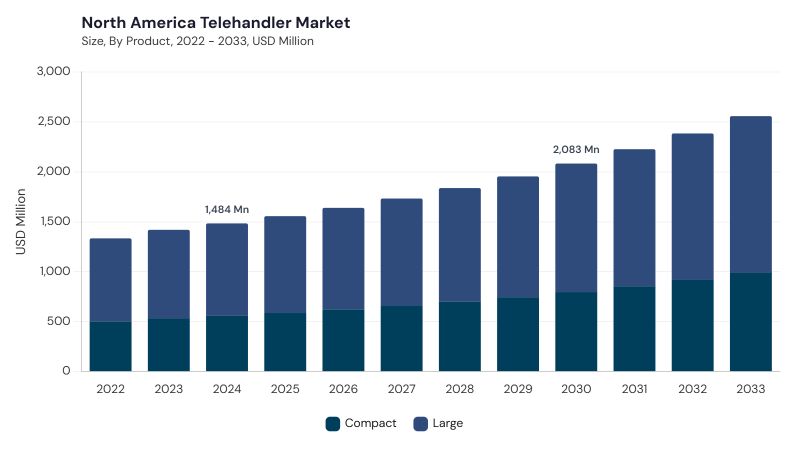
The North America Telehandler Market evolved alongside mechanized construction, commercial agriculture, industrial development, and large-scale material handling across the region. Early telehandlers primarily served as rugged lifting machines offering greater reach than conventional forklifts, while later models incorporated advanced hydraulic systems, improved stability, electronic safety controls, and multifunctional attachments. Product development expanded toward fixed-boom, compact, rotating, high-capacity, electric, and hybrid configurations. Current equipment increasingly combines lifting performance with enhanced operator visibility, intelligent controls, connected technologies, and application-specific designs suited to construction, agriculture, logistics, manufacturing, and specialized industrial environments.
Electrification, rental penetration, compact equipment demand, telematics, and advanced operator-assistance systems are shaping current market development. Electric telehandlers are gaining relevance for indoor, urban, and noise-sensitive applications, while ICE models remain important for prolonged heavy-duty outdoor operations. Telematics, GPS tracking, remote diagnostics, load monitoring, and predictive maintenance are improving fleet utilization, safety, and equipment availability. Manufacturers are also expanding attachment ecosystems, higher-capacity models, rotating configurations, and service networks. At the same time, high equipment costs, regulatory compliance, skilled operator shortages, terrain compatibility, financing constraints, and maintenance expenses continue to influence procurement and fleet-management decisions.
Based on Product, the market is segmented into Large and Compact. The Large market dominated the North America Telehandler Market by Product in 2025, and would continue to be a dominant market till 2033; thereby, achieving a market value of USD 1.4 billion by 2032, growing at a CAGR of 6.4 % during the forecast period. The Compact market is expected to witness a CAGR of 6.9% during (2026 - 2033).
Large telehandlers provide high load ratings, extended reach, robust hydraulic systems, and attachment flexibility suited to infrastructure, heavy construction, agriculture, and industrial environments. Demand is reinforced by fleet replacement, large project activity, multifunctional equipment requirements, and increasing integration of telematics and stability technologies. Compact telehandlers emphasize maneuverability, transport convenience, reduced machine dimensions, and suitability for urban construction, landscaping, facility maintenance, warehouses, and confined agricultural environments. Electric and hybrid configurations, ergonomic controls, enhanced visibility, and versatile attachment compatibility are further strengthening compact-model adoption.
Based on Lift Capacity, the market is segmented into 3–10 Ton, Less than 3 Ton, and More than 10 Ton. The 3–10 Ton market dominated the North America Telehandler Market by Lift Capacity in 2025, and would continue to be a dominant market till 2033; thereby, achieving a market value of USD 1.4 billion by 2032, growing at a CAGR of 6.1 % during the forecast period. The Less than 3 Ton market is expected to witness a CAGR of 7% during (2026 - 2033). The More than 10 Ton market is expected to witness a CAGR of 7.6% during (2026 - 2033).
The 3–10 Ton category serves as a versatile workhorse for medium-to-large construction projects, farms, warehouses, and industrial operations requiring substantial material-handling capability without the size and expense of heavy-lift machines. Less than 3 Ton telehandlers are suited to confined sites, landscaping, residential projects, indoor applications, and light agricultural tasks where maneuverability is prioritized. More than 10 Ton units address specialized heavy construction, ports, logistics hubs, industrial facilities, energy projects, and infrastructure operations requiring exceptional lifting strength. Advancements in hydraulics, boom stabilization, telematics, and safety systems are strengthening performance across all capacity ranges.
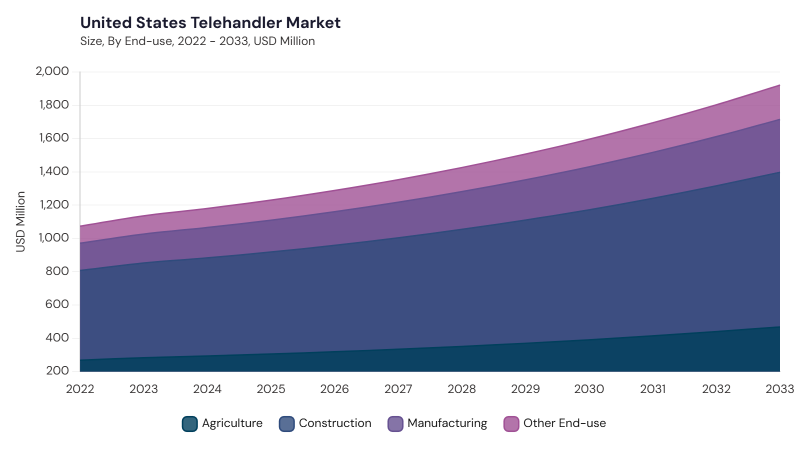
Based on End-use, the market is segmented into Construction, Agriculture, Manufacturing, and Other End-use. Construction applications use telehandlers for pallet movement, structural material placement, rough-terrain operations, and attachment-based lifting across varied job sites. Agriculture relies on telehandlers for bale stacking, feed handling, crop-related operations, manure management, loading, and general farm material movement.
Manufacturing uses telehandlers for plant logistics, raw-material handling, component movement, warehouse operations, and production support. Other End-use includes logistics, mining, forestry, utilities, waste management, municipal services, and specialized industrial environments where ruggedness, attachment versatility, and adaptability to demanding terrain remain important.
Based on Propulsion Type, the market is segmented into ICE and Electric. ICE telehandlers remain important where rugged terrain, continuous operation, fuel accessibility, and high lifting performance are essential. Manufacturers are improving engine efficiency and emissions performance while incorporating advanced controls and hybrid features to address evolving environmental standards.
Electric telehandlers are gaining relevance because of zero on-site emissions, quieter operation, lower fuel requirements, and suitability for indoor facilities, urban construction, rental fleets, and environmentally sensitive locations. Advances in lithium-ion batteries, charging technology, electric motors, and energy management are improving operating duration and competitiveness, although charging infrastructure and heavy-duty performance requirements continue to influence adoption.
Free Valuable Insights: The Global Telehandler Market will hit USD 7.3 Billion billion by 2033, at a CAGR of 7.1%
Based on Country, the market is segmented into US, Canada, Mexico, and Rest of North America. The US market dominated the North America Telehandler Market by Country in 2025, and would continue to be a dominant market till 2033; thereby, achieving a market value of USD 1.8 billion by 2032, growing at a CAGR of 5.9 % during the forecast period. The Canada market is expected to witness a CAGR of 8.9% during (2026 - 2033). Additionally, The Mexico market is expected to witness a CAGR of 8.1% during (2026 - 2033).
Across North America, telehandler adoption is being shaped by electrification, connected equipment, rental activity, application-specific models, and stronger service infrastructure. The US emphasizes electric and hybrid machines, advanced telematics, operator-assistance technologies, high-capacity models, and application-specific equipment, while Canada focuses on electric telehandlers, greater lifting capacities, advanced safety systems, telematics, and equipment adapted to diverse operating conditions. Mexico is advancing electrification, IoT-enabled fleet management, improved operator safety, local service capabilities, and terrain-specific equipment adaptation, whereas Rest of North America increasingly emphasizes rotating telehandlers, electric and hybrid propulsion, autonomous features, remote monitoring, and localized dealer and support networks.

By Product
By Lift Capacity
By End-use
By Propulsion Type
By Country
Set to reach $2.3 Billion by 2032, growing at 6.6% CAGR during 2026-2033.
The US leads with $1.8 billion by 2032, growing at 5.9% CAGR during the forecast period.
Rising demand for telehandlers with 3–10 Ton capacity, reaching $1.4 billion by 2032.
Large telehandlers will reach $1.4 billion by 2032, growing at a 6.4% CAGR during 2026-2033.
The Canada market is expected to witness a CAGR of 8.9% during 2026-2033.
The compact telehandler market is expected to witness a CAGR of 6.9% during 2026-2033.
Our team of dedicated experts can provide you with attractive expansion opportunities for your business.




 Unique Offerings