The sample copy of this report is available for access.
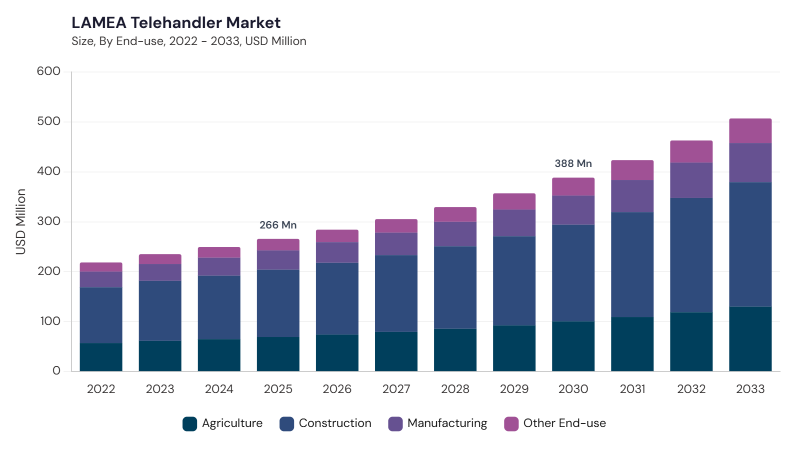
The LAMEA Telehandler Market is expected to reach USD 357.1 million by 2029, growing at a CAGR of 8.6% during (2026 - 2033).
The LAMEA Telehandler Market evolved from basic forklift-derived lifting equipment into more advanced material-handling machines serving construction, agriculture, mining, energy, logistics, and industrial operations. Early adoption remained limited by infrastructure gaps and low mechanization across several emerging economies, while subsequent investment in construction and industrial modernization strengthened demand. Advances in hydraulics, telescopic boom design, rugged chassis systems, operator controls, and attachment flexibility expanded application scope. Current development increasingly emphasizes machines adapted to rough terrain, extreme climates, variable fuel quality, digital monitoring, cleaner powertrains, and localized operational requirements across Latin America, the Middle East, and Africa.
Sustainability, telematics, customization, automation, and equipment rental are shaping current market development. Manufacturers are introducing more fuel-efficient engines, hybrid and electric powertrains, IoT-enabled monitoring, predictive maintenance, remote diagnostics, and advanced operator-assistance systems to improve productivity and equipment uptime. Growing demand for multifunctional machines is also encouraging modular attachments and application-specific configurations for construction, mining, agriculture, logistics, and industrial operations. At the same time, high capital costs, limited service infrastructure, skilled workforce shortages, regulatory fragmentation, charging limitations, and inconsistent after-sales coverage continue to influence adoption across LAMEA.
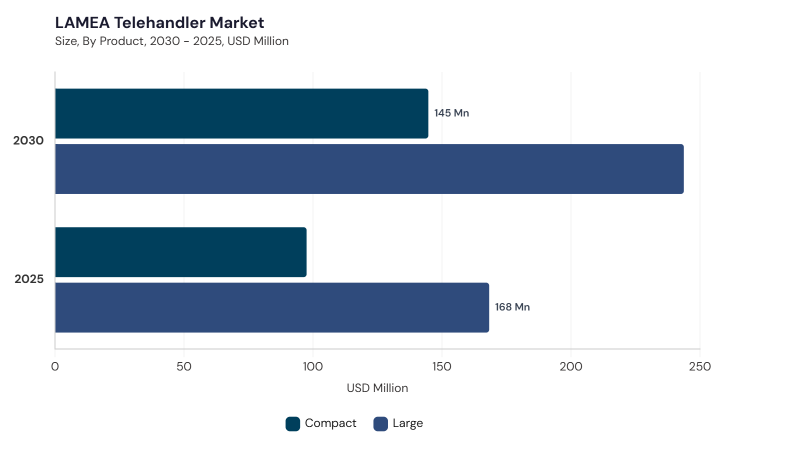
Based on Product, the market is segmented into Large and Compact. The Large market dominated the LAMEA Telehandler Market by Product in 2025, and would continue to be a dominant market till 2033; thereby, achieving a market value of USD 224.5 million by 2029, growing at a CAGR of 8.4 % during the forecast period. The Compact market is expected to witness a CAGR of 9% during (2026 - 2033).
Large telehandlers are suited to infrastructure, mining, oil and gas, ports, industrial facilities, energy projects, and major agricultural operations where high lifting capacity, durability, stability, and extended boom reach are important. Manufacturers increasingly emphasize rugged construction, enhanced cooling, telematics, stability management, and stronger ground clearance for demanding regional conditions. Compact telehandlers serve smaller building sites, farms, maintenance applications, warehouses, and confined urban environments where maneuverability, lower ownership costs, and attachment versatility are prioritized. Growing rental penetration and improved compact hydraulic and propulsion technologies are further expanding accessibility.
Based on Lift Capacity, the market is segmented into 3–10 Ton, Less than 3 Ton, and More than 10 Ton. The 3–10 Ton market dominated the LAMEA Telehandler Market by Lift Capacity in 2025, and would continue to be a dominant market till 2033; thereby, achieving a market value of USD 222.0 million by 2029, growing at a CAGR of 8.2 % during the forecast period. The Less than 3 Ton market is expected to witness a CAGR of 9.1% during (2026 - 2033). The More than 10 Ton market is expected to witness a CAGR of 10.1% during (2026 - 2033).
The 3–10 Ton category provides a practical balance between strength, reach, maneuverability, and operational flexibility, making it suitable for contractors, mining support activities, farms, and industrial operations. Less than 3 Ton telehandlers address lighter loads, smaller construction projects, compact agricultural environments, and space-sensitive applications where agility is important. More than 10 Ton machines serve mining, oil and gas facilities, ports, airports, large civil engineering projects, and heavy industrial applications requiring significant lifting strength. Telematics, enhanced hydraulics, stability controls, operator-assistance systems, and cleaner powertrains are improving performance across all capacity groups.
Based on End-use, the market is segmented into Construction, Agriculture, Manufacturing, and Other End-use. Construction applications use telehandlers for material movement, elevated placement, rough-terrain lifting, and multifunctional site operations across residential, commercial, and infrastructure projects. Agriculture relies on telehandlers for crop handling, bale movement, livestock feed management, farm maintenance, and loading activities as mechanization expands.
Manufacturing applications include intra-facility transport, assembly support, storage, and industrial material handling. Other End-use includes mining, logistics, utilities, warehousing, energy facilities, and resource-oriented operations where rugged design, attachment flexibility, and high equipment utilization are important.
Based on Propulsion Type, the market is segmented into ICE and Electric. ICE telehandlers remain important for demanding construction, mining, agriculture, and industrial applications requiring continuous high-power operation, established fuel access, and reliable performance across rough terrain. Manufacturers are improving fuel efficiency and emissions control while exploring hybrid alternatives to extend platform relevance.
Electric telehandlers are gaining importance in warehouses, enclosed facilities, urban construction, and environmentally sensitive sites because of lower noise, zero localized emissions, and reduced maintenance complexity. Improvements in battery technology and charging performance are strengthening adoption, although infrastructure availability and higher upfront costs remain key limitations.
Free Valuable Insights: Telehandler Market Size Worth USD 7.3 Billion billion by 2033
Based on Country, the market is segmented into Brazil, Argentina, UAE, Saudi Arabia, South Africa, Nigeria, and Rest of LAMEA. The Brazil market dominated the LAMEA Telehandler Market by Country in 2025, and would continue to be a dominant market till 2033; thereby, achieving a market value of USD 80.7 million by 2029, growing at a CAGR of 7.1 % during the forecast period. The Argentina market is expected to witness a CAGR of 10.4% during (2026 - 2033). Additionally, The UAE market is expected to witness a CAGR of 7.6% during (2026 - 2033).
Across LAMEA, telehandler adoption is being shaped by infrastructure growth, mining and industrial activity, electrification, digitalization, and localized equipment design. Brazil emphasizes rotating telehandlers, electric powertrains, telematics, localized manufacturing, and terrain-adapted solutions, while Argentina focuses on fuel efficiency, emissions reduction, GPS-enabled telematics, remote diagnostics, and rugged equipment customization. The UAE is advancing IoT-enabled fleet monitoring, hybrid technologies, climate-resilient machine design, advanced hydraulics, and localized service infrastructure, whereas Saudi Arabia emphasizes Vision 2030-related infrastructure, high-capacity equipment, telematics, remote operation, and cleaner propulsion technologies. South Africa focuses on ruggedized machines, mining-oriented applications, hybrid and electric powertrains, digital asset management, and localized service capabilities, while Nigeria emphasizes IoT-enabled monitoring, modular attachments, fuel efficiency, rugged designs, and stronger local parts and service networks. Rest of LAMEA continues to develop compact and high-reach machines, connected telematics, hybrid propulsion, multifunctional attachments, and localized support models.

By Product
By Lift Capacity
By End-use
By Propulsion Type
By Country
Set to reach $357.1 Million by 2029, growing at 8.6% CAGR during 2026-2033.
Brazil leads with $80.7 million by 2029, growing at 7.1% CAGR during the forecast period.
The Large product segment dominates, reaching $224.5 million by 2029 at 8.4% CAGR during 2026-2033.
The 3–10 Ton segment will reach $222.0 million by 2029, growing at 8.2% CAGR during the forecast period.
The UAE market is expected to witness a CAGR of 7.6% during 2026-2033.
The Compact segment is expected to grow at a 9% CAGR during 2026-2033.
Our team of dedicated experts can provide you with attractive expansion opportunities for your business.




 Unique Offerings