The sample copy of this report is available for access.
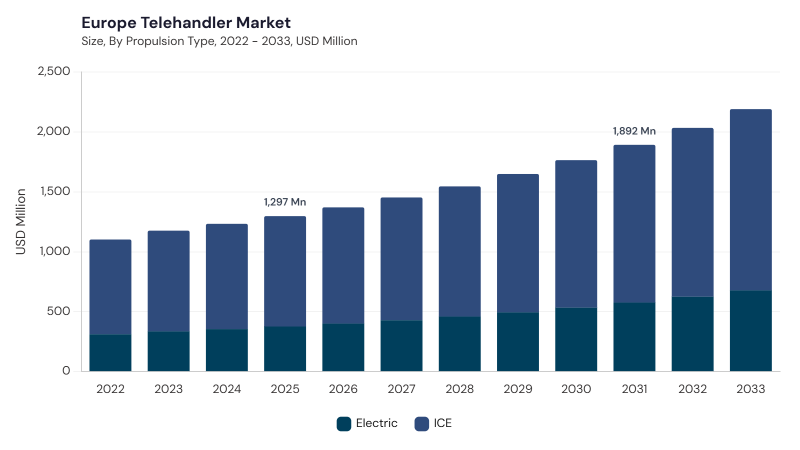
The Europe Telehandler Market is expected to reach USD 1892.3 million by 2031, growing at a CAGR of 6.9% during (2026 - 2033).
The Europe Telehandler Market evolved from basic telescopic lifting machines used in construction and agriculture into sophisticated material-handling platforms offering greater reach, maneuverability, safety, and multifunctionality. Advances in hydraulic systems, electronic controls, rotating boom configurations, operator ergonomics, and attachment versatility expanded telehandler use across construction, farming, logistics, and industrial applications. The market has also progressed from predominantly diesel-powered machines toward hybrid and electric models. Current development increasingly emphasizes rotating designs, compact platforms, advanced control systems, and equipment capable of replacing smaller cranes across selected lifting applications.
Electrification, rotating telehandlers, digitalization, and demand for compact equipment are shaping current market development. Stringent European emission regulations are encouraging electric and hybrid powertrains, while urban construction and restricted workspaces are increasing demand for maneuverable compact and rotating models. Telematics, predictive maintenance, remote diagnostics, GPS tracking, load sensing, and automated safety systems are improving fleet productivity and equipment uptime. At the same time, high acquisition costs, certification requirements, skilled operator shortages, charging limitations, regulatory complexity, and environmental compliance continue to influence purchasing and fleet-renewal decisions.
Based on Product, the market is segmented into Large and Compact. The Large market dominated the Europe Telehandler Market by Product in 2025, and would continue to be a dominant market till 2033; thereby, achieving a market value of USD 1172.7 million by 2031, growing at a CAGR of 6.7 % during the forecast period. The Compact market is expected to witness a CAGR of 7.3% during (2026 - 2033).
Large telehandlers serve infrastructure, commercial construction, agriculture, industrial facilities, renewable energy projects, and heavy material-handling operations requiring substantial load capability and stability. Manufacturers are improving hydraulics, load management, telematics, operator assistance, and powertrain efficiency to enhance productivity and compliance. Compact telehandlers address urban construction, renovation, landscaping, warehouses, and agricultural maintenance where maneuverability and transport convenience are important. Electric propulsion, ergonomic controls, reduced dimensions, modular attachments, and low-emission operation are strengthening the appeal of compact models.
Based on Lift Capacity, the market is segmented into 3–10 Ton, Less than 3 Ton, and More than 10 Ton. The 3–10 Ton market dominated the Europe Telehandler Market by Lift Capacity in 2025, and would continue to be a dominant market till 2033; thereby, achieving a market value of USD 1155.0 million by 2031, growing at a CAGR of 6.5 % during the forecast period. The Less than 3 Ton market is expected to witness a CAGR of 7.4% during (2026 - 2033). The More than 10 Ton market is expected to witness a CAGR of 8.1% during (2026 - 2033).
The 3–10 Ton category provides a balance of lifting power, reach, maneuverability, and application flexibility, making it suitable for general contractors, farms, industrial yards, and infrastructure projects. Less than 3 Ton telehandlers are used for light construction, warehousing, agriculture, and confined urban environments where compact dimensions and precision handling are important. More than 10 Ton machines address heavy infrastructure, industrial maintenance, energy projects, ports, and large agricultural operations requiring exceptional lifting strength. Advancements in stability control, hydraulics, telematics, and alternative propulsion are improving performance across all capacity ranges.
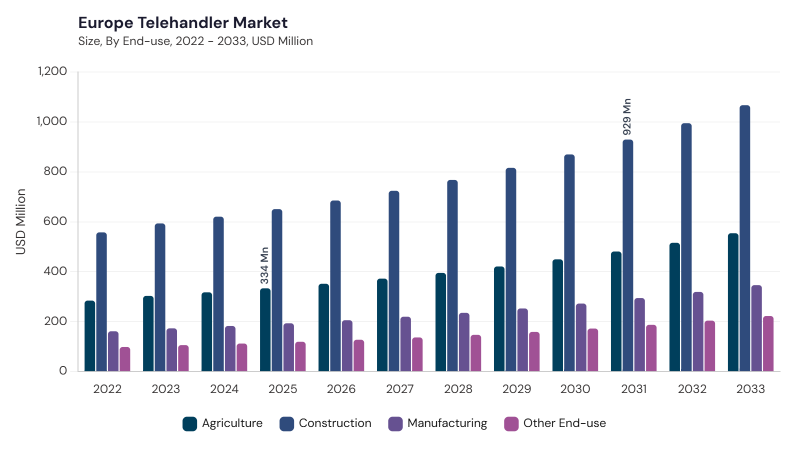
Based on End-use, the market is segmented into Construction, Agriculture, Manufacturing, and Other End-use. Construction applications use telehandlers for lifting, material placement, rough-terrain handling, site logistics, and increasingly as alternatives to smaller mobile cranes. Agriculture relies on telehandlers for feed handling, bale movement, crop management, silo operations, and general farm logistics, supported by ongoing mechanization.
Manufacturing applications include warehouse movement, component handling, production logistics, and material positioning. Other End-use includes logistics, utilities, recycling, mining, and municipal operations where specialized attachments, maneuverability, and rugged performance support varied handling requirements.
Based on Propulsion Type, the market is segmented into ICE and Electric. ICE telehandlers remain important for heavy-duty applications requiring sustained power, rapid refueling, and operation in remote or off-grid environments. Manufacturers are improving diesel efficiency and emissions performance to comply with European standards while extending the viability of existing platforms.
Electric telehandlers are gaining importance in warehouses, urban construction, rental fleets, and emission-sensitive sites due to zero on-site emissions, lower noise, and reduced maintenance requirements. Advances in battery energy density, fast charging, power management, and modular battery systems are expanding their application potential, although charging infrastructure and upfront costs remain adoption considerations.
Free Valuable Insights: The Worldwide Telehandler Market is projected to reach USD 7.3 Billion billion by 2033, at a CAGR of 7.1%
Based on Country, the market is segmented into Germany, UK, France, Russia, Spain, Italy, and Rest of Europe. The UK market dominated the Europe Telehandler Market by Country in 2025, and would continue to be a dominant market till 2033; thereby, achieving a market value of USD 382.4 million by 2031, growing at a CAGR of 5.5 % during the forecast period. The Germany market is expected to witness a CAGR of 6% during (2026 - 2033). Additionally, The France market is expected to witness a CAGR of 7.6% during (2026 - 2033).
Across Europe, telehandler adoption is increasingly influenced by sustainability, digitalization, rotating designs, modularity, and localized equipment requirements. Germany emphasizes electric and hybrid drivetrains, telematics, predictive maintenance, modular attachments, and operator-assistance systems, while the UK focuses on rotating telehandlers, low-emission equipment, digital fleet management, and intelligent safety features. France is advancing electric and hybrid models, smart monitoring, telematics, localization, and lifecycle services, whereas Russia emphasizes low-emission engines, remote diagnostics, rugged designs, and equipment adapted to severe climates and terrain. Spain focuses on electrification, IoT-enabled fleet management, modular attachments, and multifunctional machines, while Italy emphasizes electric platforms, digital monitoring, telematics, hydrogen-related development, and adaptable designs. Rest of Europe continues to develop rotating telehandlers, electric and hybrid propulsion, connected equipment, advanced safety features, and localized service networks.

By Product
By Lift Capacity
By End-use
By Propulsion Type
By Country
Set to reach $1892.3 Million by 2031, growing at 6.9% CAGR during 2026-2033.
The UK leads with a market value of $382.4 million by 2031, growing at a 5.5% CAGR during the forecast period.
The Large product segment will achieve $1172.7 million by 2031, growing at a 6.7% CAGR during the forecast period.
The 3–10 Ton segment will reach $1155.0 million by 2031, growing at a 6.5% CAGR during the forecast period.
Germany is expected to witness a CAGR of 6% during 2026-2033.
The Compact segment is expected to witness a CAGR of 7.3% during 2026-2033.
Our team of dedicated experts can provide you with attractive expansion opportunities for your business.




 Unique Offerings