The sample copy of this report is available for access.
The Asia Pacific Telehandler Market is expected to reach USD 1659.6 million by 2030, growing at a CAGR of 7.7% during (2026 - 2033).
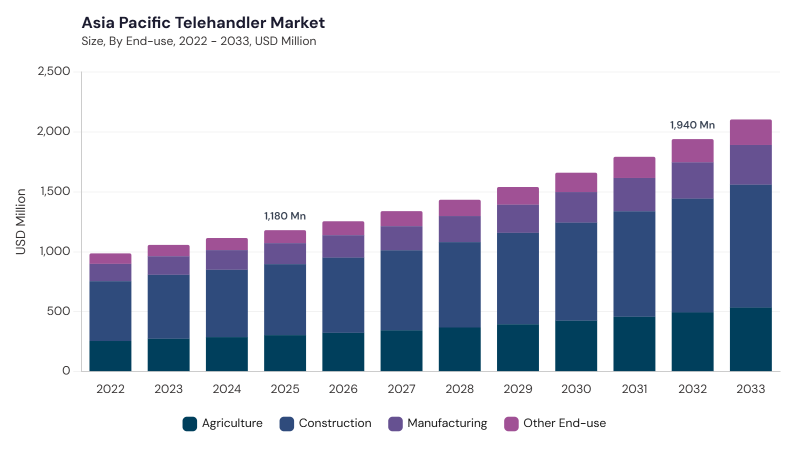
The Asia Pacific Telehandler Market evolved alongside mechanization across construction, agriculture, mining, manufacturing, and industrial material handling. Early equipment relied on basic mechanical designs derived from forklifts and loaders, while hydraulic systems later improved lifting precision, reach, stability, and operational control. Rapid infrastructure expansion and urbanization across emerging economies broadened telehandler deployment, while advances in telematics, automation, and electronic controls shifted equipment toward connected and intelligent platforms. Current development increasingly emphasizes hybrid and electric propulsion, localized manufacturing, digital fleet management, application-specific configurations, and equipment designed for higher productivity under diverse regional operating conditions.
Electrification, infrastructure expansion, rotating telehandlers, digitalization, and localization are shaping current market development. Hybrid and electric machines are gaining relevance as governments strengthen emissions requirements and operators seek lower fuel and maintenance costs, while telematics, IoT sensors, remote diagnostics, and predictive maintenance improve fleet utilization and uptime. Infrastructure, mining, industrial, and logistics investments are also increasing demand for higher-capacity and multifunctional machines. At the same time, high capital costs, limited charging and service infrastructure, skilled workforce shortages, varying regulations, and uneven support networks continue to influence adoption across Asia Pacific.
Based on Product, the market is segmented into Large and Compact. The Large market dominated the Asia Pacific Telehandler Market by Product in 2025, and would continue to be a dominant market till 2033; thereby, achieving a market value of USD 1030.85 million by 2030, growing at a CAGR of 7.5 % during the forecast period. The Compact market is expected to witness a CAGR of 8% during (2026 - 2033).
Large telehandlers support demanding construction, mining, infrastructure, and industrial applications where high load ratings, extended boom reach, stability, and durability are critical. Advanced hydraulics, telematics, load-sensing systems, operator-assistance features, and increasingly efficient powertrains are improving their productivity. Compact telehandlers serve smaller construction sites, warehouses, farms, livestock facilities, and congested urban environments where maneuverability, lower operating costs, and transportation convenience are important. Electric propulsion, compact chassis designs, automation, and multifunctional attachments are further broadening their application range.
Based on Lift Capacity, the market is segmented into 3–10 Ton, Less than 3 Ton, and More than 10 Ton. The 3–10 Ton market dominated the Asia Pacific Telehandler Market by Lift Capacity in 2025, and would continue to be a dominant market till 2033; thereby, achieving a market value of USD 1017.3 million by 2030, growing at a CAGR of 7.2 % during the forecast period. The Less than 3 Ton market is expected to witness a CAGR of 8.1% during (2026 - 2033). The More than 10 Ton market is expected to witness a CAGR of 8.8% during (2026 - 2033).
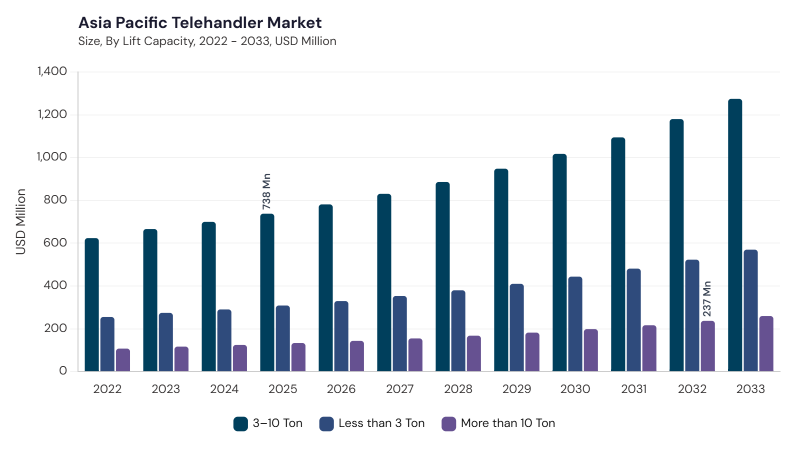
The 3–10 Ton category balances lifting power, reach, maneuverability, and multifunctionality, supporting medium-to-large construction projects, farms, industrial parks, and logistics operations. Less than 3 Ton machines are suited to horticulture, livestock facilities, smaller worksites, warehouses, and confined urban environments where lightweight design and precision handling are valued. More than 10 Ton telehandlers address mining, ports, energy projects, heavy engineering, and large infrastructure developments requiring substantial lifting capability. Advancements in hydraulic systems, stability control, automation, telematics, and hybrid technologies are strengthening efficiency across all capacity categories.
Based on End-use, the market is segmented into Construction, Agriculture, Manufacturing, and Other End-use. Construction uses telehandlers for material movement, elevated load placement, rough-terrain handling, and multifunctional lifting across increasingly complex worksites. Agriculture relies on telehandlers for crop movement, bale handling, livestock feeding, storage, loading, and general farm logistics as mechanization expands.
Manufacturing applications include warehouse handling, assembly-plant logistics, component movement, and integration with increasingly automated material-flow systems. Other End-use includes mining, ports, logistics facilities, utilities, warehousing, and municipal services where rugged designs, specialized attachments, telematics, and adaptable operating capabilities support varied requirements.
Based on Propulsion Type, the market is segmented into ICE and Electric. ICE telehandlers remain important for heavy-duty operations requiring high torque, long operating cycles, rapid refueling, and reliable performance in remote areas with limited charging infrastructure. Manufacturers are improving engine efficiency and emission control technologies while exploring hybrid solutions to extend platform viability.
Electric telehandlers are gaining importance in warehouses, urban construction, enclosed facilities, rental fleets, and environmentally sensitive sites because of zero on-site emissions, lower noise, and reduced operating costs. Improvements in lithium-ion batteries, charging systems, power management, and battery durability are expanding application potential, although upfront costs and infrastructure availability remain constraints.
Free Valuable Insights: Telehandler Market is Predicted to reach USD 7.3 Billion billion by 2033, at a CAGR of 7.1%
Based on Country, the market is segmented into China, Japan, India, South Korea, Singapore, Malaysia, and Rest of Asia Pacific. The China market dominated the Asia Pacific Telehandler Market by Country in 2025, and would continue to be a dominant market till 2033; thereby, achieving a market value of USD 596.5 million by 2030, growing at a CAGR of 6.2 % during the forecast period. The Japan market is expected to witness a CAGR of 6.6% during (2026 - 2033). Additionally, The India market is expected to witness a CAGR of 8.3% during (2026 - 2033).
Across Asia Pacific, telehandler adoption is being shaped by infrastructure development, electrification, automation, localization, and digital fleet management. China emphasizes autonomous and semi-autonomous equipment, electric and hybrid powertrains, warehouse automation, IoT connectivity, and application-specific designs, while Japan focuses on compact machinery, electric propulsion, remote operation, telematics, and solutions addressing labor shortages. India is advancing hybrid and electric equipment, rental and leasing models, IoT-enabled fleet management, localized manufacturing, and agricultural mechanization, whereas South Korea emphasizes smart construction, electric powertrains, automated controls, localization, and integrated software platforms. Singapore focuses on compact electric machines, telematics, logistics applications, advanced safety systems, and smart-city-compatible equipment, while Malaysia emphasizes cleaner powertrains, IoT monitoring, semi-automated operation, local service capabilities, and productivity-focused designs. Rest of Asia Pacific continues to develop rotating telehandlers, hybrid technologies, digital monitoring, modular attachments, localized service networks, and environmentally compliant equipment.

By Product
By Lift Capacity
By End-use
By Propulsion Type
By Country
Set to reach $1659.6 Million by 2030, growing at 7.7% CAGR during 2026-2033.
China leads with $596.5 million by 2030, at a CAGR of 6.2% during 2026-2033.
The 3–10 Ton segment dominates, reaching $1017.3 million by 2030, growing at 7.2% CAGR during 2026-2033.
Large segment to reach $1030.85 million by 2030, growing at 7.5% CAGR during 2026-2033.
India's market is expected to grow at a CAGR of 8.3% during 2026-2033.
Compact segment to witness a CAGR of 8% during 2026-2033.
Our team of dedicated experts can provide you with attractive expansion opportunities for your business.




 Unique Offerings