The sample copy of this report is available for access.
“Global Swarm Drone Market to reach a market value of USD 3731.41 Million by 2033 growing at a CAGR of %”
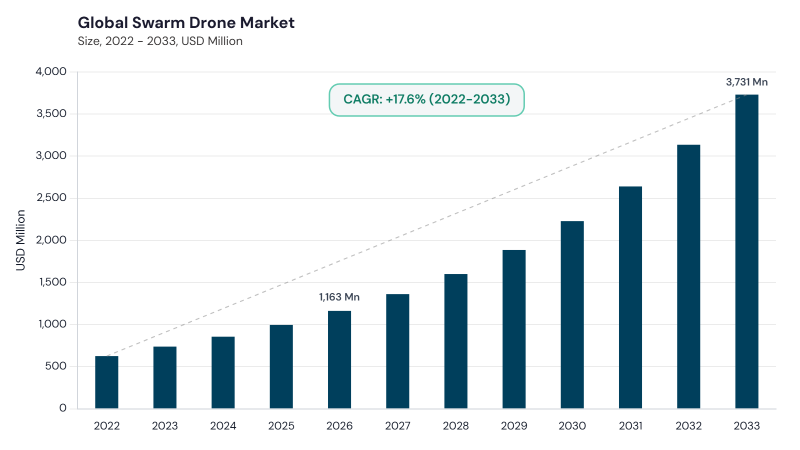
The Global Swarm Drone Market is expected to reach USD 3.7 billion by 2033, growing at a CAGR of 18.1% during (2026 - 2033).
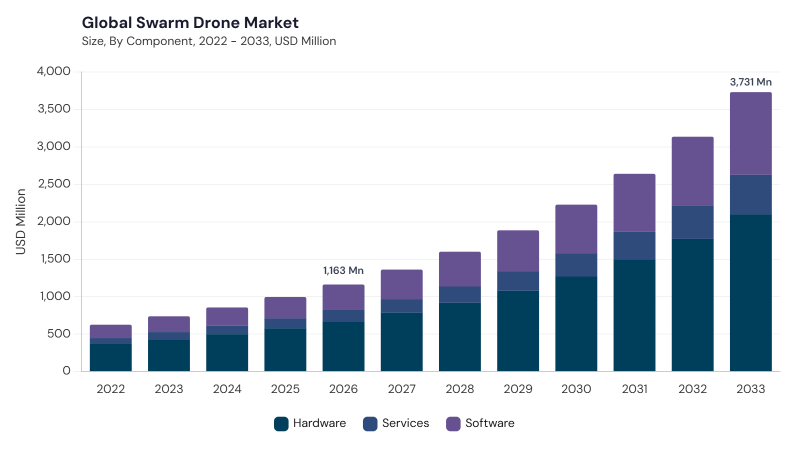
Growing need for coordinated autonomous operations, real-time surveillance, rapid data collection, scalable unmanned missions, and wider area coverage is driving the Swarm Drone Market across defense, public safety, agriculture, logistics, infrastructure inspection, environmental monitoring, and disaster management applications. Growth is further strengthened by advancements in artificial intelligence, edge computing, sensor fusion, autonomous navigation, secure communication, decentralized control, collision avoidance, intelligent mission planning, and scalable swarm management platforms.
Growth in the Swarm Drone Market is driven by the ability of coordinated UAV fleets to execute synchronized missions faster, cover larger areas, reduce human intervention, and improve operational resilience compared to single-drone systems. Defense organizations are using swarm capabilities for ISR, electronic warfare support, border surveillance, force protection, and distributed mission execution, while government agencies, agriculture operators, industrial users, and emergency-response teams are adopting swarms for monitoring, mapping, data collection, search and rescue, and infrastructure assessment. The market is also gaining momentum as AI, secure mesh networking, onboard computing, sensor miniaturization, and autonomous task allocation make multi-drone systems more scalable and reliable across complex operating environments.
The competitive environment is highly fragmented, defense-technology-driven, and innovation-intensive, with UAV manufacturers, autonomous defense technology companies, aerospace and defense primes, AI-enabled drone specialists, and regional swarm-technology developers competing across different layers of the value chain. AeroVironment, Shield AI, Kratos Defense & Security Solutions, General Atomics Aeronautical Systems, and Elbit Systems form the leading competitive tier, while Anduril Industries, RTX Corporation, NewSpace Research & Technologies, Northrop Grumman, and EDGE Group/ADASI strengthen the market through autonomous aircraft, AI pilots, command-and-control systems, resilient communications, sensors, and defense-system integration.
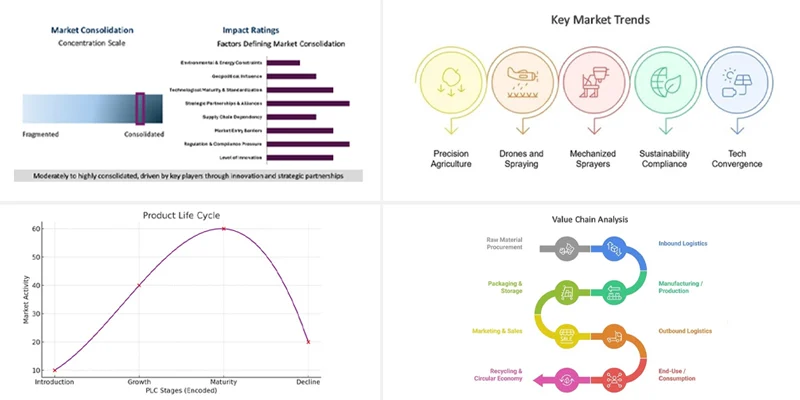

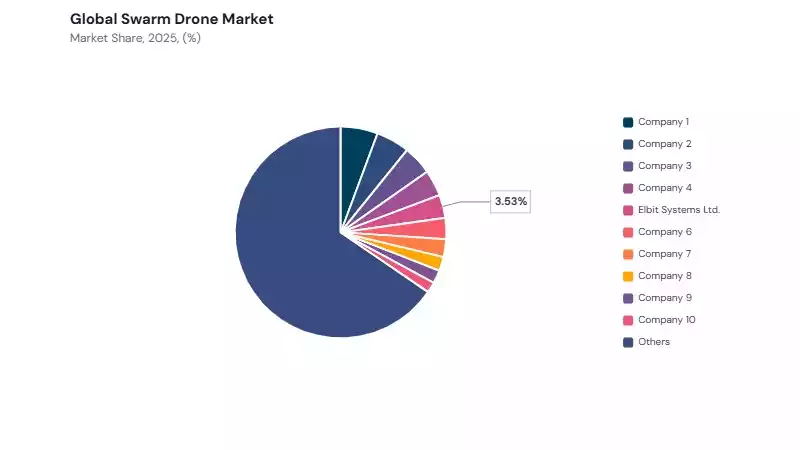
The global Swarm Drone Market reflects a highly fragmented and technology-intensive competitive landscape, where leadership is distributed across UAV manufacturers, defense primes, AI autonomy developers, mission-software providers, communication-system suppliers, and regional defense-technology firms. AeroVironment leads through dedicated swarm architectures, autonomous platforms, and multi-domain coordination capabilities, while Shield AI strengthens the market through its software-led Hivemind autonomy platform and multi-agent teaming approach. Kratos, General Atomics, Elbit Systems, Anduril Industries, RTX Corporation, NewSpace Research & Technologies, Northrop Grumman, and EDGE Group/ADASI compete through collaborative combat aircraft, heterogeneous swarms, defense integration, secure communications, command systems, sensors, and autonomous mission execution.
Based on Technology, the market is segmented into Semi-Autonomous and Fully Autonomous. The Semi-Autonomous market dominated the Global Swarm Drone Market by Technology in 2025, and would continue to be a dominant market till 2033; thereby, achieving a market value of USD 2.1 billion by 2033, growing at a CAGR of 17.8 % during the forecast period. The Fully Autonomous market is expected to witness a CAGR of 18.5% during (2026 - 2033).
Semi-Autonomous remains the leading technology category as it combines coordinated drone operations with human oversight for mission control, safety, tactical judgment, and intervention in complex operating conditions. These systems are attractive in regulated and mission-critical environments where operators require visibility and control while still benefiting from automation, collaborative navigation, and reduced workload. Fully Autonomous systems are gaining strong relevance as AI, machine learning, edge computing, sensor fusion, and decentralized decision-making enable drone fleets to execute complex missions with limited human involvement. Demand for fully autonomous systems is increasing where scale, speed, reduced operator dependence, and resilient operation in GPS- or communications-denied environments are critical.
Based on Component, the market is segmented into Hardware, Software, and Services. The Hardware market dominated the Global Swarm Drone Market by Component in 2025, and would continue to be a dominant market till 2033; thereby, achieving a market value of USD 2.0 billion by 2033, growing at a CAGR of 17.6 % during the forecast period. The Software market is expected to witness a CAGR of 18.6% during (2026 - 2033). Additionally, The Services market is expected to witness highest CAGR of 19.2% during (2026 - 2033).
Hardware remains the dominant component category because swarm drone deployment depends on airframes, propulsion systems, batteries, sensors, cameras, communication modules, onboard processors, navigation units, and mission-specific payloads. Continuous improvements in lightweight materials, energy efficiency, sensor integration, and onboard computing are enhancing swarm endurance and mission capability. Software is becoming increasingly important as swarm coordination depends on autonomous navigation, collision avoidance, mission planning, AI-based task allocation, data analytics, real-time control, and secure communication layers. Services are expanding through integration, testing, maintenance, training, consulting, operational support, and mission planning assistance as end users deploy larger and more complex multi-drone fleets.
Based on Platform, the market is segmented into Rotary-Wing, Fixed-Wing, and Hybrid VTOL. The Rotary-Wing market dominated the Global Swarm Drone Market by Platform in 2025, and would continue to be a dominant market till 2033; thereby, achieving a market value of USD 1.7 billion by 2033, growing at a CAGR of 17.5 % during the forecast period. The Fixed-Wing market is expected to witness a CAGR of 18.6% during (2026 - 2033). Additionally, The Hybrid VTOL market is expected to witness highest CAGR of 18.9% during (2026 - 2033).
Rotary-Wing remains the leading platform because vertical takeoff, landing flexibility, hovering capability, and high maneuverability make it suitable for coordinated operations in confined, urban, rugged, or complex environments. These platforms are widely relevant for ISR, public safety, agriculture, infrastructure inspection, and tactical missions requiring precise positioning. Fixed-Wing platforms are gaining demand due to longer endurance, wider operating range, higher coverage efficiency, and suitability for surveillance, mapping, and large-area monitoring. Hybrid VTOL platforms are also emerging as they combine vertical takeoff flexibility with efficient forward flight, supporting extended missions where both launch flexibility and endurance are required.
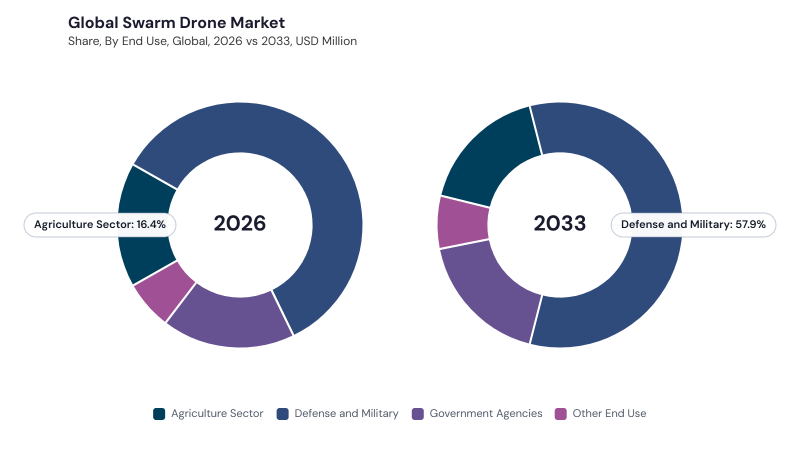
Based on End Use, the market is segmented into Defense and Military, Government Agencies, Agriculture Sector, and Other End Use. The Defense and Military market dominated the Global Swarm Drone Market by End Use in 2025, and would continue to be a dominant market till 2033; thereby, achieving a market value of USD 2.1 billion by 2033, growing at a CAGR of 17.6 % during the forecast period. The Government Agencies market is expected to witness a CAGR of 18.5% during (2026 - 2033). Additionally, The Agriculture Sector market is expected to witness highest CAGR of 18.9% during (2026 - 2033).
Defense and Military remains the leading end-use category as swarm drones support reconnaissance, surveillance, communications, electronic warfare support, force multiplication, target detection, and distributed mission execution. Government Agencies use swarm drones for public safety, disaster assessment, emergency response, border monitoring, infrastructure observation, and environmental surveillance. Agriculture Sector adoption is supported by precision farming, crop monitoring, field mapping, multispectral imaging, pest detection, irrigation assessment, and coordinated data collection across large farms. Other End Use includes logistics, industrial inspection, research, infrastructure monitoring, entertainment, and specialized commercial deployments where swarm coordination improves coverage, speed, and operational flexibility.
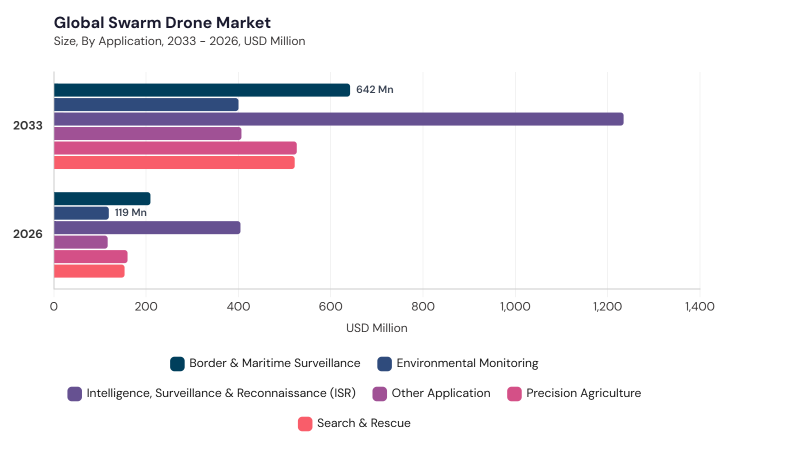
Based on Application, the market is segmented into Intelligence, Surveillance & Reconnaissance (ISR), Border & Maritime Surveillance, Precision Agriculture, Search & Rescue, Environmental Monitoring, and Other Application. The Intelligence, Surveillance & Reconnaissance (ISR) market dominated the Global Swarm Drone Market by Application in 2025, and would continue to be a dominant market till 2033; thereby, achieving a market value of USD 1.2 billion by 2033, growing at a CAGR of 17.3 % during the forecast period. The Border & Maritime Surveillance market is expected to witness a CAGR of 17.4% during (2026 - 2033). Additionally, The Precision Agriculture market is expected to witness highest CAGR of 18.6% during (2026 - 2033).
Intelligence, Surveillance & Reconnaissance (ISR) remains the leading application as coordinated drone fleets can gather information from multiple locations, expand situational awareness, and improve mission visibility. Border & Maritime Surveillance benefits from distributed monitoring, persistent coverage, and the ability to observe extensive areas with coordinated aerial assets. Precision Agriculture uses swarm drones for crop assessment, mapping, imaging, and data-driven farm management. Search & Rescue applications benefit from rapid terrain scanning, thermal imaging, real-time information sharing, and coordinated coverage during emergencies. Environmental Monitoring uses drone swarms for ecosystem observation, disaster assessment, pollution monitoring, wildlife tracking, and large-area data collection, while Other Application includes inspection, mapping, research, logistics, event-based displays, and niche commercial uses.
Free Valuable Insights: Swarm Drone Market Size to reach $3.7 Billion by 2033
Region-wise, the Swarm Drone Market is analyzed across North America, Europe, Asia Pacific, and LAMEA. The North America market dominated the Global Swarm Drone Market by Region in 2025, and would continue to be a dominant market till 2033; thereby, achieving a market value of USD 1.4 billion by 2033, growing at a CAGR of 17.6 % during the forecast period. The Asia Pacific market is expected to witness a CAGR of 18.6% during (2026 - 2033). Additionally, The Europe market is expected to witness a CAGR of 17.5% during (2026 - 2033).
North America leads the global market due to strong investment in unmanned aerial technologies, advanced defense modernization, a developed drone technology ecosystem, autonomous-system research, and extensive activity across AI-enabled multi-UAV programs. Asia Pacific is witnessing strong demand through rising defense expenditure, border surveillance needs, expanding drone manufacturing capabilities, agriculture modernization, government-backed UAV initiatives, and increasing adoption across China, Japan, India, South Korea, Singapore, and Malaysia. Europe benefits from autonomous aviation research, security and surveillance investments, collaborative drone programs, regulatory evolution, and growing attention to interoperability across Germany, the UK, France, Russia, Spain, Italy, and Rest of Europe. LAMEA is developing through surveillance, agriculture, infrastructure monitoring, defense modernization, public-sector drone initiatives, and growing interest across Brazil, Argentina, UAE, Saudi Arabia, South Africa, Nigeria, and Rest of LAMEA.
| Report Attribute | Details |
|---|---|
| Market size value in 2026 | USD 1.1 billion |
| Market size forecast in 2033 | USD 3.7 billion |
| Base Year | 2025 |
| Historical Period | 2022 to 2024 |
| Forecast Period | 2026 to 2033 |
| Revenue Growth Rate | CAGR of 18.1% from 2026 to 2033 |
| Number of Pages | XX |
| Tables | XX |
| Report Coverage | Market Trends, Revenue Estimation and Forecast, Segmentation Analysis, Regional and Country Breakdown, Competitive Landscape, Market Share Analysis, Company Profiling, Companies Strategic Developments, SWOT Analysis, Product Life Cycle Analysis, Value Chain Analysis, Market Consolidation Analysis, Key Customer Criteria, Pandemic Impact Analysis, and Winning Imperatives |
| Segments Covered | Technology, Component, Platform, End Use, Application, and Geography |
| Country Scope |
|
| Companies Included | AeroVironment, Inc.; Shield AI, Inc.; Kratos Defense & Security Solutions, Inc.; General Atomics Aeronautical Systems, Inc.; Elbit Systems Ltd.; Anduril Industries, Inc.; RTX Corporation; NewSpace Research & Technologies Pvt. Ltd.; Northrop Grumman Corporation; EDGE Group |
By Technology
By Component
By Platform
By End Use
By Application
By Geography
The market is projected to reach USD 3.7 billion by 2033, growing at 18.1% CAGR during 2026-2033.
Semi-Autonomous systems lead, expected to achieve USD 2.1 billion by 2033.
AeroVironment, Shield AI, Kratos Defense, General Atomics, Elbit Systems, and Anduril Industries are key players.
North America leads with a projected market value of USD 1.4 billion by 2033.
Enhanced operational efficiency and AI integration are key growth drivers.
Intelligence, Surveillance & Reconnaissance (ISR) leads, expected to reach USD 1.2 billion by 2033.
Our team of dedicated experts can provide you with attractive expansion opportunities for your business.






 Unique Offerings
