The sample copy of this report is available for access.
The North America Swarm Drone Market is expected to reach USD 1212.2 million by 2032, growing at a CAGR of 17.6% during (2026 - 2033).
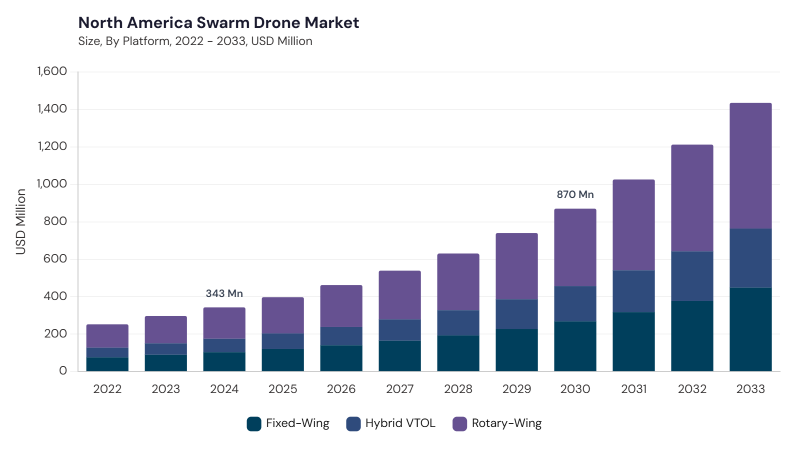
The North America Swarm Drone Market evolved from early military research involving individual unmanned aerial vehicles toward coordinated multi-drone systems capable of operating as decentralized, collaborative units. Initial development focused on surveillance and reconnaissance, while advances in wireless communication, autonomous navigation, artificial intelligence, machine learning, and sensor miniaturization enabled drones to share data and adjust mission behavior in real time. Improvements in swarm intelligence and multi-agent coordination subsequently expanded applications beyond defense into agriculture, infrastructure inspection, emergency response, and environmental monitoring. The market now emphasizes scalable, interoperable, resilient swarm architectures capable of executing coordinated missions across increasingly complex operating environments.
AI-enabled autonomy, resilient communications, commercial diversification, regulatory alignment, and Drone-as-a-Service models are shaping current market development. Operators increasingly require decentralized decision-making, dynamic task allocation, real-time data fusion, collision avoidance, secure communication, and reliable performance in GPS-denied or contested environments. Expanding use in precision agriculture, infrastructure monitoring, border security, emergency response, logistics, and environmental applications is widening the commercial opportunity base. Edge computing, sensor fusion, advanced propulsion, mobile launch systems, cybersecurity, and autonomous navigation are strengthening system capabilities. However, complex certification requirements, airspace restrictions, high development and operating costs, interoperability limitations, infrastructure gaps, cybersecurity risks, and privacy concerns continue to influence market adoption.
Based on Technology, the market is segmented into Semi-Autonomous and Fully Autonomous. The Semi-Autonomous market dominated the North America Swarm Drone Market by Technology in 2025, and would continue to be a dominant market till 2033; thereby, achieving a market value of USD 686.1 million by 2032, growing at a CAGR of 17.3 % during the forecast period. The Fully Autonomous market is expected to witness a CAGR of 18% during (2026 - 2033).
Semi-Autonomous systems combine automated navigation, obstacle detection, swarm coordination, and distributed task execution with operator oversight for critical mission decisions, making them suitable for defense, public safety, border surveillance, disaster response, and infrastructure inspection. Fully Autonomous systems rely on AI, machine learning, sensor fusion, decentralized decision-making, and dynamic route planning to execute complex missions with minimal direct human intervention. These systems are increasingly relevant for contested environments, large-scale search operations, and high-speed tactical missions. Regulatory, ethical, cybersecurity, accountability, and fail-safe requirements continue to influence the pace of fully autonomous adoption.
Based on Component, the market is segmented into Hardware, Software, and Services. The Hardware market dominated the North America Swarm Drone Market by Component in 2025, and would continue to be a dominant market till 2033; thereby, achieving a market value of USD 681.9 million by 2032, growing at a CAGR of 17.1 % during the forecast period. The Software market is expected to witness a CAGR of 18% during (2026 - 2033). Additionally, The Services market is expected to witness highest CAGR of 18.6% during (2026 - 2033).
Hardware development emphasizes lightweight materials, higher-energy batteries, miniaturized sensors, modular payloads, LiDAR, cameras, and robust communication equipment that influence endurance, maneuverability, reliability, and mission flexibility. Software enables swarm intelligence, mission planning, collective decision-making, collision avoidance, path optimization, data fusion, command-and-control, and adaptive task execution across heterogeneous drone fleets. Services include system integration, training, maintenance, regulatory support, data analytics, and Drone-as-a-Service models that reduce deployment complexity and upfront investment. Growing customer demand for turnkey capabilities, remote diagnostics, predictive maintenance, and lifecycle support is strengthening service-based market development.
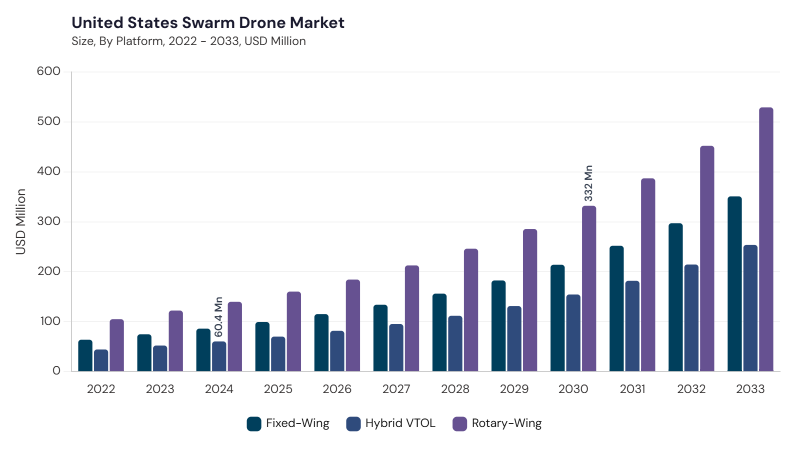
Based on Platform, the market is segmented into Rotary-Wing, Fixed-Wing, and Hybrid VTOL. The Rotary-Wing market dominated the North America Swarm Drone Market by Platform in 2025, and would continue to be a dominant market till 2033; thereby, achieving a market value of USD 569.8 million by 2032, growing at a CAGR of 17 % during the forecast period. The Fixed-Wing market is expected to witness a CAGR of 18% during (2026 - 2033). Additionally, The Hybrid VTOL market is expected to witness highest CAGR of 18.3% during (2026 - 2033).
Rotary-Wing platforms support tactical reconnaissance, infrastructure inspection, disaster response, urban surveillance, and close-quarter missions where precise spatial control and rapid deployment are important. Fixed-Wing platforms provide higher endurance, efficient forward flight, extended range, and broader area coverage, supporting border surveillance, maritime monitoring, and long-duration ISR missions. Hybrid VTOL combines vertical takeoff flexibility with fixed-wing cruise efficiency, creating a versatile platform for applications requiring both constrained deployment and extended geographic coverage. Advances in propulsion, energy management, autonomous flight control, and modular payload systems are improving performance across all three platform categories.
Based on End Use, the market is segmented into Defense and Military, Government Agencies, Agriculture Sector, and Other End Use. Defense and Military users prioritize secure communication, interoperability, resilience, autonomy, target acquisition, and coordinated deployment in contested environments. Government Agencies use swarm drones for border security, emergency response, critical infrastructure monitoring, disaster management, public safety, and territorial surveillance, where regulatory compliance and integration with existing systems remain important.
Agriculture Sector adoption centers on crop monitoring, soil assessment, pest detection, field mapping, imaging, and scalable data collection across large farming areas. Other End Use includes industrial inspection, environmental observation, entertainment, research, and specialized commercial applications that continue to broaden the role of coordinated drone fleets beyond conventional defense environments.
Based on Application, the market is segmented into Intelligence, Surveillance & Reconnaissance (ISR), Border & Maritime Surveillance, Precision Agriculture, Search & Rescue, Environmental Monitoring, and Other Application. Intelligence, Surveillance & Reconnaissance (ISR) uses distributed sensing, real-time data integration, target tracking, and persistent observation across defense and security missions. Border & Maritime Surveillance benefits from simultaneous patrol, remote-area coverage, thermal imaging, radar integration, and threat localization across extensive land and coastal environments.
Precision Agriculture uses coordinated imaging, field assessment, crop-health monitoring, moisture analysis, and targeted resource application, while Search & Rescue improves coverage of difficult terrain through simultaneous aerial scanning and sensor fusion. Environmental Monitoring supports wildlife observation, ecosystem assessment, air and water monitoring, and disaster evaluation, whereas Other Application includes infrastructure inspection, logistics, communications relay, mapping, research, and entertainment.
Free Valuable Insights: The Global Swarm Drone Market will hit USD 3.7 Billion billion by 2033, at a CAGR of 18.1%
Based on Country, the market is segmented into US, Canada, Mexico, and Rest of North America. The US market dominated the North America Swarm Drone Market by Country in 2025, and would continue to be a dominant market till 2033; thereby, achieving a market value of USD 963.7 million by 2032, growing at a CAGR of 16.9 % during the forecast period. The Canada market is expected to witness a CAGR of 20.9% during (2026 - 2033). Additionally, The Mexico market is expected to witness a CAGR of 19.6% during (2026 - 2033).
Across North America, swarm drone adoption reflects differences in defense priorities, regulatory environments, technology maturity, commercial applications, and operational requirements. The US emphasizes AI-driven autonomy, secure communications, modular platforms, defense modernization, commercial expansion, and system interoperability, while Canada focuses on autonomous coordination, allied-system integration, GPS-denied navigation, regulatory compliance, and solutions adapted to challenging geographic and climatic conditions. Mexico is advancing precision agriculture, infrastructure inspection, emergency response, localized swarm coordination, secure communications, and commercially scalable deployments supported by improving regulatory clarity. Rest of North America continues to emphasize autonomous navigation, multi-domain operations, interoperable systems, miniaturized payloads, distributed sensing, defense applications, and gradually expanding civilian use cases.

By Technology
By Component
By Platform
By End Use
By Application
By Country
Set to reach $1212.2 Million by 2032, growing at 17.6% CAGR during 2026-2033.
The US leads with $963.7 million by 2032, growing at a CAGR of 16.9% during the forecast period.
The Semi-Autonomous technology segment will achieve $686.1 million by 2032, growing at a 17.3% CAGR during 2026-2033.
The hardware component will reach $681.9 million by 2032, with a 17.1% CAGR during the forecast period.
The Canada market is expected to witness a CAGR of 20.9% during 2026-2033.
The Hybrid VTOL platform is expected to witness the highest CAGR of 18.3% during 2026-2033.
Our team of dedicated experts can provide you with attractive expansion opportunities for your business.




 Unique Offerings
