The sample copy of this report is available for access.
The Europe Swarm Drone Market is expected to reach USD 519.3 million by 2031, growing at a CAGR of 17.5% during (2026 - 2033).
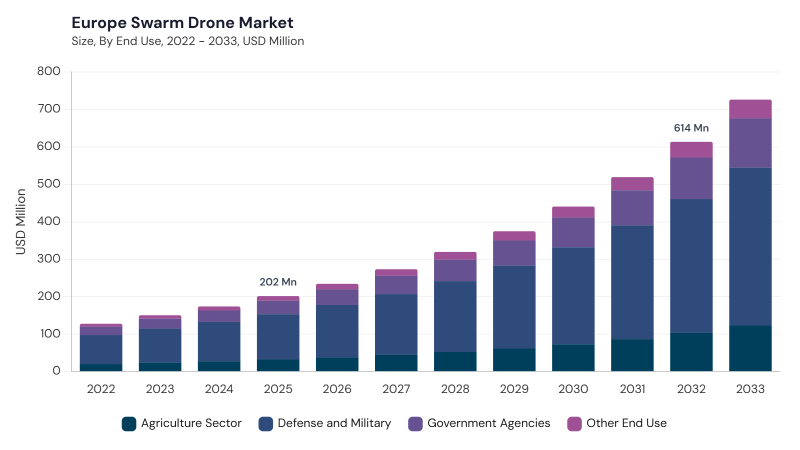
The Europe Swarm Drone Market evolved from early military-focused UAV programs centered on coordinated reconnaissance and defense into increasingly sophisticated multi-drone systems capable of autonomous, distributed operation. Initial development relied on basic swarm algorithms inspired by biological coordination models, while advances in onboard computing, sensor integration, secure communications, artificial intelligence, and edge processing enabled real-time data sharing and adaptive decision-making. Demand for resilient aerial systems supporting surveillance, electronic warfare, and area monitoring accelerated technical development. More recently, applications have broadened into logistics, infrastructure inspection, environmental monitoring, agriculture, and civil-security operations, creating a more diversified ecosystem built around interoperability, autonomy, mission scalability, and regulatory compliance.
AI-enabled autonomy, counter-swarm capabilities, interoperability, secure communications, and regulatory harmonization are shaping current market development. European users increasingly require GPS-independent navigation, distributed intelligence, resilient mesh networking, real-time sensor fusion, mixed-platform coordination, and scalable command architectures. Defense modernization and growing security concerns are stimulating investment in surveillance, counter-drone, border monitoring, and mission-resilient systems, while agriculture, smart-city management, infrastructure inspection, and environmental applications are expanding commercial relevance. Advances in 5G, edge computing, AI analytics, energy-efficient propulsion, digital twins, and simulation platforms continue to strengthen operational capabilities. However, regulatory fragmentation, high capital requirements, cybersecurity risks, interoperability limitations, complex certification, and infrastructure gaps continue to affect broader deployment.
Based on Technology, the market is segmented into Semi-Autonomous and Fully Autonomous. The Semi-Autonomous market dominated the Europe Swarm Drone Market by Technology in 2025, and would continue to be a dominant market till 2033; thereby, achieving a market value of USD 296.3 million by 2031, growing at a CAGR of 17.2 % during the forecast period. The Fully Autonomous market is expected to witness a CAGR of 17.9% during (2026 - 2033).
Semi-Autonomous systems integrate automated navigation, task allocation, data sharing, and formation control while retaining operator intervention for critical decisions, making them suitable for border surveillance, infrastructure inspection, defense, and search and rescue operations. Fully Autonomous systems rely on advanced AI, decentralized decision-making, edge computing, sensor fusion, and adaptive flight planning to execute missions with minimal human input. These platforms offer greater scalability and responsiveness for complex defense, agricultural, and emergency applications. Regulatory uncertainty, ethical considerations, cybersecurity requirements, and the need for reliable fail-safe mechanisms continue to influence the pace of fully autonomous deployment.
Based on Component, the market is segmented into Hardware, Software, and Services. The Hardware market dominated the Europe Swarm Drone Market by Component in 2025, and would continue to be a dominant market till 2033; thereby, achieving a market value of USD 295.0 million by 2031, growing at a CAGR of 17 % during the forecast period. The Software market is expected to witness a CAGR of 18% during (2026 - 2033). Additionally, The Services market is expected to witness highest CAGR of 18.6% during (2026 - 2033).
Hardware development emphasizes miniaturization, durability, payload flexibility, battery performance, high-precision sensors, and secure inter-drone connectivity needed for reliable swarm operations. Software provides the intelligence layer through autonomous coordination algorithms, fleet orchestration, cooperative routing, data fusion, mission planning, secure communications, simulation, and command-and-control capabilities. Services encompass system integration, operator training, maintenance, technical support, regulatory consulting, analytics, and lifecycle management. Growing deployment complexity is increasing demand for predictive maintenance, mission-specific customization, software updates, and end-to-end operational support across both defense and civilian environments.
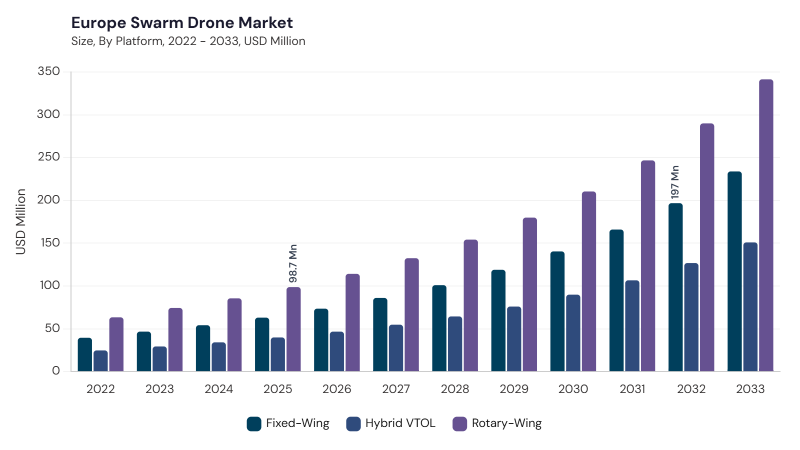
Based on Platform, the market is segmented into Rotary-Wing, Fixed-Wing, and Hybrid VTOL. The Rotary-Wing market dominated the Europe Swarm Drone Market by Platform in 2025, and would continue to be a dominant market till 2033; thereby, achieving a market value of USD 246.7 million by 2031, growing at a CAGR of 16.9 % during the forecast period. The Fixed-Wing market is expected to witness a CAGR of 18% during (2026 - 2033). Additionally, The Hybrid VTOL market is expected to witness highest CAGR of 18.3% during (2026 - 2033).
Rotary-Wing platforms support reconnaissance, infrastructure inspection, public safety, tactical surveillance, and other missions requiring localized control and rapid deployment. Fixed-Wing platforms provide longer endurance, higher forward-flight efficiency, greater range, and broader area coverage, making them relevant for border monitoring, maritime surveillance, agriculture, and persistent ISR operations. Hybrid VTOL platforms combine runway-independent deployment with more efficient cruise performance, supporting missions requiring both maneuverability and extended reach. Advances in battery density, propulsion integration, AI-assisted navigation, modular payload systems, and swarm synchronization are strengthening capabilities across all three platform categories.
Based on End Use, the market is segmented into Defense and Military, Government Agencies, Agriculture Sector, and Other End Use. Defense and Military users emphasize resilient communications, autonomous coordination, battlefield surveillance, interoperability, electronic countermeasures, and secure mission execution in contested environments. Government Agencies use swarm drones for border surveillance, disaster response, law enforcement, critical infrastructure monitoring, environmental protection, and public safety.
Agriculture Sector adoption centers on synchronized crop monitoring, precision spraying, soil assessment, pest detection, multispectral imaging, and real-time field analysis aimed at improving productivity and sustainability. Other End Use includes utilities, research institutions, logistics operators, infrastructure owners, environmental organizations, and technology developers exploring coordinated drone fleets for specialized industrial and commercial applications.
Based on Application, the market is segmented into Intelligence, Surveillance & Reconnaissance (ISR), Border & Maritime Surveillance, Precision Agriculture, Search & Rescue, Environmental Monitoring, and Other Application. Intelligence, Surveillance & Reconnaissance (ISR) supports battlefield awareness, target detection, urban surveillance, infrastructure monitoring, and real-time data integration through coordinated aerial assets. Border & Maritime Surveillance enables scalable monitoring across extensive borders, coastlines, ports, and maritime zones through distributed sensors and persistent patrol capabilities.
Precision Agriculture supports field mapping, crop-health assessment, targeted spraying, and resource optimization, while Search & Rescue improves emergency-area coverage through simultaneous deployment and shared sensor intelligence. Environmental Monitoring enables wildlife surveys, pollution detection, forest observation, habitat mapping, and climate-related data collection, whereas Other Application includes infrastructure inspection, logistics, mapping, entertainment, scientific research, and other emerging commercial uses.
Free Valuable Insights: The Worldwide Swarm Drone Market is projected to reach USD 3.7 Billion billion by 2033, at a CAGR of 18.1%
Based on Country, the market is segmented into Germany, UK, France, Russia, Spain, Italy, and Rest of Europe. The UK market dominated the Europe Swarm Drone Market by Country in 2025, and would continue to be a dominant market till 2033; thereby, achieving a market value of USD 110.4 million by 2031, growing at a CAGR of 16 % during the forecast period. The Germany market is expected to witness a CAGR of 16.6% during (2026 - 2033). Additionally, The France market is expected to witness a CAGR of 18.3% during (2026 - 2033).
Across Europe, swarm drone development reflects differences in defense priorities, industrial capabilities, regulatory environments, infrastructure needs, and technology maturity. Germany emphasizes autonomous control, edge analytics, secure communications, infrastructure inspection, precision agriculture, and modular swarm architectures, while the UK focuses on defense modernization, AI-enabled coordination, cyber-resilient communications, logistics, public safety, and interoperable platforms. France combines autonomous swarm intelligence, BVLOS-related operational development, IoT integration, digital twins, 5G connectivity, and infrastructure monitoring, whereas Russia emphasizes electronic warfare resilience, modular platforms, encrypted communications, autonomous decision-making, and defense-focused mission systems. Spain focuses on AI-enabled autonomy, emergency response, infrastructure monitoring, localized deployment, and increasingly defined operational standards, while Italy emphasizes autonomous coordination, sensor fusion, maritime surveillance, search and rescue, localized component development, and multi-domain applications. Rest of Europe continues to develop AI-driven autonomy, interoperable architectures, modular designs, defense integration, environmental monitoring, logistics, and increasingly mature commercial swarm deployments.

By Technology
By Component
By Platform
By End Use
By Application
By Country
Set to reach $519.3 Million by 2031, growing at 17.5% CAGR during 2026-2033.
The UK leads with $110.4 million by 2031, growing at 16% CAGR during the forecast period.
The Semi-Autonomous segment dominates, reaching $296.3 million by 2031 at 17.2% CAGR during 2026-2033.
The Hardware segment will reach $295.0 million by 2031, growing at 17% CAGR during the forecast period.
Germany is expected to witness a CAGR of 16.6% during 2026-2033.
The Services segment is expected to witness the highest CAGR of 18.6% during 2026-2033.
Our team of dedicated experts can provide you with attractive expansion opportunities for your business.




 Unique Offerings
