The sample copy of this report is available for access.
The Asia Pacific Swarm Drone Market is expected to reach USD 791.9 million by 2030, growing at a CAGR of 18.6% during (2026 - 2033).
The Asia Pacific Swarm Drone Market evolved from early single-UAV deployments in surveillance and agriculture toward coordinated multi-drone systems capable of distributed control and real-time information sharing. Advances in artificial intelligence, machine learning, communication networks, sensor integration, and autonomous navigation progressively enabled drone fleets to analyze environments, coordinate tasks, and adapt collectively with reduced human intervention. Defense modernization and regional security priorities accelerated development of swarm tactics, while precision agriculture, logistics, disaster management, infrastructure monitoring, and environmental applications broadened civilian adoption. The market now reflects a transition from experimental prototypes toward scalable operational systems supported by stronger autonomy, secure connectivity, localized development, and expanding dual-use deployment.
AI-enabled swarm intelligence, defense modernization, multi-sector adoption, and communication infrastructure development are shaping current market progression. Organizations increasingly require decentralized decision-making, secure drone-to-drone communication, sensor fusion, adaptive mission planning, and real-time coordination across complex terrain and operating environments. Defense demand remains significant, while agriculture, disaster response, logistics, environmental monitoring, mining, and infrastructure inspection are expanding commercial opportunities. Investments in edge computing, 5G and emerging connectivity, lightweight materials, battery efficiency, modular payloads, and data analytics are strengthening system performance. However, regulatory fragmentation, privacy concerns, high development costs, cybersecurity risks, communication reliability, limited interoperability, and infrastructure disparities continue to influence large-scale deployment.
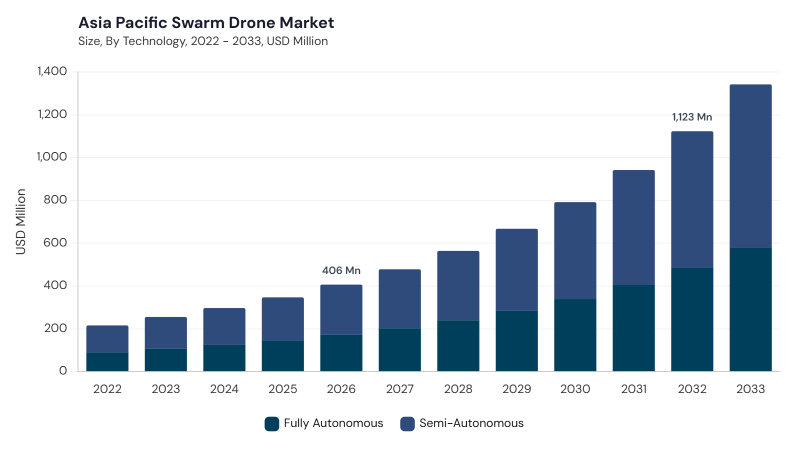
Based on Technology, the market is segmented into Semi-Autonomous and Fully Autonomous. The Semi-Autonomous market dominated the Asia Pacific Swarm Drone Market by Technology in 2025, and would continue to be a dominant market till 2033; thereby, achieving a market value of USD 452.8 million by 2030, growing at a CAGR of 18.3 % during the forecast period. The Fully Autonomous market is expected to witness a CAGR of 19% during (2026 - 2033).
Semi-Autonomous systems combine operator input with automated navigation, task allocation, formation management, and inter-drone communication, making them particularly suitable where regulations and operating conditions favor human oversight. Fully Autonomous systems rely on artificial intelligence, machine learning, onboard sensor fusion, decentralized decision-making, and dynamic route planning to execute complex missions with minimal direct intervention. Their capabilities are increasingly relevant for defense, wide-area environmental monitoring, disaster response, and collaborative logistics. However, certification complexity, airspace integration, cybersecurity, safety validation, and fail-safe requirements continue to influence the pace of fully autonomous adoption across regional markets.
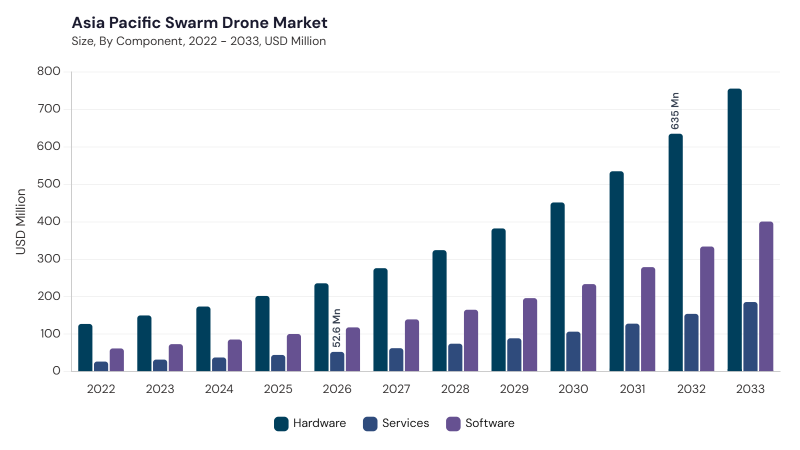
Based on Component, the market is segmented into Hardware, Software, and Services. The Hardware market dominated the Asia Pacific Swarm Drone Market by Component in 2025, and would continue to be a dominant market till 2033; thereby, achieving a market value of USD 451.6 million by 2030, growing at a CAGR of 18.1 % during the forecast period. The Software market is expected to witness a CAGR of 19.1% during (2026 - 2033). Additionally, The Services market is expected to witness highest CAGR of 19.7% during (2026 - 2033).
Hardware development focuses on lightweight construction, battery efficiency, miniaturized sensors, modular payloads, durable platforms, and communication devices capable of supporting demanding environments. Software enables collaborative flight control, route optimization, fleet synchronization, sensor fusion, automated mission planning, real-time decision-making, and scalable swarm management. Services include system integration, deployment assistance, maintenance, training, consultancy, customization, and after-sales support required to maintain increasingly complex systems. Growth in remote diagnostics, predictive maintenance, and integration with existing operational infrastructure is further increasing the strategic importance of services across defense and commercial deployments.
Based on Platform, the market is segmented into Rotary-Wing, Fixed-Wing, and Hybrid VTOL. The Rotary-Wing market dominated the Asia Pacific Swarm Drone Market by Platform in 2025, and would continue to be a dominant market till 2033; thereby, achieving a market value of USD 377.9 million by 2030, growing at a CAGR of 18 % during the forecast period. The Fixed-Wing market is expected to witness a CAGR of 19% during (2026 - 2033). Additionally, The Hybrid VTOL market is expected to witness highest CAGR of 19.4% during (2026 - 2033).
Rotary-Wing platforms support rapid deployment, tactical surveillance, crop monitoring, infrastructure inspection, disaster response, and confined-area missions requiring precise maneuverability. Fixed-Wing platforms provide longer endurance, efficient forward flight, and broader geographic coverage, supporting maritime patrol, border surveillance, large-scale mapping, environmental monitoring, and persistent ISR operations. Hybrid VTOL combines vertical takeoff flexibility with improved cruise efficiency and extended range, making it attractive for disaster-relief logistics, coastal surveillance, remote-area operations, and other missions requiring varied deployment conditions. Advances in battery technology, propulsion, autonomous navigation, 5G connectivity, and platform synchronization continue to improve operational effectiveness across all three categories.
Based on End Use, the market is segmented into Defense and Military, Government Agencies, Agriculture Sector, and Other End Use. Defense and Military applications emphasize reconnaissance, electronic warfare, autonomous coordination, secure communications, distributed sensing, and tactical force multiplication. Government Agencies employ swarm drones for public safety, disaster management, infrastructure monitoring, environmental surveillance, border control, and emergency response, where real-time data aggregation improves operational awareness.
Agriculture Sector adoption centers on crop-health monitoring, soil analysis, pest detection, spraying, seeding, field mapping, and precision management across large agricultural areas. Other End Use includes infrastructure inspection, mining, logistics, environmental research, industrial monitoring, and other specialized activities where coordinated drones provide broader coverage, redundancy, and operational efficiency.
Based on Application, the market is segmented into Intelligence, Surveillance & Reconnaissance (ISR), Border & Maritime Surveillance, Precision Agriculture, Search & Rescue, Environmental Monitoring, and Other Application. Intelligence, Surveillance & Reconnaissance (ISR) supports military reconnaissance, target tracking, border monitoring, urban surveillance, and real-time intelligence gathering through coordinated aerial sensing. Border & Maritime Surveillance enables persistent monitoring of extensive coastlines, island territories, maritime routes, and remote borders, while Precision Agriculture supports crop imaging, spraying, soil analysis, pest management, and field intelligence.
Search & Rescue improves response across earthquakes, floods, cyclones, tsunamis, and inaccessible terrain through parallel aerial scanning and sensor sharing. Environmental Monitoring supports forest assessment, biodiversity observation, pollution tracking, wildlife monitoring, and natural-resource management, whereas Other Application includes infrastructure inspection, mapping, logistics, entertainment, scientific research, and other emerging industrial applications.
Free Valuable Insights: Swarm Drone Market is Predicted to reach USD 3.7 Billion billion by 2033, at a CAGR of 18.1%
Based on Country, the market is segmented into China, Japan, India, South Korea, Singapore, Malaysia, and Rest of Asia Pacific. The China market dominated the Asia Pacific Swarm Drone Market by Country in 2025, and would continue to be a dominant market till 2033; thereby, achieving a market value of USD 293.7 million by 2030, growing at a CAGR of 17.1 % during the forecast period. The Japan market is expected to witness a CAGR of 17.4% during (2026 - 2033). Additionally, The India market is expected to witness a CAGR of 19.3% during (2026 - 2033).
Across Asia Pacific, swarm drone development reflects differences in defense priorities, regulatory maturity, industrial capabilities, infrastructure, and commercial adoption. China emphasizes AI-enabled autonomy, dual-use deployment, integrated airspace management, domestic manufacturing, and sensor-rich coordinated systems, while Japan focuses on robotics, AI-driven navigation, disaster response, infrastructure inspection, and regulatory safety. India advances indigenous swarm algorithms, precision agriculture, defense applications, IoT-enabled communication, and localized manufacturing, whereas South Korea emphasizes distributed AI, heterogeneous-platform interoperability, secure communications, and government-supported development. Singapore focuses on high-autonomy swarms, counter-drone resilience, modular systems, cybersecurity, and urban security applications, while Malaysia emphasizes AI-enabled control, emergency response, agriculture, infrastructure monitoring, and compliance-oriented commercialization. Rest of Asia Pacific continues to develop AI-driven coordination, defense capabilities, smart-city applications, environmental monitoring, logistics, localized manufacturing, and increasingly diversified commercial deployments.

By Technology
By Component
By Platform
By End Use
By Application
By Country
Set to reach $791.9 Million by 2030, growing at 18.6% CAGR during 2026-2033.
China leads with $293.7 million by 2030, growing at 17.1% CAGR during 2026-2033.
Semi-Autonomous segment hits $452.8 million by 2030 at 18.3% CAGR during 2026-2033.
India market is expected to witness a CAGR of 19.3% during 2026-2033.
Software component is expected to witness a CAGR of 19.1% during 2026-2033.
Our team of dedicated experts can provide you with attractive expansion opportunities for your business.




 Unique Offerings
