The sample copy of this report is available for access.
The LAMEA Swarm Drone Market is expected to reach USD 104.1 million by 2029, growing at a CAGR of 21.1% during (2026 - 2033).
The LAMEA Swarm Drone Market evolved from conventional single-UAV deployments used primarily for military surveillance and reconnaissance toward coordinated multi-drone systems capable of distributed operation and collective task execution. Advances in artificial intelligence, sensor miniaturization, wireless communication, autonomous navigation, and real-time analytics enabled multiple drones to operate cohesively with reduced human intervention. Rising defense modernization, security requirements, and demand for scalable aerial intelligence accelerated regional adoption, while agriculture, mining, environmental monitoring, logistics, and infrastructure inspection broadened commercial relevance. The market now reflects increasing integration of autonomous coordination, localized innovation, flexible payloads, secure communication, and scalable swarm architectures adapted to diverse climatic and geographic operating conditions.
AI-enabled autonomy, regulatory modernization, multifunctional deployment, and IoT-based intelligence are shaping current market development. Users increasingly require autonomous task allocation, secure inter-drone communication, real-time data sharing, resilient navigation, and scalable fleet coordination across defense, agriculture, mining, infrastructure, and disaster-management applications. Governments are gradually developing clearer operational frameworks for coordinated UAV deployment, while public-private partnerships and localized manufacturing support broader ecosystem development. Advances in edge computing, big data analytics, sensor fusion, high-density batteries, and secure communication networks are improving operational effectiveness. However, high capital expenditure, fragmented regulation, airspace-management constraints, communication reliability, limited interoperability, cybersecurity risks, and infrastructure disparities continue to influence adoption.
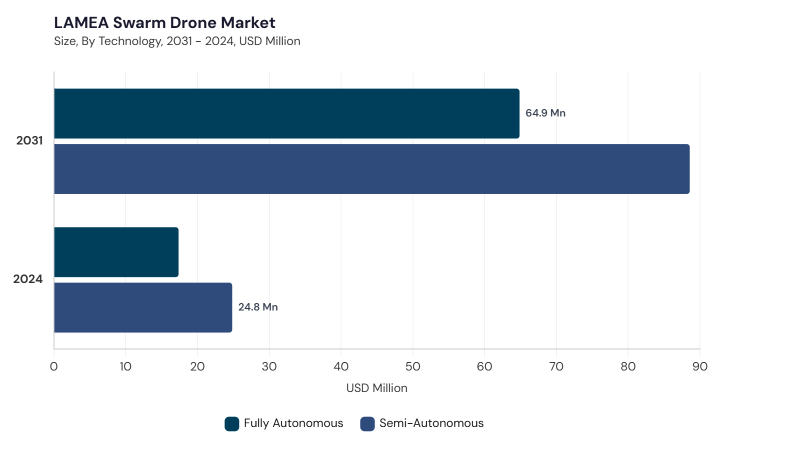
Based on Technology, the market is segmented into Semi-Autonomous and Fully Autonomous. The Semi-Autonomous market dominated the LAMEA Swarm Drone Market by Technology in 2025, and would continue to be a dominant market till 2033; thereby, achieving a market value of USD 60.4 million by 2029, growing at a CAGR of 20.7 % during the forecast period. The Fully Autonomous market is expected to witness a CAGR of 21.6% during (2026 - 2033).
Semi-Autonomous systems combine automated navigation, coordinated movement, obstacle avoidance, task allocation, and mission assistance with operator-in-the-loop or operator-on-the-loop control, supporting defense, border surveillance, infrastructure inspection, disaster response, and public-safety applications. Fully Autonomous systems use artificial intelligence, machine vision, sensor fusion, decentralized communication, and distributed computing to coordinate navigation and mission execution with minimal direct human input. Their potential is strongest in defense, homeland security, emergency response, and large-area industrial applications. Wider commercialization remains constrained by regulatory uncertainty, accountability concerns, cybersecurity risks, AI validation requirements, communication reliability, high system complexity, and stringent fail-safe requirements.
Based on Component, the market is segmented into Hardware, Software, and Services. The Hardware market dominated the LAMEA Swarm Drone Market by Component in 2025, and would continue to be a dominant market till 2033; thereby, achieving a market value of USD 60.3 million by 2029, growing at a CAGR of 20.5 % during the forecast period. The Software market is expected to witness a CAGR of 21.5% during (2026 - 2033). Additionally, The Services market is expected to witness highest CAGR of 22.7% during (2026 - 2033).
Hardware development emphasizes durable platforms, sensor integration, battery efficiency, communication resilience, modular payloads, collision avoidance, and component miniaturization required for scalable swarm deployments. Software manages autonomous navigation, swarm algorithms, geofencing, mission scheduling, data interpretation, real-time analytics, cybersecurity, and adaptive decision-making across coordinated fleets. Services include system integration, training, maintenance, technical configuration, compliance support, software updates, and after-sales assistance. Growing deployment complexity and limited in-house expertise among some regional users are increasing the importance of professional support, customization, and lifecycle services.
Based on Platform, the market is segmented into Rotary-Wing, Fixed-Wing, and Hybrid VTOL. The Rotary-Wing market dominated the LAMEA Swarm Drone Market by Platform in 2025, and would continue to be a dominant market till 2033; thereby, achieving a market value of USD 50.5 million by 2029, growing at a CAGR of 20.4 % during the forecast period. The Fixed-Wing market is expected to witness a CAGR of 21.4% during (2026 - 2033). Additionally, The Hybrid VTOL market is expected to witness highest CAGR of 22.1% during (2026 - 2033).
Rotary-Wing platforms support tactical surveillance, infrastructure inspection, disaster management, precision agriculture, and other missions requiring maneuverability in confined or complex environments. Fixed-Wing platforms provide longer endurance, greater speed, and more efficient coverage across deserts, coastlines, agricultural zones, pipelines, borders, and sparsely populated territories. Hybrid VTOL platforms combine runway-independent deployment with efficient forward flight, supporting missions requiring both localized access and broader geographic reach. Advances in propulsion, battery density, autonomous flight control, swarm intelligence, and payload integration continue to improve the operational flexibility and efficiency of all three platform categories.
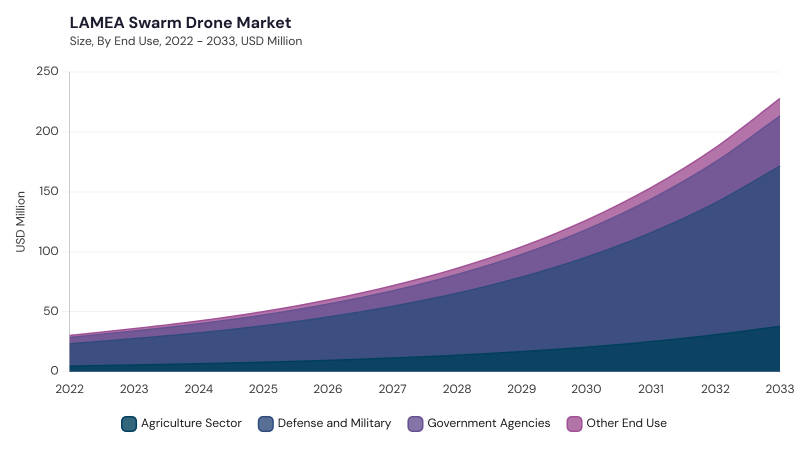
Based on End Use, the market is segmented into Defense and Military, Government Agencies, Agriculture Sector, and Other End Use. Defense and Military applications emphasize reconnaissance, target acquisition, electronic warfare, distributed sensing, autonomous coordination, and force multiplication while reducing personnel exposure. Government Agencies deploy swarm drones for disaster management, public safety, infrastructure surveillance, environmental monitoring, territorial observation, and emergency response.
Agriculture Sector adoption centers on crop monitoring, pest control, soil assessment, irrigation management, multispectral imaging, and large-area field intelligence aimed at improving productivity and resource efficiency. Other End Use includes mining, oil and gas, utilities, environmental conservation, research, and infrastructure maintenance where coordinated aerial systems improve coverage, safety, and operational efficiency.
Based on Application, the market is segmented into Intelligence, Surveillance & Reconnaissance (ISR), Border & Maritime Surveillance, Precision Agriculture, Search & Rescue, Environmental Monitoring, and Other Application. Intelligence, Surveillance & Reconnaissance (ISR) supports battlefield monitoring, border security, target tracking, and real-time intelligence gathering through coordinated aerial sensing. Border & Maritime Surveillance enables persistent observation across extensive land boundaries, coastal territories, shipping corridors, and isolated areas, while Precision Agriculture supports crop-health assessment, soil monitoring, pest detection, field mapping, and resource optimization.
Search & Rescue enhances emergency response during floods, earthquakes, wildfires, and remote-area incidents through coordinated scanning and sensor sharing. Environmental Monitoring supports ecosystem assessment, pollution tracking, wildlife conservation, desertification monitoring, and water-resource observation, whereas Other Application includes mining, infrastructure inspection, mapping, entertainment, and other emerging industrial uses.
Free Valuable Insights: Swarm Drone Market Size Worth USD 3.7 Billion billion by 2033
Based on Country, the market is segmented into Brazil, Argentina, UAE, Saudi Arabia, South Africa, Nigeria, and Rest of LAMEA. The Brazil market dominated the LAMEA Swarm Drone Market by Country in 2025, and would continue to be a dominant market till 2033; thereby, achieving a market value of USD 22.4 million by 2029, growing at a CAGR of 19.3 % during the forecast period. The Argentina market is expected to witness a CAGR of 21.7% during (2026 - 2033). Additionally, The UAE market is expected to witness a CAGR of 20.1% during (2026 - 2033).
Across LAMEA, swarm drone development reflects differences in defense priorities, industrial structure, infrastructure readiness, regulation, and commercial application maturity. Brazil emphasizes autonomous coordination, 5G integration, precision agriculture, security surveillance, environmental monitoring, and localized solutions for extensive operating areas, while Argentina focuses on AI-enabled swarm intelligence, mesh networking, agriculture, mining, hybrid propulsion, and infrastructure inspection. The UAE advances AI-driven coordination, smart-city integration, oil and gas inspection, cybersecurity, and autonomous security applications, whereas Saudi Arabia emphasizes defense modernization, GPS-denied navigation, network-centric operations, localization, and indigenous technology development. South Africa focuses on mining, agriculture, GIS integration, environmental monitoring, secure communications, and public-safety applications, while Nigeria emphasizes precision agriculture, AI-enabled autonomy, infrastructure assessment, oil and gas operations, and localized technology adoption. Rest of LAMEA continues to develop defense, border security, agriculture, mining, infrastructure, environmental, and disaster-response applications supported by decentralized control, AI analytics, secure communications, and scalable swarm architectures.

By Technology
By Component
By Platform
By End Use
By Application
By Country
Set to reach $104.1 Million by 2029, growing at 21.1% CAGR during 2026-2033.
Brazil leads with $22.4 million by 2029, growing at a CAGR of 19.3% during 2026-2033.
The Semi-Autonomous segment will reach $60.4 million by 2029, growing at a CAGR of 20.7% during 2026-2033.
The Hardware market will reach $60.3 million by 2029, growing at a CAGR of 20.5% during 2026-2033.
The UAE market is expected to witness a CAGR of 20.1% during 2026-2033.
The Hybrid VTOL market will witness the highest CAGR of 22.1% during 2026-2033.
Our team of dedicated experts can provide you with attractive expansion opportunities for your business.




 Unique Offerings
