The sample copy of this report is available for access.
“Global Ride-Hailing Market to reach a market value of USD 375,695.62 Million by 2033 growing at a CAGR of 16%”
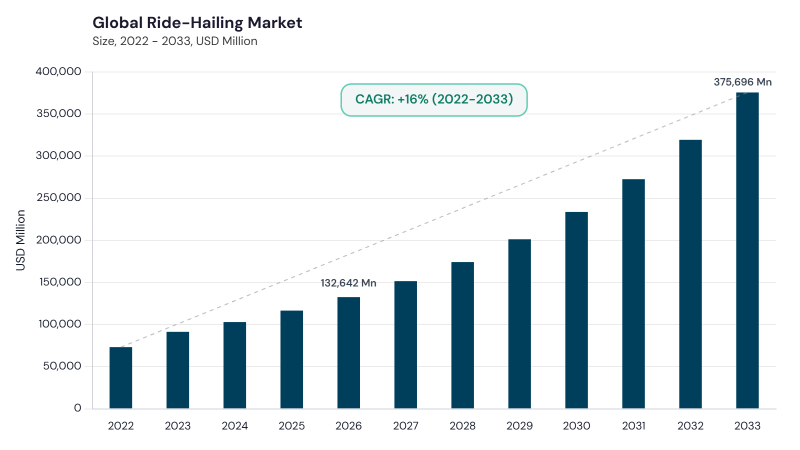
The Global Ride-Hailing Market is expected to reach USD 375.7 billion by 2033, growing at a CAGR of 16% during (2026 - 2033).
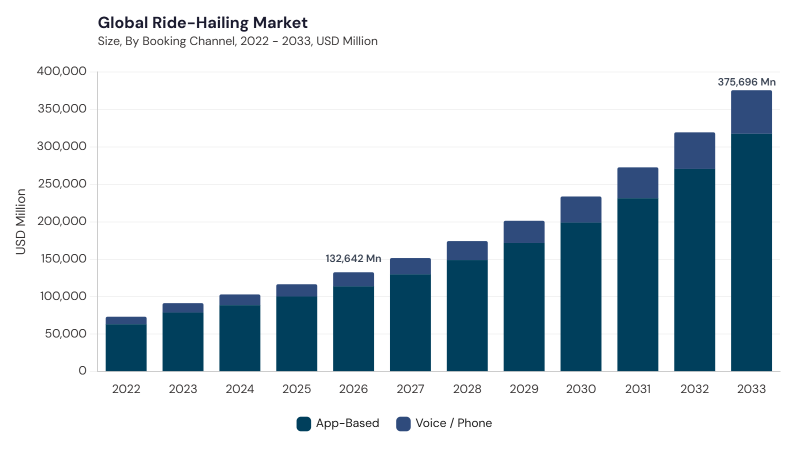
Ride hailing market is driven by increasing consumer preference for flexible, convenient, and app-based mobility solutions across airport transfers, daily commuting, short-distance transportation, and corporate travel. Digital payment adoption, rising smartphone penetration, urbanization, enhanced driver-partner networks, and shared mobility expansion are some of the elements surging adoption globally. Ride hailing market evolved with the convergence of GPS technology, smartphone, and mobile internet connectivity. Dynamic pricing, real-time tracking, digital payments, user payments and safety features enhanced operational efficiency and service quality, thereby resulting in ride hailing market.
Ride hailing market is rising as urban consumers largely prefer digital, on-demand mobility over private vehicle ownership, and taxi services. Ride hailing platforms enhance transportation access through GPS tracking, mobile apps, driver tracking, real-time service availability, and cashless ratings. The expansion of AI-based dispatch systems, electric vehicle fleets, integrated payment solutions, and dynamic pricing is enhancing platform efficiency. Corporate mobility programs, shared mobility models, and subscription-based ride packages are also resulting in the growth of ride hailing market.
Competitive landscape of the market is platform driven, with regional super apps, global mobility platforms, and technology-enabled transportation providers competing across markets. Market players are positioning themselves ahead through driver networks, user scale, AI-based dispatching, app experience, driver networks, fleet partnerships, digital payments, multimodal mobility ecosystems, and safe features. Additionally, competition in market is anticipated to be driven by electric fleet adoption, autonomous mobility, regulatory adaptation, payment integration and mobility-as-a-service expansion.
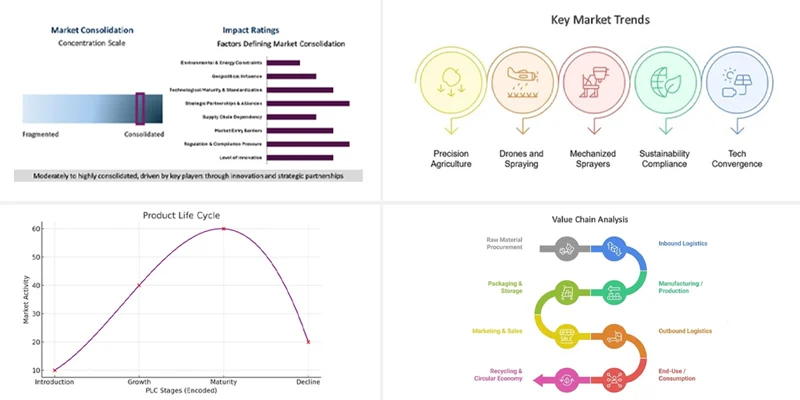

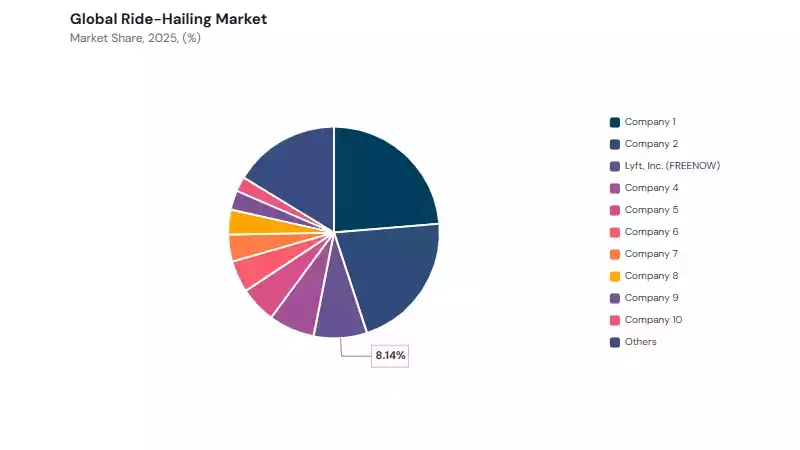
Ride hailing market represents a moderately consolidated competitive environment, driven by digital transportation providers, global mobility platforms, and regional super apps. DiDi Global and Uber Technologies maintain strong leadership through advanced dispatching systems, large user networks, broad geographic reach, and digital payment ecosystems. Bolt, Lyft, Ola, GoTo, Yandex Go, and inDrive further supported market through driver networks, localized mobility offerings, regional scale, and integrated service ecosystems. Market competition is predicted to depend on electric fleets, autonomous mobility, regulatory compliance, AI-based optimization, multimodal transportation capabilities, and regulatory compliance.
Based on Booking Channel, the market is segmented into App-Based and Voice / Phone. The App-Based market dominated the Global Ride-Hailing Market by Booking Channel in 2025, and would continue to be a dominant market till 2033; thereby, achieving a market value of USD 317.4 billion by 2033, growing at a CAGR of 15.8 % during the forecast period. The Voice / Phone market is expected to witness a CAGR of 17.5% during (2026 - 2033).
App-based booking is central to ride-hailing growth because it enables real-time ride matching, transparent fares, customer feedback, driver tracking, and contactless payment. The segment benefits from increasing digital literacy, stronger mobile internet networks, and improved app functionality. Voice and phone-based booking remains relevant for accessibility-focused users, elderly passengers, local transport operators, and markets where smartphone adoption is uneven. Both channels help platforms address diverse customer access needs.
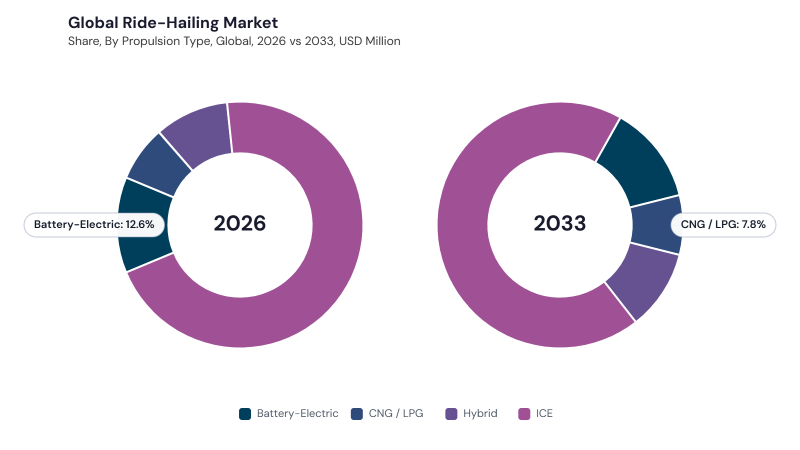
Based on Propulsion Type, the market is segmented into ICE, Battery-Electric, Hybrid, and CNG / LPG. The ICE market dominated the Global Ride-Hailing Market by Propulsion Type in 2025, and would continue to be a dominant market till 2033; thereby, achieving a market value of USD 258.1 billion by 2033, growing at a CAGR of 15.6 % during the forecast period. The Battery-Electric market is expected to witness a CAGR of 16.5% during (2026 - 2033). The CNG / LPG market is expected to witness a CAGR of 17.2% during (2026 - 2033).
Hybrid vehicles are gaining importance as operators seek better fuel efficiency while reducing emissions without fully depending on charging networks. CNG / LPG vehicles support cleaner fuel adoption in markets where alternative fuel infrastructure and cost advantages are available. The propulsion mix is gradually shifting as ride-hailing operators balance affordability, operating cost, sustainability, regulatory requirements, and vehicle availability. Electric and hybrid fleet adoption is expected to strengthen as platforms pursue low-emission urban mobility.
Based on End User, the market is segmented into Personal and Corporate / Institutional. The Personal market dominated the Global Ride-Hailing Market by End User in 2025, and would continue to be a dominant market till 2033; thereby, achieving a market value of USD 234.8 billion by 2033, growing at a CAGR of 15.6 % during the forecast period. The Corporate / Institutional market is expected to witness a CAGR of 16.8% during (2026 - 2033).
The personal segment benefits from urbanization, smartphone-based booking, digital payments, and changing consumer preference toward shared mobility. Corporate and institutional users require reliable ride scheduling, centralized billing, trip tracking, expense management, and compliance with internal mobility policies. As organizations prioritize flexible transport solutions and cost efficiency, ride-hailing platforms are strengthening business-focused services. This is helping expand ride-hailing from individual mobility into structured enterprise transportation solutions.
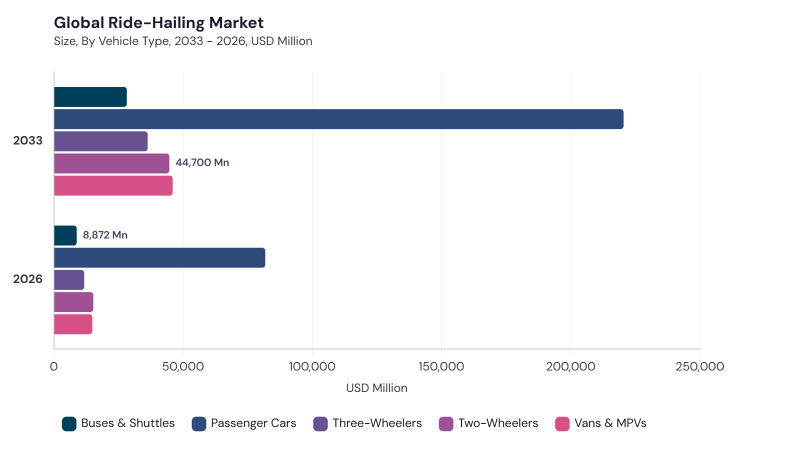
Based on Vehicle Type, the market is segmented into Passenger Cars, Two-Wheelers, Vans & MPVs, Three-Wheelers, and Buses & Shuttles. The Passenger Cars market dominated the Global Ride-Hailing Market by Vehicle Type in 2025, and would continue to be a dominant market till 2033; thereby, achieving a market value of USD 220.4 billion by 2033, growing at a CAGR of 15.2 % during the forecast period. The Two-Wheelers market is expected to witness a CAGR of 16.6% during (2026 - 2033). Additionally, The Vans & MPVs market is expected to witness highest CAGR of 17.5% during (2026 - 2033).
Vans & MPVs serve group travel, airport transfers, family rides, and corporate mobility needs where higher seating capacity is required. Three-Wheelers are important in selected emerging markets due to affordability, compact size, and suitability for short-distance urban trips. Buses & Shuttles support shared mobility, employee transport, institutional movement, and first-mile or last-mile transit services. The diverse vehicle mix allows platforms to serve different mobility needs across urban, suburban, and emerging markets.
Based on Service Type, the market is segmented into E-Hailing, Car-Sharing / Peer-to-Peer, Subscription-Based Ride Packages, and Robo-Taxi. The E-Hailing market dominated the Global Ride-Hailing Market by Service Type in 2025, and would continue to be a dominant market till 2033; thereby, achieving a market value of USD 260.7 billion by 2033, growing at a CAGR of 15.6 % during the forecast period. The Car-Sharing / Peer-to-Peer market is expected to witness a CAGR of 16.5% during (2026 - 2033). Additionally, The Subscription-Based Ride Packages market is expected to witness highest CAGR of 17.4% during (2026 - 2033).
Subscription-Based Ride Packages are emerging among frequent commuters and corporate users seeking predictable mobility costs and bundled service benefits. Robo-Taxi services remain at an early stage but are expected to reshape long-term ride-hailing economics through autonomous vehicle deployment. Service diversification is helping platforms move beyond basic point-to-point rides into integrated mobility ecosystems. These models support customer retention, cost efficiency, convenience, and broader urban mobility coverage.
Free Valuable Insights: Ride-Hailing Market Size to reach $375.7 Billion by 2033
Region-wise, the Ride-Hailing Market is analyzed across North America, Europe, Asia Pacific, and LAMEA. The Asia Pacific region held the highest share in ride hailing market in 2025, and is estimated to remain dominant till 2033, with a market value of USD 148.9 billion by 2033, expanding at a CAGR of 16.5% in the projection period. North America market is predicted to expand at a CAGR of 15.6% in the forecast period. Moreover, the Europe market is estimated to expand at a CAGR of 15.6% during 2026-2033.
Europe market is driven by shared transportation adoption, sustainable mobility demand, urban transportation modernization, regulatory focus, and shared adoption. LAMEA is gaining momentum through urban transport gaps, expanding digital payments, and rising acceptance of app-based ride booking. Regional growth is supported by consumer mobility behavior, infrastructure maturity, payment ecosystems, vehicle availability, and the strength of regional platform operators.
| Report Attribute | Details |
|---|---|
| Market size value in 2026 | USD 132.6 billion |
| Market size forecast in 2033 | USD 375.7 billion |
| Base Year | 2025 |
| Historical Period | 2022 to 2024 |
| Forecast Period | 2026 to 2033 |
| Revenue Growth Rate | CAGR of 16.0% from 2026 to 2033 |
| Number of Pages | 700 |
| Tables | 900 |
| Report Coverage | Market Trends, Revenue Estimation and Forecast, Segmentation Analysis, Regional and Country Breakdown, Competitive Landscape, Market Share Analysis, Company Profiling, Companies Strategic Developments, SWOT Analysis, Product Life Cycle Analysis, Value Chain Analysis, Market Consolidation Analysis, Key Customer Criteria, Pandemic Impact Analysis, and Winning Imperatives |
| Segments Covered | Booking Channel, Propulsion Type, End User, Vehicle Type, Service Type, and Geography |
| Country Scope |
|
| Companies Included | Uber Technologies, Inc.; DiDi Global Inc.; Lyft, Inc.; Grab Holdings Limited; Bolt Technology OÜ; ANI Technologies Pvt. Ltd.; SUOL Innovations Ltd.; Yandex Go; Cabify |
By Booking Channel
By Propulsion Type
By End User
By Vehicle Type
By Service Type
By Geography
The ride-hailing market is valued at USD 132.6 billion in 2026.
App-based booking leads, projected to reach USD 317.4 billion by 2033.
Uber, DiDi, Lyft, Grab, Bolt, ANI Technologies, SUOL Innovations, Yandex Go, and Cabify are key players.
Asia Pacific leads, expected to reach USD 148.9 billion by 2033.
Smartphone penetration and digital infrastructure expansion enhance ride accessibility and user base growth.
Passenger cars lead, projected to hit USD 220.4 billion by 2033.
Our team of dedicated experts can provide you with attractive expansion opportunities for your business.








 Unique Offerings