The LAMEA Ride-Hailing Market is expected to reach USD 19.0 billion by 2029, growing at a CAGR of 17.7% during (2026 – 2033).
The LAMEA Ride-Hailing Market originated from the early use of app-based mobility platforms across Latin America, the Middle East, and Africa, where urban commuters needed more reliable alternatives to traditional taxi services. Early adoption was supported by smartphones, GPS tools, and mobile internet, which helped connect riders and drivers through on-demand platforms. As digital payments, real-time tracking, driver ratings, and app-based customer support improved, ride-hailing became more trusted in major cities. The entry of global operators and regional platforms further formalized the market through stronger service standards and localized operations. Today, the market reflects a diverse mobility ecosystem shaped by city congestion, digital inclusion, affordability needs, and regulatory development.
The current LAMEA Ride-Hailing Market is shaped by smartphone penetration, digital payments, urbanization, AI-based route optimization, electric mobility, and localized platform strategies. Operators are adapting to different income levels, languages, payment habits, road conditions, and regulatory systems across the region. Digital wallets, mobile money, app localization, driver verification, and safety tools are improving user confidence and service accessibility. Electric and hybrid vehicle adoption is growing gradually in major cities as governments and operators focus on cleaner transport. These trends are making ride-hailing an important part of flexible urban mobility while supporting new models such as carpooling, subscriptions, and multimodal transport.
Based on Booking Channel, the market is segmented into App-Based and Voice / Phone. The App-Based market dominated the LAMEA Ride-Hailing Market by Booking Channel in 2025, and would continue to be a dominant market till 2033; thereby, achieving a market value of USD 16.3 billion by 2029, growing at a CAGR of 17.5 % during the forecast period. The Voice / Phone market is expected to witness a CAGR of 19.4% during (2026 - 2033).
App-based booking leads due to rising smartphone usage, improving broadband connectivity, GPS-enabled ride tracking, fare estimates, driver ratings, and expanding digital payment ecosystems. It is widely used in major cities where consumers prefer faster booking, transparent pricing, and convenient on-demand transport. Voice and phone booking remains relevant in semi-urban and rural areas, among users with limited smartphone access, and in markets where traditional taxi dispatch services are still common. This channel supports accessibility for digitally underserved users while app-based platforms continue to dominate core urban demand.
Based on Propulsion Type, the market is segmented into ICE, Battery-Electric, Hybrid, and CNG/LPG. The ICE market dominated the LAMEA Ride-Hailing Market by Propulsion Type in 2025, and would continue to be a dominant market till 2033; thereby, achieving a market value of USD 13.3 billion by 2029, growing at a CAGR of 17.3 % during the forecast period. The Battery-Electric market is expected to witness a CAGR of 18.2% during (2026 - 2033). The CNG / LPG market is expected to witness a CAGR of 19.2% during (2026 - 2033).
ICE vehicles lead due to affordability, widespread availability, mature refueling networks, and suitability across most urban and peri-urban ride-hailing operations in the region. Battery-electric vehicles are gradually expanding as sustainability initiatives, charging infrastructure investments, and urban emission concerns increase in major markets. Hybrid vehicles are gaining traction among fleet operators seeking better fuel efficiency without full dependence on charging networks. CNG/LPG vehicles remain smaller but useful in countries with alternative fuel infrastructure, lower fuel costs, and supportive clean transport policies.
Based on End User, the market is segmented into Personal and Corporate / Institutional. The Personal market dominated the LAMEA Ride-Hailing Market by End User in 2025, and would continue to be a dominant market till 2033; thereby, achieving a market value of USD 12.2 billion by 2029, growing at a CAGR of 17.3 % during the forecast period. The Corporate / Institutional market is expected to witness a CAGR of 18.6% during (2026 - 2033).
Personal users lead due to rising urbanization, growing smartphone access, limited public transport reliability in several cities, and increasing preference for affordable point-to-point travel. This segment uses ride-hailing for daily commuting, shopping, social trips, airport transfers, and flexible urban mobility. Corporate and institutional users are expanding as businesses use digital transport platforms for employee commuting, client travel, airport transfers, and event mobility. Centralized billing, scheduled rides, safety tracking, and mobility reporting are strengthening adoption among organizations.
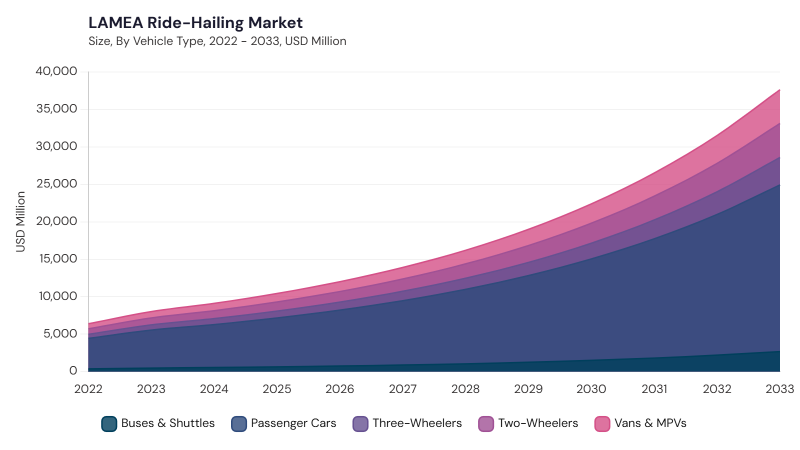
Based on Vehicle Type, the market is segmented into Passenger Cars, Two-Wheelers, Vans & MPVs, Three-Wheelers, and Buses & Shuttles. Passenger cars lead due to their broad availability, comfort, safety perception, and suitability for everyday urban passenger transport. Two-wheelers are gaining traction in dense and congested cities where affordability, maneuverability, and faster short-distance travel improve mobility access.
Vans and MPVs support family travel, shared rides, tourism, airport transfers, and corporate transport needs. Three-wheelers remain meaningful in selected developing markets for economical last-mile travel, while buses and shuttles serve employee transportation, institutional mobility, and organized group travel.
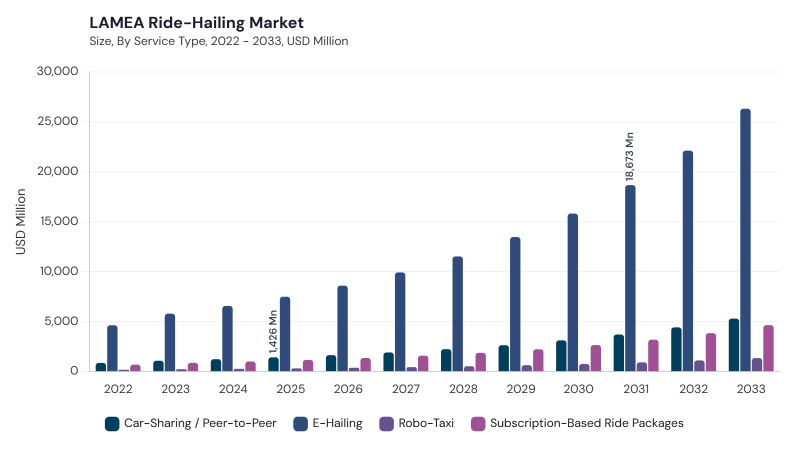
Based on Service Type, the market is segmented into E-Hailing, Car-Sharing / Peer-to-Peer, Subscription-Based Ride Packages, and Robo-Taxi. E-hailing leads due to growing consumer familiarity with app-based transport, real-time booking, flexible payment options, route tracking, and expanding urban service availability. Car-sharing and peer-to-peer services are gradually expanding as consumers seek lower-cost mobility options and better use of privately owned vehicles.
Subscription-based ride packages are gaining acceptance among frequent travelers and corporate users looking for predictable mobility costs. Robo-taxi services remain nascent, with development limited to pilot initiatives where autonomous driving infrastructure, regulation, and smart city programs are still evolving.
Free Valuable Insights: Ride-Hailing Market Size Worth USD 375.7 Billion billion by 2033
Based on Country, the market is segmented into Brazil, Argentina, UAE, Saudi Arabia, South Africa, Nigeria, and Rest of LAMEA. The Brazil market dominated the LAMEA Ride-Hailing Market by Country in 2025, and would continue to be a dominant market till 2033; thereby, achieving a market value of USD 4.5 billion by 2029, growing at a CAGR of 16.1 % during the forecast period. The Argentina market is expected to witness a CAGR of 19.1% during (2026 - 2033). Additionally, The UAE market is expected to witness a CAGR of 16.6% during (2026 - 2033).
Brazil leads due to strong urban ride-hailing adoption, local and global platform presence, app-based payments, AI-enabled allocation, and increasing use of electric and hybrid vehicles. Argentina contributes through hybrid payment models, improving regulatory clarity, safety-focused features, and localized ride-hailing services. The UAE is supported by smart city initiatives, digital mobility infrastructure, strong regulatory systems, autonomous vehicle pilots, and premium service demand. Saudi Arabia, South Africa, and Nigeria add growth through urbanization, digital payments, financial inclusion, platform localization, and expanding driver networks, while Rest of LAMEA supports gradual demand across emerging mobility markets.

By Booking Channel
By Propulsion Type
By End User
By Vehicle Type
By Service Type
By Country
Set to reach $19.0 Billion by 2029, growing at 17.7% CAGR during 2026-2033.
Brazil dominates with $4.5 billion by 2029, growing at 16.1% CAGR during the forecast period.
App-Based booking channel dominates, reaching $16.3 billion by 2029 at 17.5% CAGR during the forecast period.
ICE propulsion reaches $13.3 billion by 2029, growing at 17.3% CAGR during the forecast period.
The UAE market is expected to witness a CAGR of 16.6% during 2026-2033.
Voice/Phone booking channel is expected to witness a CAGR of 19.4% during 2026-2033.
Our team of dedicated experts can provide you with attractive expansion opportunities for your business.




 Unique Offerings