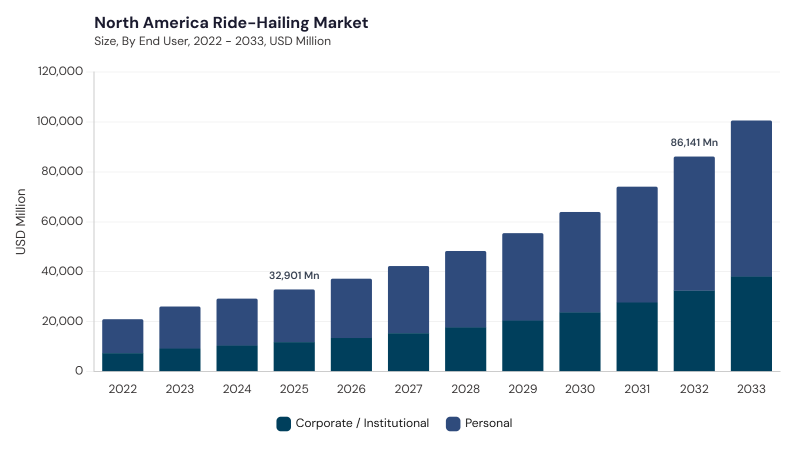
The North America Ride-Hailing Market is expected to reach USD 86.1 billion by 2032, growing at a CAGR of 15.3% during (2026 – 2033).
The North America Ride-Hailing Market originated with smartphone-based platforms that connected riders and independent drivers through GPS-enabled mobile applications. Early development disrupted traditional taxi services by offering convenient, on-demand, and digitally managed urban transportation. Over time, real-time location tracking, dynamic pricing, digital payments, driver ratings, and passenger safety tools strengthened service reliability. Regulatory responses later shaped operating standards, driver requirements, and platform accountability. Today, the market reflects a mature mobility ecosystem shaped by app-based access, urban transportation demand, sustainability goals, and emerging autonomous mobility models.
The current North America Ride-Hailing Market is shaped by fleet electrification, autonomous vehicle development, multimodal mobility, data-driven personalization, and stricter regulatory scrutiny. Operators are investing in AI-based route optimization, dynamic pricing, safety features, digital payments, and predictive demand management to improve service efficiency. Electric vehicles and ride-pooling options are gaining importance as cities and consumers focus on lower-emission transportation. Corporate mobility, public transit integration, and subscription-based ride models are also expanding service use cases. These trends are positioning ride-hailing as a broader urban mobility platform rather than only an on-demand ride service.
Based on Booking Channel, the market is segmented into App-Based and Voice / Phone. The App-Based market dominated the North America Ride-Hailing Market by Booking Channel in 2025, and would continue to be a dominant market till 2033; thereby, achieving a market value of USD 72.6 billion by 2032, growing at a CAGR of 15 % during the forecast period. The Voice / Phone market is expected to witness a CAGR of 16.7% during (2026 - 2033).
App-based booking leads due to widespread smartphone penetration, real-time ride tracking, digital payment integration, fare transparency, and strong platform availability across major cities. It supports features such as loyalty programs, ride scheduling, dynamic pricing, eco-friendly ride choices, and personalized user experiences. Voice and phone booking remains relevant for older users, customers with accessibility needs, corporate dispatch requirements, and areas where traditional booking preferences continue. This channel supports inclusivity, but its growth remains limited compared to mobile app-based ride access.
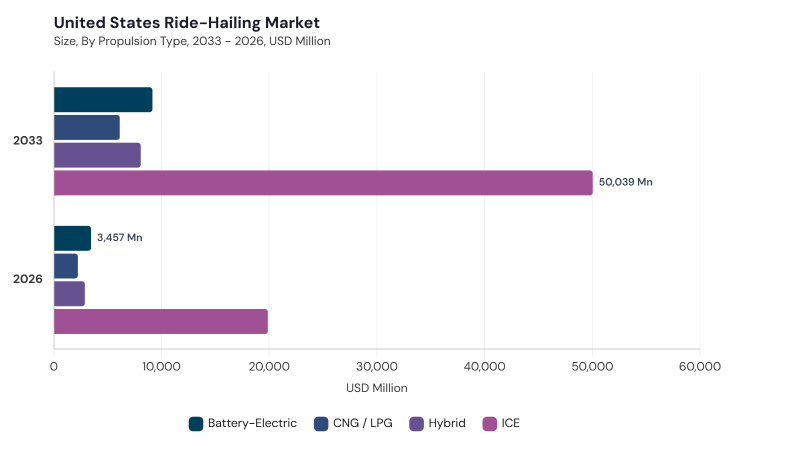
Based on Propulsion Type, the market is segmented into ICE, Battery-Electric, Hybrid, and CNG/LPG. The ICE market dominated the North America Ride-Hailing Market by Propulsion Type in 2025, and would continue to be a dominant market till 2033; thereby, achieving a market value of USD 59.1 billion by 2032, growing at a CAGR of 14.9 % during the forecast period. The Battery-Electric market is expected to witness a CAGR of 15.7% during (2026 - 2033). The CNG / LPG market is expected to witness a CAGR of 16.3% during (2026 - 2033).
ICE vehicles lead due to their broad availability, mature refueling network, lower replacement cost, driver familiarity, and suitability across urban and suburban ride-hailing operations. Battery-electric vehicles are expanding as platforms support fleet electrification, government incentives, lower operating costs, and growing charging infrastructure. Hybrid vehicles are gaining importance as they improve fuel efficiency while reducing driver operating expenses. CNG/LPG vehicles remain comparatively limited due to restricted fueling infrastructure and stronger industry focus on electric mobility.
Based on End User, the market is segmented into Personal and Corporate / Institutional. The Personal market dominated the North America Ride-Hailing Market by End User in 2025, and would continue to be a dominant market till 2033; thereby, achieving a market value of USD 53.8 billion by 2032, growing at a CAGR of 14.8 % during the forecast period. The Corporate / Institutional market is expected to witness a CAGR of 16% during (2026 - 2033).
Personal users lead due to rising demand for convenient, flexible, and on-demand travel for commuting, airport transfers, shopping, entertainment, and daily urban mobility. This segment benefits from app-based booking, seamless payments, reduced parking concerns, and changing preferences toward shared mobility. Corporate and institutional users are growing as organizations use ride-hailing for employee commuting, business travel, client transportation, event mobility, and centralized transportation management. Corporate demand also supports integrated billing, ride tracking, reporting, and low-emission ride options.
Based on Vehicle Type, the market is segmented into Passenger Cars, Two-Wheelers, Vans & MPVs, Three-Wheelers, and Buses & Shuttles. Passenger cars lead due to their versatility, wide fleet availability, comfort, safety perception, and suitability for individual, business, airport, urban, and suburban trips.
Two-wheelers are gaining selective adoption in dense urban locations where shorter travel time and lower operating cost are useful. Vans and MPVs support group travel, airport transfers, ride pooling, family trips, and corporate mobility needs. Three-wheelers remain niche due to regulatory and infrastructure limitations, while buses and shuttles are used mainly for employee transport, institutional mobility, and first- and last-mile programs.
Based on Service Type, the market is segmented into E-Hailing, Car-Sharing / Peer-to-Peer, Subscription-Based Ride Packages, and Robo-Taxi. E-hailing leads due to high consumer familiarity, strong app-based platform penetration, dynamic pricing, real-time tracking, digital payments, and continuous improvements in service reliability. Car-sharing and peer-to-peer models attract users seeking flexible vehicle access without ownership.
Subscription-based ride packages are gaining acceptance among frequent commuters and business users who prefer predictable mobility expenses and bundled benefits. Robo-taxi services remain early-stage, with deployment focused on pilot cities where autonomous vehicle testing, regulation, and infrastructure readiness support gradual commercialization.
Free Valuable Insights: The Global Ride-Hailing Market will hit USD 375.7 Billion billion by 2033, at a CAGR of 16.0%
Based on Country, the market is segmented into US, Canada, Mexico, and Rest of North America. The US market dominated the North America Ride-Hailing Market by Country in 2025, and would continue to be a dominant market till 2033; thereby, achieving a market value of USD 63.3 billion by 2032, growing at a CAGR of 14.5 % during the forecast period. The Canada market is expected to witness a CAGR of 17.9% during (2026 - 2033). Additionally, The Mexico market is expected to witness a CAGR of 16.6% during (2026 - 2033).
The US leads due to strong app-based mobility adoption, large urban ride volumes, advanced digital platforms, autonomous vehicle pilots, electric fleet initiatives, and mature competitive intensity. Canada contributes through regulated platform expansion, EV adoption, safety features, and partnerships with municipalities and transit authorities. Mexico supports growth through smartphone penetration, GPS tracking, integrated payments, AI-based route optimization, and localized ride-hailing services. Rest of North America adds demand through suburban mobility, smaller-city expansion, micromobility links, and growing multimodal transportation models.

By Booking Channel
By Propulsion Type
By End User
By Vehicle Type
By Service Type
By Country
Set to reach $86.1 Billion by 2032, growing at 15.3% CAGR during 2026-2033.
The US leads with $63.3 billion by 2032, growing at a CAGR of 14.5% during the forecast period.
App-based bookings dominate, expected to reach $72.6 billion by 2032, growing at 15% CAGR during the forecast period.
The personal segment will reach $53.8 billion by 2032, growing at a 14.8% CAGR during the forecast period.
The Canada market is expected to witness a CAGR of 17.9% during 2026-2033.
The battery-electric market is expected to witness a CAGR of 15.7% during 2026-2033.
Our team of dedicated experts can provide you with attractive expansion opportunities for your business.




 Unique Offerings