The Asia Pacific Ride-Hailing Market is expected to reach USD 91.6 billion by 2030, growing at a CAGR of 16.5% during (2026 – 2033).
The Asia Pacific Ride-Hailing Market originated with the rise of smartphone-based mobility platforms that enabled riders to book vehicles through GPS-enabled apps and digital payment systems. Early services challenged traditional taxi and informal transport models by offering real-time ride matching, transparent fares, and easier access to urban mobility. Over time, local and regional platforms expanded across China, India, Southeast Asia, Japan, South Korea, and Australia by adapting to local regulations and consumer behavior. The market then evolved from simple ride booking into integrated mobility ecosystems with carpooling, delivery, electric mobility, and super-app services. Today, the market reflects a highly localized, technology-led transportation landscape shaped by urbanization, affordability, and digital adoption.
The current Asia Pacific Ride-Hailing Market is shaped by fleet electrification, AI-based routing, super-app integration, localized service models, and rising demand for efficient last-mile connectivity. Operators are using machine learning, predictive demand analytics, dynamic pricing, digital wallets, and multilingual apps to improve service reliability and user engagement. Electric, hybrid, two-wheeler, and three-wheeler mobility options are gaining relevance as cities address congestion and pollution. Partnerships with automakers, payment providers, governments, and energy companies are helping platforms expand services and improve compliance. These trends are making ride-hailing a broader digital mobility and lifestyle platform across the region.
Based on Booking Channel, the market is segmented into App-Based and Voice / Phone. The App-Based market dominated the Asia Pacific Ride-Hailing Market by Booking Channel in 2025, and would continue to be a dominant market till 2033; thereby, achieving a market value of USD 78.0 billion by 2030, growing at a CAGR of 16.2 % during the forecast period. The Voice / Phone market is expected to witness a CAGR of 18% during (2026 - 2033).
App-based booking leads due to widespread smartphone adoption, affordable mobile internet, real-time GPS tracking, cashless payments, ride ratings, and strong regional super-app ecosystems. This channel supports AI-powered trip matching, multilingual access, digital wallets, loyalty rewards, and integrated mobility services. Voice and phone booking remains relevant for rural users, older passengers, customers with lower digital literacy, and users preferring conventional taxi dispatch. Although limited compared to app-based access, it supports inclusivity in markets where internet reliability and smartphone adoption vary.
Based on Propulsion Type, the market is segmented into ICE, Battery-Electric, Hybrid, and CNG/LPG. The ICE market dominated the Asia Pacific Ride-Hailing Market by Propulsion Type in 2025, and would continue to be a dominant market till 2033; thereby, achieving a market value of USD 63.7 billion by 2030, growing at a CAGR of 16.1 % during the forecast period. The Battery-Electric market is expected to witness a CAGR of 16.9% during (2026 - 2033). The CNG / LPG market is expected to witness a CAGR of 17.7% during (2026 - 2033).
ICE vehicles lead due to extensive availability, established refueling infrastructure, affordable acquisition costs, and strong use across developing and developed regional markets. Battery-electric vehicles are expanding rapidly as governments support clean mobility through incentives, charging infrastructure, and emission reduction policies, especially in China and advanced Asian markets. Hybrid vehicles are strengthening as they improve fuel efficiency while reducing concerns around charging access and range. CNG/LPG vehicles remain more concentrated in markets with supportive fuel infrastructure and clean transport initiatives.
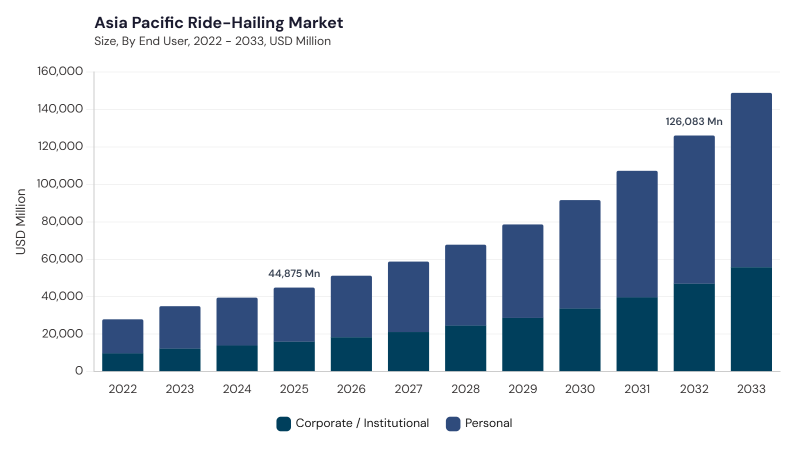
Based on End User, the market is segmented into Personal and Corporate / Institutional. The Personal market dominated the Asia Pacific Ride-Hailing Market by End User in 2025, and would continue to be a dominant market till 2033; thereby, achieving a market value of USD 58.0 billion by 2030, growing at a CAGR of 16 % during the forecast period. The Corporate / Institutional market is expected to witness a CAGR of 17.2% during (2026 - 2033).
Personal users lead due to rapid urbanization, rising smartphone penetration, increasing disposable incomes, and growing reliance on app-based transport for commuting, errands, social travel, and last-mile connectivity. This segment is supported by affordable fares, ride tracking, digital payments, safety tools, and flexible vehicle choices. Corporate and institutional users are expanding as businesses use ride-hailing for employee transportation, airport transfers, business travel, and mobility management. Centralized billing, usage analytics, safety monitoring, and sustainable travel options are improving adoption among organizations.
Based on Vehicle Type, the market is segmented into Passenger Cars, Two-Wheelers, Vans & MPVs, Three-Wheelers, and Buses & Shuttles. Passenger cars lead due to their versatility, comfort, broad fleet availability, and suitability for urban, intercity, airport, and business travel. Two-wheelers are strongly adopted in dense cities where affordability, faster travel through congestion, and efficient last-mile access are important.
Vans and MPVs support shared rides, family travel, airport transfers, tourism, and corporate transport. Three-wheelers remain important in several developing markets for economical short-distance mobility, while buses and shuttles serve employee transport, institutional mobility, commuter services, and smart city connectivity programs.
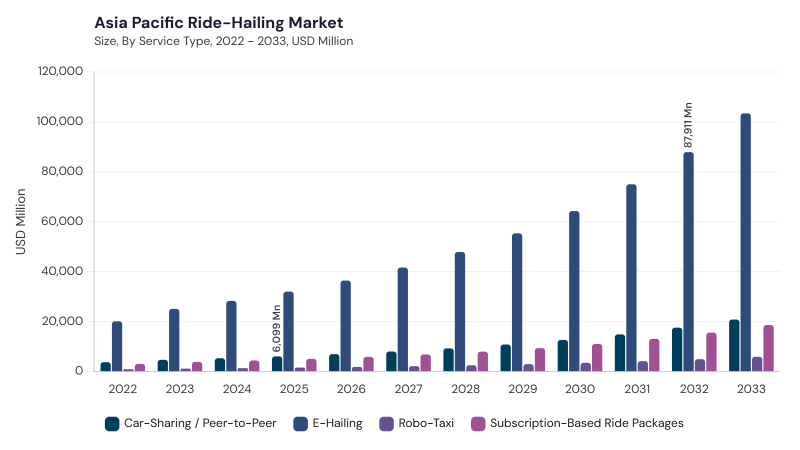
Based on Service Type, the market is segmented into E-Hailing, Car-Sharing / Peer-to-Peer, Subscription-Based Ride Packages, and Robo-Taxi. E-hailing leads due to widespread consumer adoption, competitive digital platforms, mobile booking convenience, real-time tracking, dynamic pricing, and integrated payment solutions. Car-sharing and peer-to-peer services are gaining traction as urban users seek flexible mobility without vehicle ownership costs.
Subscription-based ride packages are expanding among frequent commuters and corporate users who prefer predictable travel expenses and bundled benefits. Robo-taxi services remain early-stage, supported by autonomous vehicle pilots, AI development, smart city programs, and technology investments in advanced regional markets.
Free Valuable Insights: Ride-Hailing Market is Predicted to reach USD 375.7 Billion billion by 2033, at a CAGR of 16.0%
Based on Country, the market is segmented into China, Japan, India, South Korea, Singapore, Malaysia, and Rest of Asia Pacific. The China market dominated the Asia Pacific Ride-Hailing Market by Country in 2025, and would continue to be a dominant market till 2033; thereby, achieving a market value of USD 29.3 billion by 2030, growing at a CAGR of 14.7 % during the forecast period. The Japan market is expected to witness a CAGR of 14.9% during (2026 - 2033). Additionally, The India market is expected to witness a CAGR of 17% during (2026 - 2033).
China leads due to strong mobile internet adoption, large urban mobility demand, digital payment maturity, fleet electrification, regulatory oversight, and autonomous ride-hailing development. Japan contributes through app-based taxi dispatch, localization, safety-focused services, autonomous trials, and high service reliability standards. India supports growth through affordable ride-hailing, two-wheeler mobility, tier-2 and tier-3 city expansion, EV adoption, and digital payment penetration. South Korea, Singapore, and Malaysia add demand through regulated digital platforms, super-app ecosystems, multimodal integration, and sustainability-focused mobility, while Rest of Asia Pacific benefits from localized services and expanding urban transportation needs.

By Booking Channel
By Propulsion Type
By End User
By Vehicle Type
By Service Type
By Country
Set to reach $91.6 Billion by 2030, growing at 16.5% CAGR during 2026-2033.
China leads with $29.3 billion by 2030, growing at a 14.7% CAGR during the forecast period.
Rising app-based bookings will reach $78.0 billion by 2030, growing at a 16.2% CAGR during the forecast period.
ICE vehicles will reach $63.7 billion by 2030, growing at a 16.1% CAGR during the forecast period.
India is expected to witness a 17% CAGR during 2026-2033.
Expected to witness a 17.2% CAGR during 2026-2033.
Our team of dedicated experts can provide you with attractive expansion opportunities for your business.




 Unique Offerings