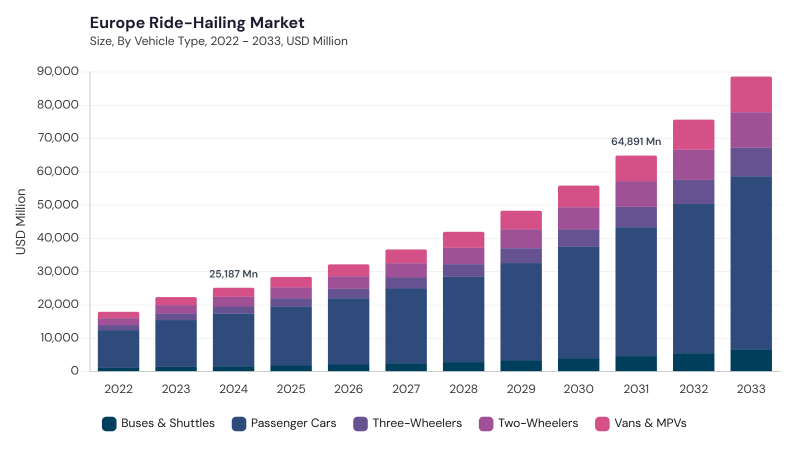
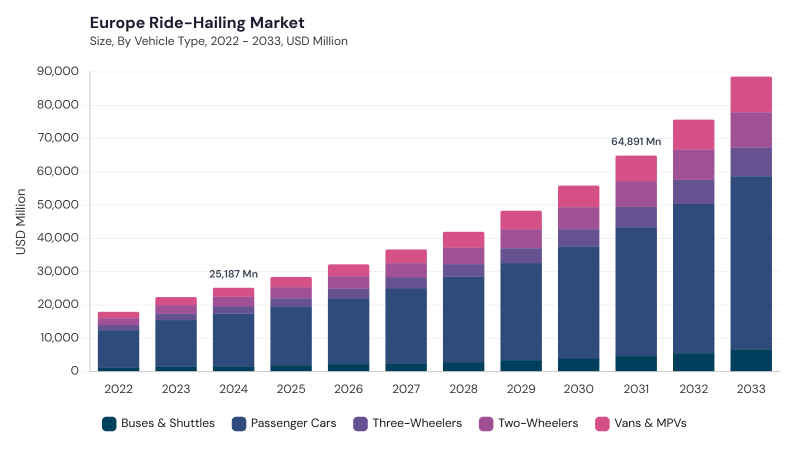
The Europe Ride-Hailing Market is expected to reach USD 64.9 billion by 2031, growing at a CAGR of 15.6% during (2026 – 2033).
The Europe Ride-Hailing Market originated from the rise of app-based urban mobility services that connected passengers with drivers through smartphones, GPS tracking, and digital payments. Early adoption was shaped by demand for convenient alternatives to traditional taxis, especially across major European cities. Over time, real-time booking, fare transparency, driver-rider matching, and mobile payment systems improved service reliability and user confidence. Regulatory developments gradually shaped licensing, safety, labor, and operational requirements across different countries. Today, the market reflects a mature and highly regulated mobility ecosystem where ride-hailing, taxis, car-sharing, electrified fleets, and multimodal transport services increasingly overlap.
The current Europe Ride-Hailing Market is shaped by fleet electrification, stricter emission rules, AI-based routing, platform diversification, and growing integration with public transport and micromobility. Operators are investing in electric and hybrid vehicles to meet low-emission zone requirements and consumer preference for sustainable travel. Digital platforms are using data analytics, dynamic pricing, real-time demand forecasting, and app personalization to improve service efficiency. Partnerships with automakers, local authorities, and mobility providers are strengthening ecosystem-based services. These trends are shifting ride-hailing from a standalone service toward a broader mobility-as-a-service model across Europe.
Based on Booking Channel, the market is segmented into App-Based and Voice / Phone. The App-Based market dominated the Europe Ride-Hailing Market by Booking Channel in 2025, and would continue to be a dominant market till 2033; thereby, achieving a market value of USD 55.2 billion by 2031, growing at a CAGR of 15.3 % during the forecast period. The Voice / Phone market is expected to witness a CAGR of 17% during (2026 - 2033).
App-based booking leads due to high smartphone penetration, digital payment adoption, real-time trip tracking, fare transparency, and growing preference for convenient on-demand mobility. It also supports multimodal journey planning, loyalty programs, sustainability-focused ride options, and personalized user experiences. Voice and phone booking remains relevant for elderly passengers, tourists, corporate dispatch services, and areas where traditional taxi booking habits continue. This channel supports accessibility but remains smaller as digital platforms dominate urban ride requests.
Based on Propulsion Type, the market is segmented into ICE, Battery-Electric, Hybrid, and CNG/LPG. The ICE market dominated the Europe Ride-Hailing Market by Propulsion Type in 2025, and would continue to be a dominant market till 2033; thereby, achieving a market value of USD 45.0 billion by 2031, growing at a CAGR of 15.2 % during the forecast period. The Battery-Electric market is expected to witness a CAGR of 16% during (2026 - 2033). The CNG / LPG market is expected to witness a CAGR of 16.8% during (2026 - 2033).
ICE vehicles lead due to their established availability, mature fueling infrastructure, lower upfront vehicle cost, and continued use in cities where fleet transition is gradual. Battery-electric vehicles are gaining strong momentum as European governments promote low-emission mobility, charging infrastructure, and environmental compliance. Hybrid vehicles remain attractive for drivers needing lower fuel consumption and operational flexibility across urban and regional routes. CNG/LPG vehicles maintain a smaller role, mainly in countries with supportive alternative fuel infrastructure and policy backing.
Based on End User, the market is segmented into Personal and Corporate / Institutional. The Personal market dominated the Europe Ride-Hailing Market by End User in 2025, and would continue to be a dominant market till 2033; thereby, achieving a market value of USD 40.9 billion by 2031, growing at a CAGR of 15.1 % during the forecast period. The Corporate / Institutional market is expected to witness a CAGR of 16.3% during (2026 - 2033).
Personal users lead due to urbanization, reduced dependence on private vehicle ownership, commuter demand, leisure travel, airport transfers, and increasing use of digital mobility platforms. This segment is strongly influenced by convenience, app usability, contactless payments, safety tools, and access to low-emission ride options. Corporate and institutional users are expanding as businesses use ride-hailing for employee mobility, client transport, business travel, and managed travel programs. Sustainability targets, centralized billing, reporting tools, and integration with corporate travel systems are supporting adoption in this segment.
Based on Vehicle Type, the market is segmented into Passenger Cars, Two-Wheelers, Vans & MPVs, Three-Wheelers, and Buses & Shuttles. Passenger cars lead due to their suitability for individual rides, business travel, airport transfers, urban mobility, and small-group transport across European cities. Their role is strengthened by broad fleet availability and compatibility with app-based mobility platforms.
Two-wheelers are gaining adoption in congested cities where compact, faster, and lower-cost mobility is preferred. Vans and MPVs support shared rides, family travel, tourism, airport transfers, and corporate mobility, while three-wheelers remain niche and buses and shuttles serve organized commuter, airport, and institutional mobility needs.
Based on Service Type, the market is segmented into E-Hailing, Car-Sharing / Peer-to-Peer, Subscription-Based Ride Packages, and Robo-Taxi. E-hailing leads due to mature digital mobility platforms, real-time booking, ride tracking, cashless payments, dynamic pricing, and strong consumer familiarity. Car-sharing and peer-to-peer services are expanding as users seek flexible vehicle access without ownership and cities promote shared mobility.
Subscription-based ride packages are gaining attention among frequent commuters who prefer predictable transport costs and bundled mobility benefits. Robo-taxi services remain emerging, supported by pilot deployments, autonomous vehicle research, smart city initiatives, and gradual regulatory acceptance.
Free Valuable Insights: The Worldwide Ride-Hailing Market is projected to reach USD 375.7 Billion billion by 2033, at a CAGR of 16.0%
Based on Country, the market is segmented into Germany, UK, France, Russia, Spain, Italy, and Rest of Europe. The UK market dominated the Europe Ride-Hailing Market by Country in 2025, and would continue to be a dominant market till 2033; thereby, achieving a market value of USD 12.7 billion by 2031, growing at a CAGR of 13.9 % during the forecast period. The Germany market is expected to witness a CAGR of 14.4% during (2026 - 2033). Additionally, The France market is expected to witness a CAGR of 16.3% during (2026 - 2033).
Germany leads due to strong digital mobility adoption, strict transport regulations, EV integration, multimodal platforms, and growing alignment with green mobility goals. The UK supports growth through app-based ride access, fleet electrification, public transport integration, AI-enabled routing, and safety-focused regulation. France is driven by sustainable mobility policies, electric and hybrid fleet adoption, digital payments, and multimodal transport partnerships. Russia, Spain, and Italy contribute through localized platforms, regulatory adaptation, urban demand, and mobility service diversification, while Rest of Europe benefits from smaller-city expansion and integrated shared mobility models.

By Booking Channel
By Propulsion Type
By End User
By Vehicle Type
By Service Type
By Country
Set to reach $64.9 Billion by 2031, growing at 15.6% CAGR during 2026-2033.
The UK leads with $12.7 billion by 2031, growing at 13.9% CAGR during the forecast period.
App-Based booking channels will reach $55.2 billion by 2031, growing at a 15.3% CAGR.
ICE propulsion will reach $45.0 billion by 2031, growing at a 15.2% CAGR.
The France market is expected to witness a CAGR of 16.3% during 2026-2033.
The Voice/Phone market is expected to witness a CAGR of 17% during 2026-2033.
Our team of dedicated experts can provide you with attractive expansion opportunities for your business.




 Unique Offerings