The sample copy of this report is available for access.
“Global Radio Frequency Identification Chips Market to reach a market value of USD 27161.77 Million by 2033 growing at a CAGR of 12.5%”
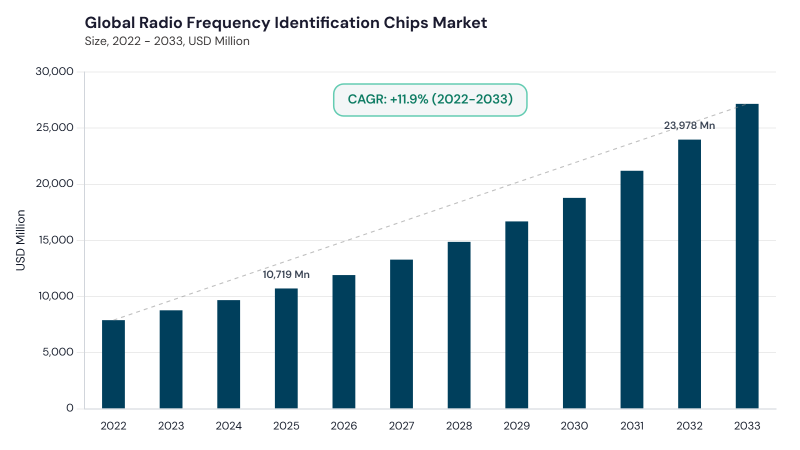
The Global Radio Frequency Identification Chips Market is expected to reach USD 27,161.8 million by 2033, growing at a CAGR of 12.5% during 2026 - 2033.
The Global Radio Frequency Identification Chips Market is witnessing steady growth, driven by rising demand for supply chain visibility, asset tracking, retail inventory automation, healthcare traceability, contactless identification, and industrial digitalization. The market originated from early military and industrial identification technologies, where radar-based recognition systems laid the foundation for wireless object identification. Over time, improvements in semiconductor fabrication, antenna design, chip miniaturization, security features, and communication protocols transformed RFID chips from bulky and expensive tracking components into compact, cost-efficient, and application-specific identification solutions. Presently, the market is shaped by passive RFID expansion, ultra-high frequency adoption, secure data exchange, IoT integration, smart supply chain systems, chip miniaturization, and growing use of RFID chips across retail, logistics, healthcare, manufacturing, transportation, and connected infrastructure applications.
The Radio Frequency Identification Chips Market is expanding as organizations across retail, logistics, healthcare, manufacturing, transportation, and industrial sectors increasingly prioritize automated identification and real-time asset visibility. RFID chips enable contactless data capture, inventory accuracy, product authentication, supply chain traceability, and operational efficiency without requiring line-of-sight scanning. The market is also benefiting from the growing integration of RFID with IoT platforms, cloud analytics, artificial intelligence, and blockchain-enabled traceability systems, which transform RFID chips from simple identification components into data-generating assets within connected digital ecosystems. At the same time, rising privacy concerns and data security requirements are encouraging vendors to improve encryption, authentication, and secure communication capabilities.
The Radio Frequency Identification Chips Market is characterized by a moderately consolidated and semiconductor-driven competitive environment consisting of RFID integrated circuit manufacturers, NFC chip suppliers, secure identification technology providers, IoT semiconductor companies, tag and inlay providers, and specialized tracking solution vendors. Competition is centered on chip miniaturization, read accuracy, read range, frequency compatibility, energy efficiency, security functionality, interoperability, production scalability, cost optimization, and application-specific customization. Leading vendors compete through strong semiconductor portfolios, standards participation, secure identification expertise, global manufacturing partnerships, and integrated IoT ecosystems, while specialized players compete through niche RFID designs, regional support, vertical-focused solutions, and cost-efficient chip architectures.

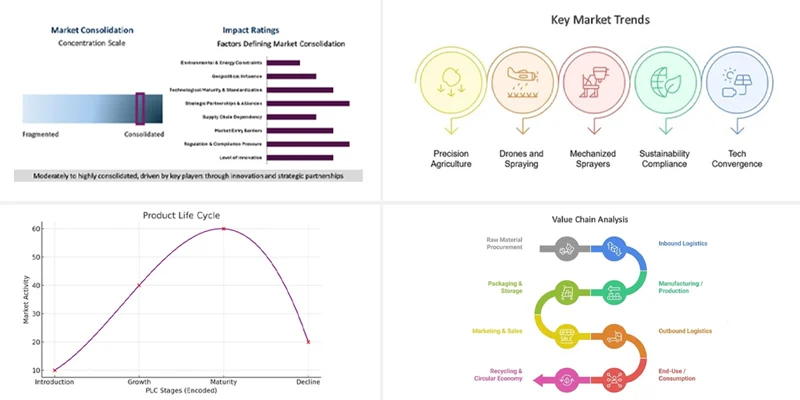


The Radio Frequency Identification Chips Market exhibits a relatively concentrated and semiconductor-driven competitive structure, with established RFID, NFC, and secure identification technology vendors holding strong positions. NXP Semiconductors leads the market, supported by its strong position in NFC and RFID integrated circuits, broad deployment across contactless payments, secure identification, automotive, access control, and connected device applications. Impinj maintains a strong position as a specialized RFID semiconductor provider with a robust RAIN RFID ecosystem and broad adoption across retail, logistics, inventory tracking, and industrial asset monitoring. STMicroelectronics, Infineon Technologies, and Texas Instruments also represent major participants, supported by secure microcontrollers, NFC solutions, authentication technologies, embedded systems, and industrial semiconductor capabilities. Other key companies include EM Microelectronic-Marin, Murata Manufacturing, Avery Dennison, Identiv, and Alien Technology. Competition increasingly revolves around miniaturization, security enhancements, energy efficiency, IoT integration, manufacturing scale, interoperability, standards compliance, and the ability to support high-volume RFID deployments across global industries.
Based on Resolution, the market is segmented into Passive RFID Chips, Active RFID Chips, and Semi-Passive RFID Chips. The Passive RFID Chips market dominated the Global Radio Frequency Identification Chips Market by Resolution in 2025, and would continue to be a dominant market till 2033; thereby, achieving a market value of USD 20516.5 million by 2033, growing at a CAGR of 12.1 % during the forecast period. The Active RFID Chips market is expected to witness a CAGR of 13.3% during (2026 - 2033). Additionally, The Semi-Passive RFID Chips market is expected to witness highest CAGR of 14.5% during (2026 - 2033).
Passive RFID chips are preferred for high-volume tagging environments where affordability, durability, and easy integration are essential. Active RFID chips support mission-critical tracking across large facilities, warehouses, ports, airports, mines, factories, hospitals, defense sites, and transportation networks. Semi-passive RFID chips bridge the performance gap between passive and active technologies by supporting monitoring applications in cold chain logistics, pharmaceuticals, food safety, healthcare shipments, smart packaging, and high-value cargo tracking. The technology landscape reflects rising demand for scalable, secure, and application-specific RFID chip solutions.
Based on Frequency Band, the market is segmented into Ultra-High Frequency, High Frequency, and Low Frequency. The Ultra-High Frequency (300 MHz to 3 GHz) market dominated the Global Radio Frequency Identification Chips Market by Frequency Band in 2025, and would continue to be a dominant market till 2033; thereby, achieving a market value of USD 16798.1 million by 2033, growing at a CAGR of 12.1 % during the forecast period. The High Frequency (3 MHz to 30 MHz) market is expected to witness a CAGR of 13.1% during (2026 - 2033). Additionally, The Low Frequency (30 kHz to 300 kHz) market is expected to witness highest CAGR of 13.5% during (2026 - 2033).
Ultra-high frequency RFID chips are essential for high-volume tracking where speed, range, and inventory visibility are important. High frequency RFID chips support secure and controlled identification environments that require moderate read range, data integrity, and interoperability with NFC-enabled systems. Low frequency RFID chips serve specialized use cases where rugged performance and interference resistance matter more than long read range or high data transfer speed. Across frequency bands, improvements in antenna design, chip sensitivity, signal reliability, and security features continue to strengthen adoption.
Based on Application, the market is segmented into Retail and Consumer Goods, Logistics and Supply Chain, Healthcare, Manufacturing, Transportation, and Other Application. The Retail & Consumer Goods market dominated the Global Radio Frequency Identification Chips Market by Application in 2025, and would continue to be a dominant market till 2033; thereby, achieving a market value of USD 9366.6 million by 2033, growing at a CAGR of 11.7 % during the forecast period. The Logistics & Supply Chain market is expected to witness a CAGR of 12% during (2026 - 2033). Additionally, The Healthcare market is expected to witness highest CAGR of 13% during (2026 - 2033).
Retailers use RFID chips to improve stock accuracy, replenish products faster, reduce manual scanning, and support connected store operations. Logistics operators rely on RFID-enabled tracking to reduce shipment errors, improve warehouse productivity, and strengthen supply chain visibility. Healthcare providers use RFID chips to improve patient safety, monitor medical equipment, and support traceability requirements. Manufacturers integrate RFID into production workflows to improve process visibility and reduce downtime. Transportation operators use RFID chips to improve mobility management, automated identification, and operational control across vehicle and passenger systems.
Free Valuable Insights: Radio Frequency Identification Chips Market Size to reach $27,161.8 Million by 2033
Region-wise, the Radio Frequency Identification Chips Market is analyzed across North America, Europe, Asia Pacific, and LAMEA. The Asia Pacific market dominated the Global Radio Frequency Identification Chips Market by Region in 2025, and would continue to be a dominant market till 2033; thereby, achieving a market value of USD 11263.8 million by 2033, growing at a CAGR of 12.9 % during the forecast period.The North America market is expected to witness a CAGR of 11.7% during (2026 - 2033). Additionally, The Europe market is expected to witness a CAGR of 12.3% during (2026 - 2033).
Asia Pacific benefits from manufacturing scale, rapid adoption of warehouse automation, smart retail, connected logistics, and electronics supply chain strength. North America is shaped by advanced retail inventory systems, healthcare modernization, logistics transparency, and industrial automation. Europe benefits from strong compliance-focused traceability, secure identification systems, and smart factory development. LAMEA continues to grow as public and private organizations increasingly adopt RFID systems for transportation, logistics, access control, and asset tracking.
Radio Frequency Identification Chips Market Coverage:
| Report Attribute | Details |
|---|---|
| Market size value in forecast opening year | USD 11,912.7 Million |
| Market size forecast in forecast closing year | USD 27,161.8 Million |
| Base Year | 2025 |
| Historical Period | 2022 to 2024 |
| Forecast Period | 2026 to 2033 |
| Revenue Growth Rate | CAGR of 12.5% from 2026 to 2033 |
| Number of Pages | 558 |
| Tables | 690 |
| Report Coverage | Market Trends, Revenue Estimation and Forecast, Segmentation Analysis, Regional and Country Breakdown, Competitive Landscape, Market Share Analysis, Company Profiling, Companies Strategic Developments, SWOT Analysis, Product Life Cycle Analysis, Value Chain Analysis, Market Consolidation Analysis, Key Customer Criteria, Pandemic Impact Analysis, and Winning Imperatives |
| Segments Covered | Technology, Frequency Band, Application, Region |
| Country Scope |
|
| Companies Included | NXP Semiconductors, Impinj, STMicroelectronics, Infineon Technologies, Texas Instruments, EM Microelectronic-Marin, Murata Manufacturing, Avery Dennison, Identiv, and Alien Technology |
By Resolution
By Frequency Band
By Application
By Geography
Expected to reach USD 27,161.8 Million by 2033, growing at 12.5% CAGR during 2026-2033.
Retail & Consumer Goods segment leads, growing at 11.7% CAGR during 2026-2033.
NXP Semiconductors, Impinj, STMicroelectronics, Infineon Technologies, and Texas Instruments dominate the market.
Asia Pacific leads, achieving USD 11,263.8 Million by 2033, growing at 12.9% CAGR during 2026-2033.
Demand for enhanced supply chain visibility and advancements in RFID chip capabilities drive growth.
Asia Pacific's strong manufacturing ecosystem and smart retail initiatives bolster its market dominance.
Our team of dedicated experts can provide you with attractive expansion opportunities for your business.








 Unique Offerings