The sample copy of this report is available for access.
The Europe Radio Frequency Identification Chips Market is expected to reach USD 5,298.36 Million by 2031, growing at a CAGR of 12.3% during 2026 - 2033.
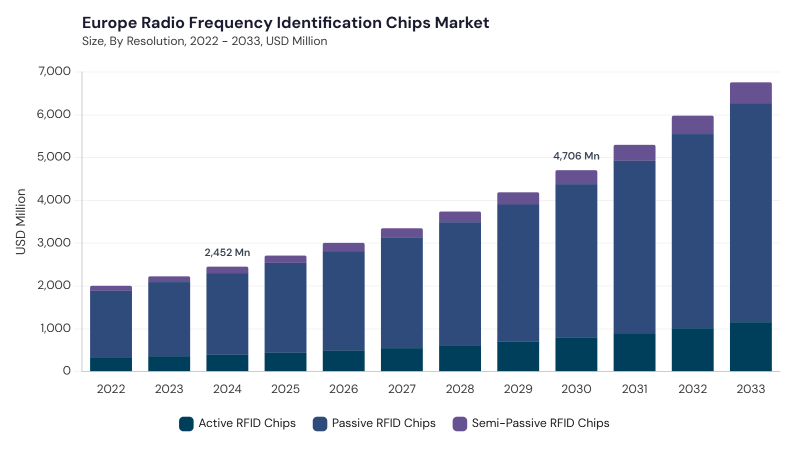
The Europe Radio Frequency Identification Chips Market is witnessing steady growth, supported by supply chain modernization, retail automation, industrial traceability, healthcare compliance, transport digitization, smart logistics, and the region’s strong focus on product visibility, sustainability, and regulatory transparency.
Germany holds a major position in the Europe Radio Frequency Identification Chips Market, supported by advanced manufacturing, automotive supply chains, Industry 4.0 adoption, healthcare traceability, and strong regulatory alignment. The UK, France, Russia, Spain, and Italy are also witnessing growing adoption through smart manufacturing, retail automation, logistics digitization, healthcare asset management, transportation systems, anti-counterfeiting solutions, and IoT-enabled asset tracking.
The Europe Radio Frequency Identification Chips Market has evolved significantly since its inception, originating from early developments in wireless identification technologies in the latter part of the twentieth century. Initially, RFID systems were primarily experimental and limited to military and niche industrial applications due to high costs and technological constraints. Over time, advancements in semiconductor miniaturization, signal processing, and data encoding expanded their commercial and logistical use across Europe. The transition from low-frequency RFID systems to ultra-high-frequency chips improved read range, data transmission, and adoption across supply chain management, retail, healthcare, manufacturing, and transportation.
The current market is shaped by integration with IoT, Industry 4.0 systems, AI, blockchain, contactless applications, and sustainability-focused identification solutions. European companies are increasingly using RFID chips for real-time asset tracking, automated inventory control, product authentication, healthcare compliance, smart packaging, and cross-border supply chain visibility. Regulatory frameworks supporting interoperability, data privacy, environmental responsibility, and product traceability are encouraging vendors to develop secure, energy-efficient, recyclable, and application-specific RFID chip solutions.
Based on resolution, the market is segmented into Passive RFID Chips, Active RFID Chips, and Semi-Passive RFID Chips. The Passive RFID Chips market dominated the Europe Radio Frequency Identification Chips Market by Resolution in 2025, and would continue to be a dominant market till 2033; thereby, achieving a market value of USD 4,033.27Million by 2031, growing at a CAGR of 11.9 % during the forecast period. The Active RFID Chips market is expected to witness a CAGR of 13.1% during (2026 - 2033). Additionally, The Semi-Passive RFID Chips market is expected to witness highest CAGR of 14.4% during (2026 - 2033).
Passive RFID Chips remain the primary category, supported by economical deployment, compact structure, broad usability, and suitability for item-level and asset-level identification across retail, logistics, healthcare, public transportation, libraries, automotive, and industrial operations. Active RFID Chips represent a significant segment for applications requiring extended detection range, continuous asset monitoring, container visibility, fleet supervision, smart facility management, and tracking of valuable equipment across manufacturing plants, logistics centers, ports, airports, hospitals, energy facilities, and public infrastructure. Semi-Passive RFID Chips serve more specialized requirements, particularly in temperature-sensitive logistics, pharmaceuticals, laboratory materials, food traceability, healthcare, industrial monitoring, smart packaging, and regulated goods where condition monitoring and enhanced read performance are important.
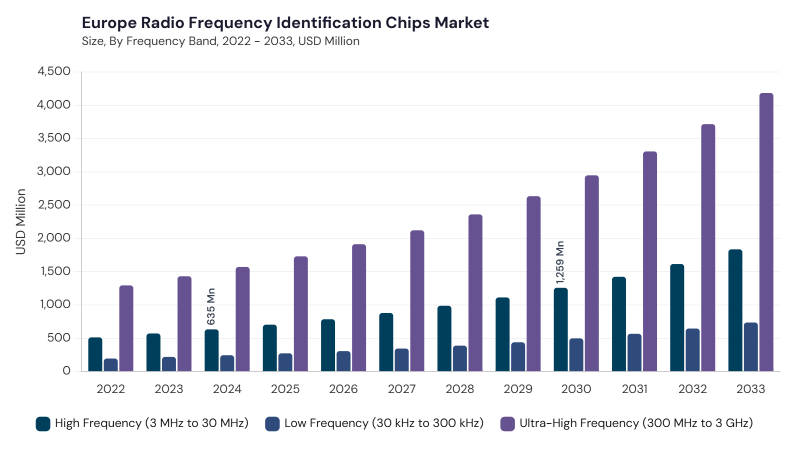
Based on frequency band, the market is segmented into Ultra-High Frequency, High Frequency, and Low Frequency. The Ultra-High Frequency (300 MHz to 3 GHz) market dominated the Europe Radio Frequency Identification Chips Market by Frequency Band in 2025, and would continue to be a dominant market till 2033; thereby, achieving a market value of USD 3,306.96 Million by 2031, growing at a CAGR of 11.8 % during the forecast period. The High Frequency (3 MHz to 30 MHz) market is expected to witness a CAGR of 12.9% during (2026 - 2033). Additionally, The Low Frequency (30 kHz to 300 kHz) market is expected to witness highest CAGR of 13.3% during (2026 - 2033).
Ultra-High Frequency RFID Chips form the dominant category, supported by rapid scanning, wider read coverage, longer read range, high data transmission, and strong adoption in retail distribution, warehouse automation, apparel tagging, logistics hubs, industrial automation, and cross-border supply chain operations. High Frequency RFID Chips hold a notable role in secure and controlled identification uses such as access systems, contactless cards, healthcare authentication, library management, product verification, ticketing, payment systems, and consumer-interaction applications. Low Frequency RFID Chips address focused use cases requiring dependable close-range performance, including livestock identification, industrial access, vehicle security, equipment tagging, animal tracking, industrial tool tracking, and environments where stable operation is preferred over scanning speed.
Based on application, the market is classified into Retail & Consumer Goods, Logistics & Supply Chain, Healthcare, Manufacturing, Transportation, and Other Application. Retail & Consumer Goods stands as the leading application area, driven by inventory precision, apparel tagging, store automation, omnichannel retailing, loss control, smart checkout, product authenticity, and improved product availability. Logistics & Supply Chain represents a strong demand area, supported by shipment traceability, pallet identification, warehouse visibility, dock operations, reusable container tracking, freight management, customs control, and distribution efficiency across regional trade networks. Healthcare, Manufacturing, and Transportation contribute consistent adoption through medical asset visibility, medicine traceability, patient wristbands, surgical instrument tracking, production monitoring, component identification, transit systems, fleet management, ticketing, toll collection, and cargo control, while Other Application includes government, education, libraries, events, agriculture, smart packaging, access control, security, waste management, and specialized asset-management uses.
Free Valuable Insights: The Worldwide Radio Frequency Identification Chips Market is projected to reach USD 27,161.8 Million billion by 2033, at a CAGR of 12.5%
Based on country, the market is segmented into Germany, UK, France, Russia, Spain, Italy, and Rest of Europe. Germany is a major market for RFID chips in Europe, supported by automotive manufacturing, industrial automation, IoT integration, logistics infrastructure, healthcare applications, and privacy-enhanced RFID adoption. The UK is witnessing growing use through smart manufacturing, retail, logistics, healthcare, IoT platforms, and scalable asset tracking solutions. France is advancing through supply chain transparency, healthcare traceability, food safety, retail automation, anti-counterfeiting, and IoT-enabled RFID systems. Russia is supported by logistics modernization, transportation, retail, manufacturing, defense logistics, localization of production, and secure identification systems. Spain is expanding through e-commerce, omnichannel retail, smart packaging, healthcare, logistics, and Industry 4.0 applications, while Italy is growing through smart packaging, inventory automation, automotive, healthcare, anti-counterfeiting, and sustainability-focused RFID deployments.

By Resolution
By Frequency Band
By Application
By Country
Set to reach $5,298.36 Million by 2031, growing at 12.3% CAGR during 2026-2033.
The Passive RFID Chips segment is set to reach $4,033.27 Million by 2031, growing at 11.9% CAGR during the forecast period.
Ultra-High Frequency segment to reach $3,306.96 Million by 2031, growing at 11.8% CAGR during the forecast period.
The Semi-Passive RFID Chips segment is expected to witness the highest CAGR of 14.4% during 2026-2033.
Active RFID Chips segment is expected to grow at a CAGR of 13.1% during 2026-2033.
Our team of dedicated experts can provide you with attractive expansion opportunities for your business.




 Unique Offerings