The sample copy of this report is available for access.
The LAMEA Radio Frequency Identification Chips Market is expected to reach USD 1,133.57 Million by 2029, growing at a CAGR of 14% during 2026 - 2033.
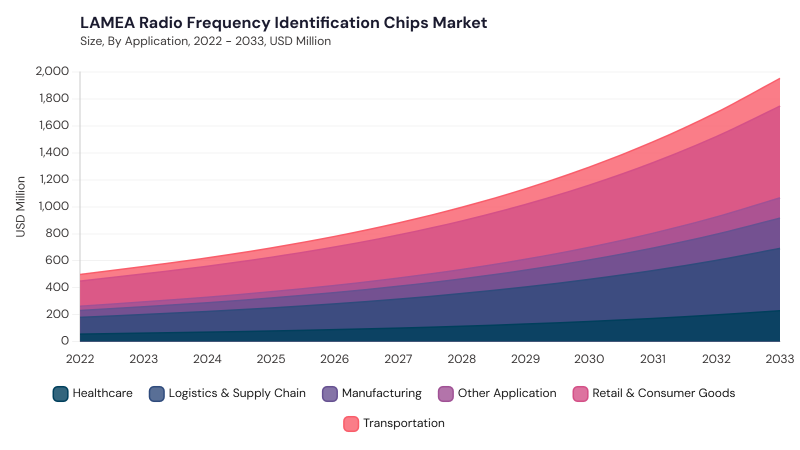
The LAMEA Radio Frequency Identification Chips Market is witnessing steady growth, supported by improving logistics infrastructure, expanding organized retail, port and cargo modernization, healthcare inventory control, industrial asset management, transport system upgrades, and the growing need for dependable identification across goods, equipment, vehicles, and institutional assets.
Brazil holds a major position in the LAMEA Radio Frequency Identification Chips Market, supported by growing adoption across agri-food traceability, retail inventory visibility, logistics, manufacturing, and industrial automation. The UAE and Saudi Arabia are also witnessing strong demand due to smart infrastructure, supply chain optimization, healthcare modernization, transportation systems, and government-led digital transformation initiatives, while South Africa, Argentina, and Nigeria are expanding through retail automation, agriculture, logistics, healthcare, asset tracking, and anti-counterfeiting applications.
The current market is shaped by the integration of RFID chips with IoT platforms, real-time asset monitoring systems, secure identification technologies, and regional digitalization initiatives. Businesses are increasingly using RFID chips for inventory accuracy, cargo tracking, product authentication, healthcare asset management, livestock monitoring, and transport visibility. Rising demand for anti-counterfeiting solutions, secure data transmission, scalable RFID deployments, and cost-effective chip production tailored to local market needs is encouraging vendors to develop durable, interoperable, and application-specific RFID chip solutions across Latin America, the Middle East, and Africa.
Based on resolution, the market is segmented into Passive RFID Chips, Active RFID Chips, and Semi-Passive RFID Chips. The Passive RFID Chips market dominated the LAMEA Radio Frequency Identification Chips Market by Resolution in 2025, and would continue to be a dominant market till 2033; thereby, achieving a market value of USD 877.06 Million by 2029, growing at a CAGR of 13.6 % during the forecast period. The Active RFID Chips market is expected to witness a CAGR of 14.8% during (2026 - 2033). Additionally, The Semi-Passive RFID Chips market is expected to witness highest CAGR of 16.8% during (2026 - 2033).
Passive RFID Chips represent the key category, supported by cost-efficient tagging, lightweight design, easy deployment, and wide use across retail products, warehouse inventory, healthcare items, agriculture, public infrastructure, and industrial assets. Active RFID Chips form a specialized category for applications requiring wider tracking coverage, ongoing asset visibility, fleet oversight, container movement control, and monitoring of valuable equipment in ports, mining sites, oil and gas facilities, hospitals, and logistics centers. Semi-Passive RFID Chips serve targeted requirements in temperature-controlled distribution, pharmaceutical movement, food monitoring, laboratory materials, sensitive cargo, healthcare shipments, and industrial equipment where condition sensing and stronger read consistency are important.
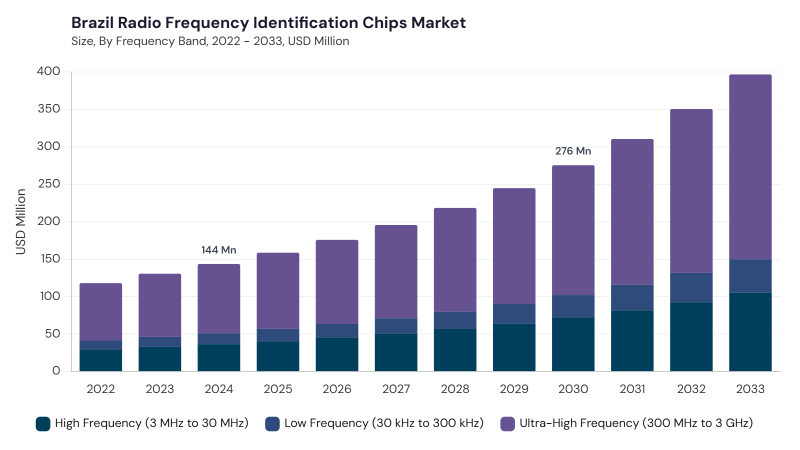
Based on frequency band, the market is segmented into Ultra-High Frequency, High Frequency, and Low Frequency. The Ultra-High Frequency (300 MHz to 3 GHz) market dominated the LAMEA Radio Frequency Identification Chips Market by Frequency Band in 2025, and would continue to be a dominant market till 2033; thereby, achieving a market value of USD 1220.5 Million by 2033, growing at a CAGR of 13.5 % during the forecast period. The High Frequency (3 MHz to 30 MHz) market is expected to witness a CAGR of 14.6% during (2026 - 2033). Additionally, The Low Frequency (30 kHz to 300 kHz) market is expected to witness highest CAGR of 15.4% during (2026 - 2033).
Ultra-High Frequency RFID Chips form the leading category, supported by extended read coverage, rapid tag capture, high data throughput, and strong suitability for retail distribution, warehouse operations, cargo handling, port logistics, supply chain visibility, vehicle tracking, and large-scale inventory management. High Frequency RFID Chips play an important role in secure and controlled identification uses such as access cards, healthcare verification, contactless systems, library management, product authentication, smart cards, ticketing, and institutional security. Low Frequency RFID Chips serve focused applications requiring stable close-distance identification, including livestock tagging, vehicle security, industrial entry, equipment marking, rugged operating environments, and agricultural tracking where reliability is valued over scanning speed.
Based on application, the market is classified into Retail & Consumer Goods, Logistics & Supply Chain, Healthcare, Manufacturing, Transportation, and Other Application. Retail & Consumer Goods represents the leading application area, supported by store inventory control, product tagging, stock visibility, shrink management, replenishment improvement, product authentication, and rising adoption among supermarkets, apparel retailers, and consumer goods distributors. Logistics & Supply Chain forms a strong demand area, driven by cargo tracking, shipment validation, warehouse visibility, port operations, returnable container monitoring, distribution efficiency, and cross-border trade routes. Healthcare, Manufacturing, and Transportation generate consistent demand through medical equipment tracking, medicine identification, patient identification, production monitoring, tool and component control, fleet systems, tolling, ticketing, baggage handling, and cargo supervision, while Other Application includes government, education, libraries, agriculture, livestock tracking, events, security, recreation, and specialized asset-control uses.
Free Valuable Insights: Radio Frequency Identification Chips Market Size Worth USD 27,161.8 Million billion by 2033
Based on country, the market is segmented into Brazil, Argentina, UAE, Saudi Arabia, South Africa, Nigeria, and Rest of LAMEA. Brazil is a major market for RFID chips in LAMEA, supported by agri-food traceability, retail inventory visibility, logistics, industrial automation, and localized RFID adoption. Argentina is witnessing growing use through agriculture, logistics, retail, healthcare, smart packaging, and secure asset tracking. The UAE is advancing through smart infrastructure, supply chain transparency, healthcare, retail, smart transportation, and AI-enabled RFID systems. Saudi Arabia is expanding through smart city projects, oil and gas asset management, healthcare, retail, transportation, and government-backed digital transformation. South Africa is supported by retail stock optimization, agriculture, livestock management, cold chain tracking, and supply chain transparency, while Nigeria is growing through customs, logistics, retail inventory, agriculture, healthcare, and anti-counterfeiting applications.

By Resolution
By Frequency Band
By Application
By Country
Set to reach $1,133.57 Million by 2029, growing at 14% CAGR during 2026-2033.
Passive RFID Chips will dominate, reaching $877.06 Million by 2029 at 13.6% CAGR during the forecast period.
Ultra-High Frequency segment will achieve $1220.5 Million by 2033, growing at 13.5% CAGR during the forecast period.
Low Frequency segment will witness the highest CAGR of 15.4% during 2026-2033.
Active RFID Chips are expected to grow at a CAGR of 14.8% during 2026-2033.
Our team of dedicated experts can provide you with attractive expansion opportunities for your business.




 Unique Offerings