The sample copy of this report is available for access.
The Asia Pacific Radio Frequency Identification Chips Market is expected to reach USD 7,708.50 Million by 2030, growing at a CAGR of 12.9% during 2026 - 2033.
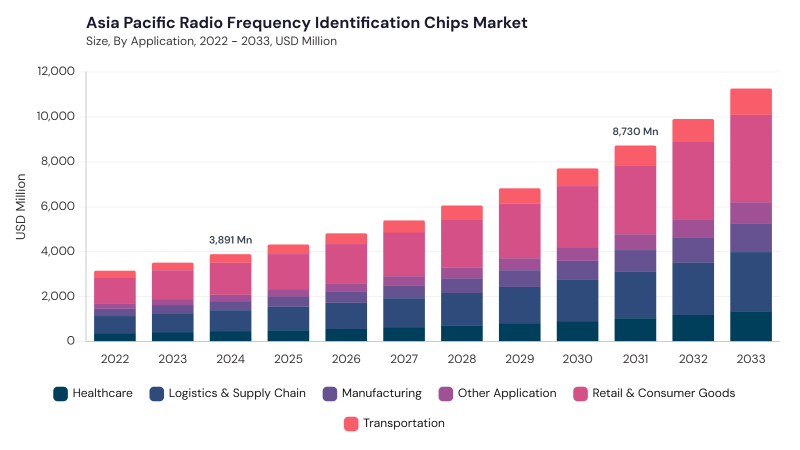
The Asia Pacific Radio Frequency Identification Chips Market is witnessing strong growth, supported by expanding retail networks, e-commerce fulfillment, smart manufacturing, logistics digitization, healthcare modernization, transport infrastructure upgrades, and the region’s growing need for efficient product identification, shipment visibility, and automated asset management.
The Asia Pacific Radio Frequency Identification Chips Market originated in the late twentieth century as a specialized segment within the broader RFID technology ecosystem, initially focused on logistics and asset tracking applications. Over time, advancements in semiconductor fabrication, miniaturization, antenna design, enhanced memory capacity, and security protocols improved chip performance, read range, data handling, and reliability. The transition from passive low-frequency chips to active and semi-passive high-frequency variants supported broader adoption across retail, manufacturing, healthcare, transportation, logistics, and smart infrastructure.
Based on resolution, the market is segmented into Passive RFID Chips, Active RFID Chips, and Semi-Passive RFID Chips. The Passive RFID Chips market dominated the Asia Pacific Radio Frequency Identification Chips Market by Resolution in 2025, and would continue to be a dominant market till 2033; thereby, achieving a market value of USD 5,884.60 Million by 2030, growing at a CAGR of 12.5 % during the forecast period. The Active RFID Chips market is expected to witness a CAGR of 13.7% during (2026 - 2033). Additionally, The Semi-Passive RFID Chips market is expected to witness highest CAGR of 15% during (2026 - 2033).
Passive RFID Chips occupy the principal category, supported by affordable implementation, small form factor, broad tagging suitability, and extensive use in retail merchandise, warehouse goods, medical supplies, industrial components, apparel, consumer electronics, and public transit applications. Active RFID Chips form a valuable category for broad-area detection, live asset supervision, vehicle tracking, container management, airport operations, port logistics, factory monitoring, hospital asset tracking, and high-value equipment management. Semi-Passive RFID Chips address selective requirements in cold chain distribution, pharmaceutical handling, food quality monitoring, laboratory tracking, electronics shipments, industrial monitoring, smart packaging, and sensitive goods movement where environmental sensing and improved signal reliability are required.
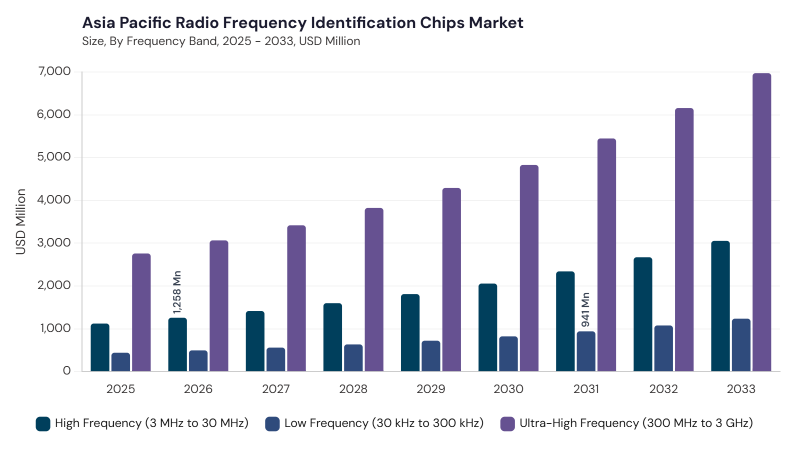
Based on frequency band, the market is segmented into Ultra-High Frequency, High Frequency, and Low Frequency. The Ultra-High Frequency (300 MHz to 3 GHz) market dominated the Asia Pacific Radio Frequency Identification Chips Market by Frequency Band in 2025, and would continue to be a dominant market till 2033; thereby, achieving a market value of USD 4,828.28 Million by 2030, growing at a CAGR of 12.5 % during the forecast period. The High Frequency (3 MHz to 30 MHz) market is expected to witness a CAGR of 13.5% during (2026 - 2033). Additionally, The Low Frequency (30 kHz to 300 kHz) market is expected to witness highest CAGR of 13.9% during (2026 - 2033).
Ultra-High Frequency RFID Chips represent the most established category, supported by broad read coverage, quick multi-item capture, longer read range, and strong suitability for retail distribution, e-commerce warehouses, manufacturing lines, cargo handling, smart factories, and regional supply chain networks. High Frequency RFID Chips maintain an important position in controlled and secure identification uses, including contactless access, smart cards, payment systems, healthcare verification, library systems, product authentication, public transit, and device-enabled consumer interactions. Low Frequency RFID Chips serve narrower applications that require robust close-distance identification, such as livestock tagging, vehicle security, industrial entry systems, equipment marking, automotive immobilizers, access control, and harsh operating conditions where consistency is prioritized over rapid scanning.
Based on application, the market is classified into Retail & Consumer Goods, Logistics & Supply Chain, Healthcare, Manufacturing, Transportation, and Other Application. Retail & Consumer Goods remains the foremost application area, supported by merchandise tagging, stock accuracy, store automation, omnichannel operations, shrink control, faster replenishment, automated checkout, and improved supply chain transparency across organized retail and online commerce channels. Logistics & Supply Chain represents a major demand base, driven by parcel tracking, warehouse automation, shipment validation, port operations, returnable container management, cold chain monitoring, and cross-border trade visibility. Healthcare, Manufacturing, and Transportation generate steady adoption through hospital equipment tracking, medicine identification, patient tracking, production flow monitoring, component traceability, fleet systems, ticketing, tolling, baggage handling, and cargo oversight, while Other Application includes government, education, libraries, agriculture, livestock tracking, events, security, recreation, access control, and specialized asset-control uses.
Free Valuable Insights: Radio Frequency Identification Chips Market is Predicted to reach USD 27,161.8 Million billion by 2033, at a CAGR of 12.5%
Based on country, the market is segmented into China, Japan, India, South Korea, Singapore, Malaysia, and Rest of Asia Pacific. China is a major market for RFID chips in Asia Pacific, supported by smart manufacturing, IoT infrastructure, retail digitization, pharmaceutical traceability, transportation applications, and government-led industrial modernization. Japan represents a mature market, driven by electronics manufacturing strength, retail automation, transportation systems, pet microchipping, anti-counterfeit requirements, and secure RFID deployments. India is witnessing growing adoption through logistics, retail, manufacturing, pharmaceuticals, food traceability, and IoT-enabled asset tracking. South Korea is supported by its strong electronics and semiconductor ecosystem, smart asset management, transportation systems, IoT integration, and public infrastructure adoption. Singapore is advancing through logistics, healthcare, smart warehouses, access control, and enterprise automation, while Malaysia is expanding through supply chain management, Industry 4.0 adoption, retail security, logistics, and manufacturing applications.

By Resolution
By Frequency Band
By Application
By Country
Set to reach $7,708.50 Million by 2030, growing at a CAGR of 12.9% during 2026-2033.
Passive RFID Chips will achieve $5,884.60 Million by 2030, growing at a CAGR of 12.5% during the forecast period.
Ultra-High Frequency segment will reach $4,828.28 Million by 2030, growing at a CAGR of 12.5% during the forecast period.
Active RFID Chips are expected to grow at a CAGR of 13.7% during 2026-2033.
The Semi-Passive RFID Chips market is expected to witness the highest CAGR of 15% during 2026-2033.
Our team of dedicated experts can provide you with attractive expansion opportunities for your business.




 Unique Offerings