The sample copy of this report is available for access.
The North America Radio Frequency Identification Chips Market is expected to reach USD 6,391.46 Million by 2032, growing at a CAGR of 11.7% during 2026 - 2033.
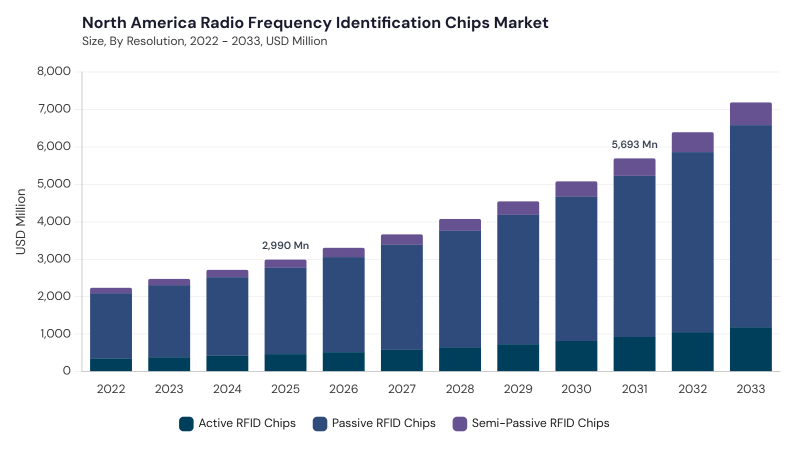
The North America Radio Frequency Identification Chips Market is witnessing steady growth, supported by the increasing use of RFID chips across retail inventory digitization, warehouse automation, supply chain visibility, healthcare tracking, manufacturing traceability, transportation monitoring, and enterprise asset connectivity.
The US market holds a major position in the North America Radio Frequency Identification Chips Market, supported by strong adoption across retail, logistics, healthcare, manufacturing, and consumer contactless solutions. Canada is also witnessing growing adoption due to demand from mining, forestry, healthcare logistics, and supply chain management, while Mexico is expanding through government identification, inventory management, hospitality, entertainment, and industrial tracking applications.
The market originated from early wireless identification technologies developed during the latter half of the twentieth century, with initial usage focused on logistics, inventory management, military, aviation, and asset tracking applications. Over time, semiconductor fabrication improvements enabled RFID chips to become smaller, more affordable, energy-efficient, and suitable for broader commercial deployment. The transition from bulky tracking tags to passive, active, and intelligent RFID chips helped expand adoption across retail, healthcare, logistics, manufacturing, agriculture, and transportation.
Based on resolution, the market is segmented into Passive RFID Chips, Active RFID Chips, and Semi-Passive RFID Chips. The Passive RFID Chips market dominated the North America Radio Frequency Identification Chips Market by Resolution in 2025, and would continue to be a dominant market till 2033; thereby, achieving a market value of USD 4,816.08 Million by 2032, growing at a CAGR of 11.4 % during the forecast period. The Active RFID Chips market is expected to witness a CAGR of 12.5% during (2026 - 2033). Additionally, The Semi-Passive RFID Chips market is expected to witness highest CAGR of 13.6% during (2026 - 2033).
Passive RFID Chips hold a leading position in the North America Radio Frequency Identification Chips Market due to their low cost, compact design, long life, and suitability for large-scale tagging across retail, logistics, healthcare, transportation, warehousing, and document tracking. Active RFID Chips are important for long-range tracking, fleet monitoring, hospital equipment tracking, defense facilities, airports, logistics hubs, and high-value industrial assets. Semi-Passive RFID Chips are gaining traction in cold chain monitoring, pharmaceutical logistics, food safety, smart packaging, laboratory samples, and industrial quality control where sensing and better read reliability are required.
Based on frequency band, the market is segmented into Ultra-High Frequency, High Frequency, and Low Frequency. The Ultra-High Frequency (300 MHz to 3 GHz) market dominated the North America Radio Frequency Identification Chips Market by Frequency Band in 2025, and would continue to be a dominant market till 2033; thereby, achieving a market value of USD 3,946.02 Million by 2032, growing at a CAGR of 11.3 % during the forecast period. The High Frequency (3 MHz to 30 MHz) market is expected to witness a CAGR of 12.3% during (2026 - 2033).
Ultra-High Frequency RFID Chips represent the foremost category, supported by longer read range, fast bulk scanning, multi-tag reading, and strong use in retail, warehousing, logistics, manufacturing, and supply chain operations. High Frequency RFID Chips are used for secure and close-range applications such as access control, smart cards, contactless payment systems, healthcare workflows, libraries, authentication, and product verification. Low Frequency RFID Chips serve applications that require stable short-range performance, including animal identification, industrial access, vehicle immobilization, proximity sensing, and rugged asset tagging.
Based on application, the market is classified into Retail & Consumer Goods, Logistics & Supply Chain, Healthcare, Manufacturing, Transportation, and Other Application. Retail & Consumer Goods leads the market, driven by item-level tagging, inventory accuracy, omnichannel fulfillment, shrink reduction, faster stock counting, and improved customer experience. Logistics & Supply Chain is strongly supported by pallet tracking, shipment verification, dock-door scanning, warehouse automation, reverse logistics, and supply chain transparency. Healthcare, Manufacturing, and Transportation contribute steady demand through asset tracking, medication monitoring, pharmaceutical authentication, production visibility, fleet tracking, tolling, ticketing, and cargo monitoring, while Other Application includes agriculture, livestock management, smart packaging, education, libraries, government, events, and niche asset-tracking uses.
Free Valuable Insights: The Global Radio Frequency Identification Chips Market will hit USD 27,161.8 Million billion by 2033, at a CAGR of 12.5%
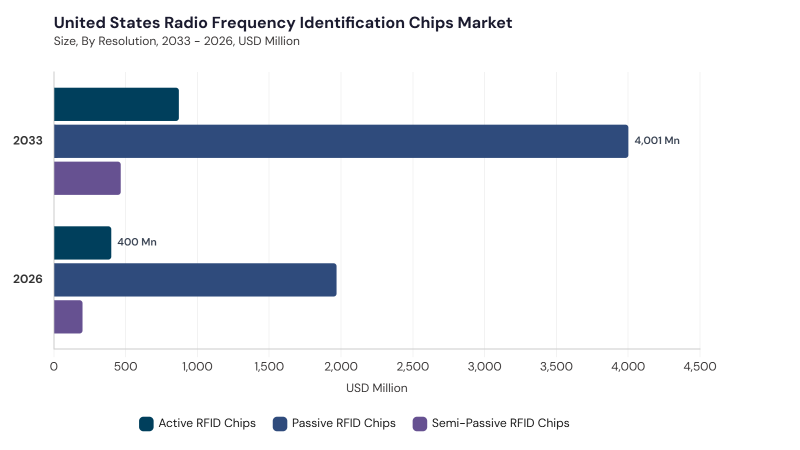
The US Radio Frequency Identification Chips Market is the most advanced market in the region, supported by early adoption in military, aviation, logistics, retail, healthcare, and industrial automation. The market evolved with the adoption of ultra-high-frequency RFID chips, passive RFID systems, chipless RFID technologies, and IoT integration. Current trends in the US focus on printable RFID, edge computing, sustainability, eco-friendly materials, contactless consumer systems, and secure authentication. Canada is expanding through intelligent RFID adoption in supply chain management, mining, forestry, healthcare logistics, and industrial automation, while Mexico is growing through RFID-enabled government identification, blockchain-based traceability, smart devices, hospitality, entertainment, and regulatory-driven tagging applications.

By Resolution
By Frequency Band
By Application
By Country
Set to reach $6,391.46 Million by 2032, growing at 11.7% CAGR during 2026-2033.
Passive RFID Chips will achieve $4,816.08 Million by 2032, growing at 11.4% CAGR during the forecast period.
Ultra-High Frequency will reach $3,946.02 Million by 2032, growing at 11.3% CAGR during the forecast period.
Active RFID Chips are expected to grow at 12.5% CAGR during 2026-2033.
Semi-Passive RFID Chips will witness the highest growth at 13.6% CAGR during 2026-2033.
Our team of dedicated experts can provide you with attractive expansion opportunities for your business.




 Unique Offerings