The sample copy of this report is available for access.
The North America Virtual Goods Market is expected to reach USD 72.0 billion by 2032, growing at a CAGR of 9.3% during (2026 - 2033).
The North America Virtual Goods Market originated from the early growth of digital entertainment and interactive media, where virtual goods first appeared as simple add-ons in online games and social platforms. Initial adoption centered on digital upgrades, cosmetic enhancements, and basic in-game assets, while improvements in internet infrastructure, mobile access, digital payments, immersive technologies, blockchain, and NFT-related ownership models expanded the market beyond gaming. The market has since developed into a broader digital economy covering gaming, metaverse platforms, virtual events, social commerce, personalization, digital ownership, and secondary trading ecosystems.
Current market growth is shaped by customization, AR and VR integration, blockchain-enabled ownership, metaverse platforms, and social digital identities. Consumers are increasingly using virtual goods for self-expression, avatar personalization, community status, and interactive digital experiences. Secure ownership protocols, AI-driven personalization, cross-platform compatibility, digital collectibles, and play-to-earn or decentralized marketplace models are also influencing how platforms monetize engagement and build stronger virtual economies.
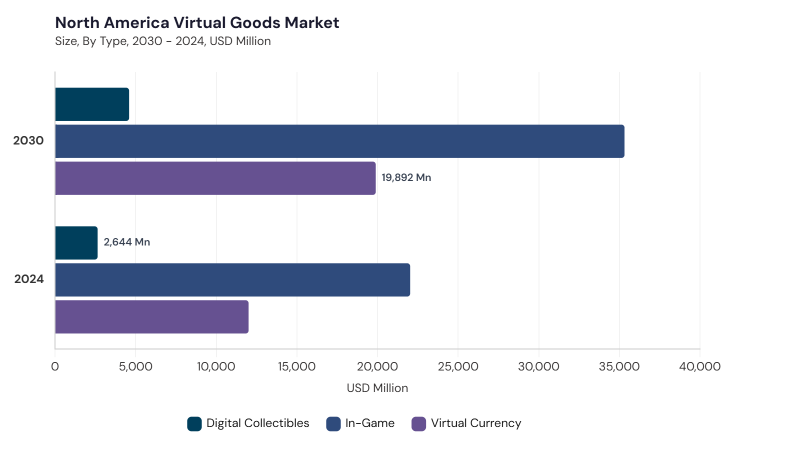
Based on Type, the market is segmented into In-Game, Virtual Currency, and Digital Collectibles. The In-Game market dominated the North America Virtual Goods Market by Type in 2025, and would continue to be a dominant market till 2033; thereby, achieving a market value of USD 42.2 billion by 2032, growing at a CAGR of 8.9 % during the forecast period. The Virtual Currency market is expected to witness a CAGR of 9.6% during (2026 - 2033). The Digital Collectibles market is expected to witness a CAGR of 10.4% during (2026 - 2033).
In-Game virtual goods remain central as players purchase skins, outfits, weapons, power-ups, event-based items, and other enhancements that improve personalization, engagement, and identity expression across gaming platforms. Virtual Currency maintains a considerable role as users purchase platform-specific coins, tokens, or credits to unlock premium content, complete in-app transactions, and participate in digital economies. Digital Collectibles hold a promising position through scarce or distinctive assets such as digital art, avatars, trading cards, gaming memorabilia, NFT-linked items, and collectibles tied to entertainment communities, ownership verification, and online identities.
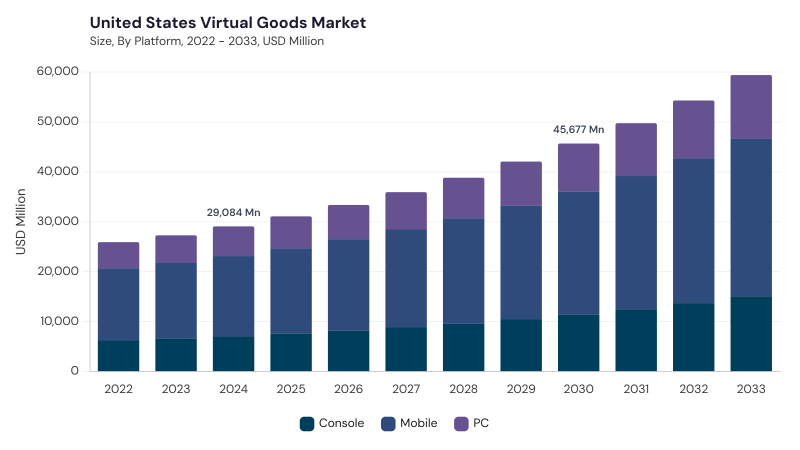
Based on Platform, the market is segmented into Mobile, Console, and PC. Mobile platforms remain highly important because casual gaming, social apps, mobile payments, short-session engagement, AI-based offers, and free-to-play models support frequent purchases of virtual currencies, cosmetic items, access enhancements, social filters, and event tokens.
Console platforms maintain a considerable share through premium franchises, downloadable content, expansion packs, exclusive branded items, subscription bundles, season-based content, and connected multiplayer ecosystems. PC platforms hold a promising position through highly engaged gaming communities, digital distribution platforms, user-generated content, modding ecosystems, virtual events, NFTs, esports, live streaming influence, and customizable virtual assets.
Free Valuable Insights: The Global Virtual Goods Market will hit USD 217.5 Billion billion by 2033, at a CAGR of 9.8%
Based on Country, the market is segmented into US, Canada, Mexico, and Rest of North America. The US market dominated the North America Virtual Goods Market by Country in 2025, and would continue to be a dominant market till 2033; thereby, achieving a market value of USD 54.2 billion by 2032, growing at a CAGR of 8.6 % during the forecast period. The Canada market is expected to witness a CAGR of 12.1% during (2026 - 2033). Additionally, The Mexico market is expected to witness a CAGR of 10.9% during (2026 - 2033).
The US is shaped by online gaming, social media platforms, blockchain and NFT ownership, metaverse expansion, digital asset tokenization, and immersive virtual goods ecosystems, while Canada reflects multiplayer gaming, mobile gaming, secure payments, blockchain integration, gamified social environments, and compliance-led digital asset adoption. Mexico is driven by mobile technology, broadband expansion, blockchain-enabled asset verification, AI personalization, regulatory adaptation, and localized virtual goods offerings, whereas Rest of North America is supported by smartphone penetration, mobile gaming, social networking apps, blockchain-enabled virtual assets, metaverse environments, personalization, and user-generated content.

By Type
By Platform
By Country
Set to reach $72.0 Billion by 2032, growing at 9.3% CAGR during 2026-2033.
The US leads with $54.2 billion by 2032, growing at 8.6% CAGR during the forecast period.
In-Game segment dominates, reaching $42.2 billion by 2032, growing at 8.9% CAGR during 2026-2033.
Canada is expected to witness a CAGR of 12.1% during 2026-2033.
The Digital Collectibles market is expected to witness a CAGR of 10.4% during 2026-2033.
Our team of dedicated experts can provide you with attractive expansion opportunities for your business.




 Unique Offerings
