The sample copy of this report is available for access.
The LAMEA Virtual Goods Market is expected to reach USD 9.1 billion by 2029, growing at a CAGR of 11.5% during (2026 - 2033).
The LAMEA Virtual Goods Market originated as digital economies expanded across Latin America, the Middle East, and Africa, supported by rising internet penetration and smartphone adoption. Early activity centered on in-game items and digital collectibles within regional gaming platforms, while improvements in mobile connectivity, digital payments, localized marketplaces, and secure transaction systems gradually widened adoption beyond entertainment. The market has since evolved into a more structured digital ecosystem covering gaming, social engagement, e-commerce-linked experiences, digital expression, and emerging virtual ownership models.
Current market growth is shaped by localized content, mobile-first consumption, blockchain-enabled ownership, alternative digital payments, and culturally relevant virtual assets. Providers are designing goods around regional customs, languages, entertainment preferences, and payment realities, while mobile gaming and smartphone access are broadening participation across diverse consumer groups. Blockchain, decentralized trading, AR-enabled experiences, metaverse integration, and cross-platform interoperability are also strengthening the role of virtual goods as tradable, personalized, and socially meaningful digital assets.
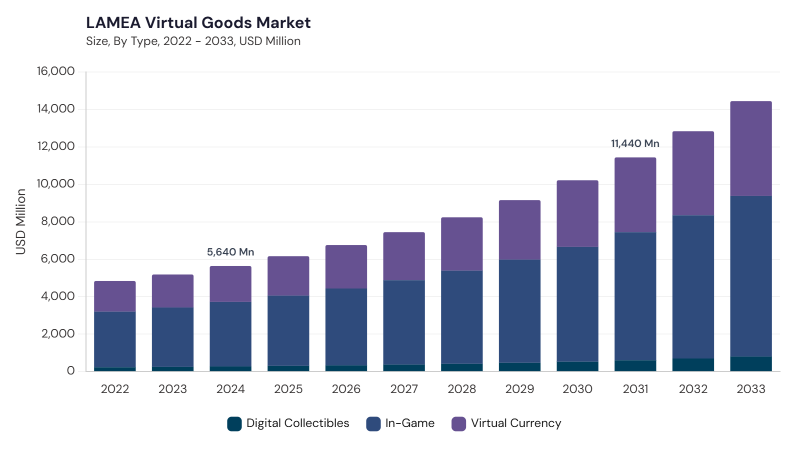
Based on Type, the market is segmented into In-Game, Virtual Currency, and Digital Collectibles. The In-Game market dominated the LAMEA Virtual Goods Market by Type in 2025, and would continue to be a dominant market till 2033; thereby, achieving a market value of USD 5.5 billion by 2029, growing at a CAGR of 11.1 % during the forecast period. The Virtual Currency market is expected to witness a CAGR of 11.8% during (2026 - 2033). The Digital Collectibles market is expected to witness a CAGR of 13.4% during (2026 - 2033).
In-Game virtual goods remain central as players purchase skins, weapons, avatars, upgrades, enhancements, limited-time items, and personalization features across mobile, PC, and online gaming environments. Virtual Currency maintains a considerable role as game-specific credits, tokens, and platform coins simplify purchases, unlock premium features, support bundled sales, and encourage recurring microtransactions. Digital Collectibles hold a promising position through limited-edition digital assets, virtual trading cards, NFT-linked items, artwork, entertainment-linked assets, and community-oriented collectibles supported by blockchain-based provenance and secondary trading potential.
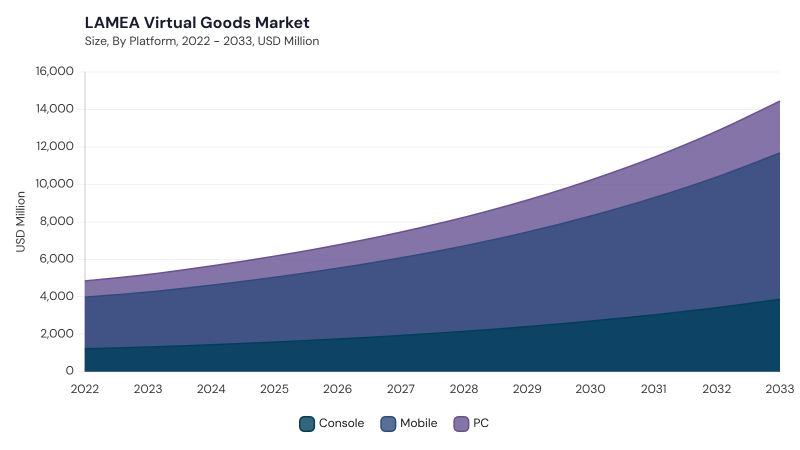
Based on Platform, the market is segmented into Mobile, Console, and PC. Mobile platforms remain the primary channel for virtual goods consumption due to smartphone adoption, mobile gaming, social applications, free-to-play models, digital wallets, 5G development, and frequent microtransactions for skins, avatars, currencies, upgrades, and premium features.
Console platforms maintain a considerable share through PlayStation, Xbox, Nintendo, downloadable content, exclusive skins, expansion packs, in-game currencies, subscription services, esports, and premium gaming communities. PC platforms hold a promising presence through MMORPGs, battle royale games, esports, gaming cafés, open marketplaces, virtual real estate, collectibles, digital distribution channels, user-generated content, cloud gaming, and VR-linked virtual goods.
Free Valuable Insights: Virtual Goods Market Size Worth USD 217.5 Billion billion by 2033
Based on Country, the market is segmented into Brazil, Argentina, UAE, Saudi Arabia, South Africa, Nigeria, and Rest of LAMEA. The Brazil market dominated the LAMEA Virtual Goods Market by Country in 2025, and would continue to be a dominant market till 2033; thereby, achieving a market value of USD 2.7 billion by 2029, growing at a CAGR of 10.3 % during the forecast period. The Argentina market is expected to witness a CAGR of 13.2% during (2026 - 2033). Additionally, The UAE market is expected to witness a CAGR of 9.7% during (2026 - 2033).
Brazil is supported by mobile gaming, digital wallets, social gaming, esports, live streaming, blockchain ownership, and localized virtual goods, while Argentina is shaped by mobile gaming, blockchain and NFTs, culturally adapted content, AR items, virtual events, and digital fashion. The UAE reflects metaverse engagement, blockchain ownership, AR-enhanced goods, digital art, virtual fashion, and localized multilingual experiences, whereas Saudi Arabia is driven by mobile gaming, 4G/5G deployment, NFTs, regionalized Arabic platforms, immersive technologies, and regulatory improvements. South Africa is advancing through smartphone adoption, AR integration, blockchain security, local market customization, and improving digital payments; Nigeria is supported by smartphone usage, licensed virtual asset activity, AI and blockchain integration, local telecom partnerships, and structured digital transaction frameworks; and Rest of LAMEA is shaped by mobile-first consumption, localized virtual assets, blockchain and NFTs, social gaming, payment partnerships, and broader digital entertainment adoption.

By Type
By Platform
By Country
Set to reach $9.1 Billion by 2029, growing at 11.5% CAGR during 2026-2033.
Brazil leads with a market value of USD 2.7 billion by 2029, growing at a CAGR of 10.3% during 2026-2033.
Rising demand for digital collectibles with a CAGR of 13.4% during 2026-2033 is a key growth driver.
The in-game segment will reach USD 5.5 billion by 2029, growing at a CAGR of 11.1% during 2026-2033.
Argentina is expected to witness a CAGR of 13.2% during 2026-2033.
The UAE market is expected to witness a CAGR of 9.7% during 2026-2033.
Our team of dedicated experts can provide you with attractive expansion opportunities for your business.




 Unique Offerings
