The sample copy of this report is available for access.
The North America Infrastructure Automation Market is expected to reach USD 15.9 billion by 2032, growing at a CAGR of 13.2% during (2026 - 2033).
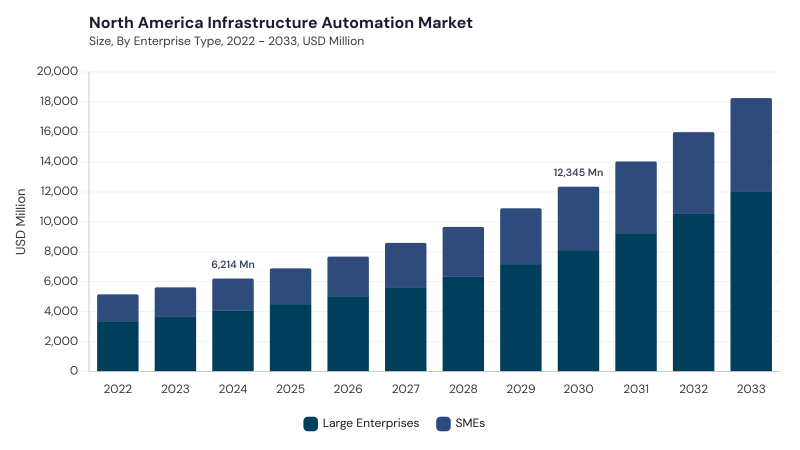
The North America Infrastructure Automation Market originated from the rising complexity of enterprise IT environments, where early automation focused on server provisioning, network configuration, and system monitoring through manual scripting and basic orchestration tools. Over time, cloud computing, Infrastructure as Code, DevOps integration, AI, machine learning, predictive analytics, and self-healing systems shifted the market from reactive manual processes toward scalable, repeatable, and increasingly autonomous infrastructure management. The market now spans cloud, on-premises, and hybrid environments with advanced orchestration and AI-driven integration capabilities.
Current market growth is shaped by AI-enabled automation, multi-cloud and hybrid cloud strategies, sustainability requirements, energy-efficient data centers, and growing demand from AI workloads and edge computing. Enterprises are increasingly adopting automation platforms that support intelligent workload management, adaptive scaling, predictive maintenance, cross-platform governance, smart cooling, power optimization, and consistent orchestration across heterogeneous infrastructure environments. Demand is also rising for interoperable, secure, and integrated automation frameworks that improve visibility, reliability, agility, and operational resilience.
Based on Enterprise Type, the market is segmented into Large Enterprises and SMEs. The Large Enterprises market dominated the North America Infrastructure Automation Market by Enterprise Type in 2025, and would continue to be a dominant market till 2033; thereby, achieving a market value of USD 10.5 billion by 2032, growing at a CAGR of 13.3 % during the forecast period. The SMEs market is expected to witness a CAGR of 12.9% during (2026 - 2033).
Large Enterprises remain the leading segment as they use infrastructure-as-code, DevOps practices, configuration management, AI-assisted operations, hybrid cloud integration, cybersecurity automation, compliance governance, and orchestration across large distributed environments. SMEs hold a smaller but promising presence through cloud-native automation platforms, subscription-based solutions, managed services, server provisioning, patch management, backup orchestration, simplified automation tools, and lean IT operations that reduce implementation barriers.
Based on Component, the market is segmented into Solution and Services. The Solution market dominated the North America Infrastructure Automation Market by Component in 2025, and would continue to be a dominant market till 2033; thereby, achieving a market value of USD 10.6 billion by 2032, growing at a CAGR of 13 % during the forecast period. The Services market is expected to witness a CAGR of 13.6% during (2026 - 2033).
Solution remains central as organizations deploy automation software platforms, orchestration tools, workflow automation systems, infrastructure-as-code capabilities, container orchestration, network automation, AI-driven management, observability, cloud management, and policy-driven automation across complex technology environments. Services hold a lower but encouraging foothold through consulting, implementation, system integration, migration, training, managed services, technical support, optimization, and lifecycle management, especially where organizations face automation skills gaps and hybrid infrastructure complexity.
Based on Testing Type, the market is segmented into Cloud, Network Automation, Server Automation, Database Automation, and Other Testing Type. Cloud remains the leading testing type as enterprises automate validation of infrastructure-as-code templates, security compliance, performance benchmarking, hybrid cloud configurations, CI/CD pipelines, and policy-as-code testing. Network Automation holds a substantial share through SDN, NFV, policy-driven orchestration, AI-enabled monitoring, anomaly detection, 5G, and edge computing validation.
Server Automation maintains a considerable presence through server provisioning, configuration management, patching, firmware integrity, hypervisor validation, compliance checks, and predictive failure analytics. Database Automation holds a noteworthy foothold through database provisioning, schema validation, backup and recovery testing, replication, failover, performance tuning, and DBaaS validation. Other Testing Type includes security testing, compliance auditing, disaster recovery validation, automated penetration testing, policy enforcement tests, and automated failover drills.
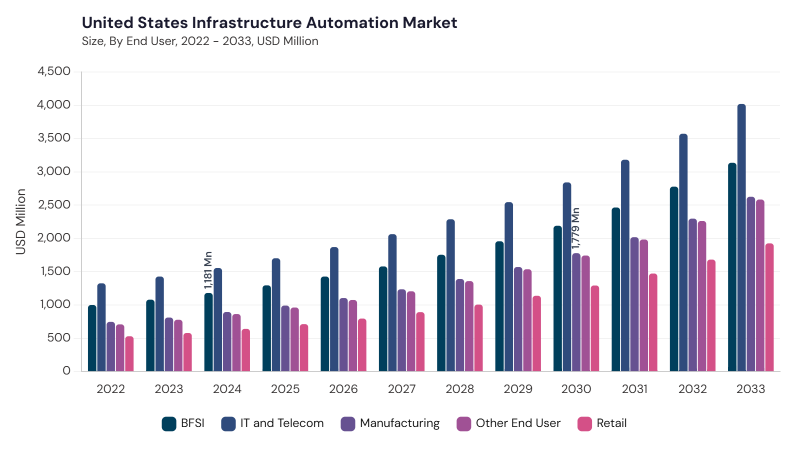
Based on End User, the market is segmented into IT and Telecom, BFSI, Manufacturing, Retail, and Other End User. IT and Telecom remain the leading end-user segment through network provisioning, cloud infrastructure management, data traffic optimization, service assurance, 5G orchestration, edge computing, NFV, and software-defined infrastructure. BFSI holds a significant share through secure infrastructure provisioning, cybersecurity automation, disaster recovery orchestration, compliance management, auditability, identity and access management, and hybrid cloud protection.
Manufacturing maintains a meaningful foothold through Industry 4.0, IT/OT integration, predictive maintenance, factory networks, IoT connectivity, and smart production workflows. Retail represents the smallest but promising segment through omnichannel infrastructure, store network management, POS systems, e-commerce platforms, inventory databases, edge computing, and scalable transaction support. Other End User includes government, healthcare, education, utilities, public service networks, healthcare data centers, campus IT environments, smart grids, security management, compliance enforcement, and operational monitoring.
Free Valuable Insights: The Global Infrastructure Automation Market will hit USD 48.7 Billion billion by 2033, at a CAGR of 13.7%
Based on Country, the market is segmented into US, Canada, Mexico, and Rest of North America. The US market dominated the North America Infrastructure Automation Market by Country in 2025, and would continue to be a dominant market till 2033; thereby, achieving a market value of USD 12.5 billion by 2032, growing at a CAGR of 12.5 % during the forecast period. The Canada market is expected to witness a CAGR of 16.2% during (2026 - 2033). Additionally, The Mexico market is expected to witness a CAGR of 15.2% during (2026 - 2033).
The US is shaped by AI-enabled predictive analytics, edge computing, IT/OT convergence, IIoT, cybersecurity integration, sustainability-driven automation, and modernization of aging public assets, while Canada reflects AI and machine learning, digital twins, IoT-enabled devices, cloud and edge computing, smart grids, water management, cybersecurity, and sustainability-focused infrastructure modernization. Mexico is supported by smart factory adoption, industrial automation, logistics and supply chain systems, IoT-enabled monitoring, AI-driven analytics, edge computing, 5G connectivity, and Industry 4.0 deployment, whereas Rest of North America is influenced by intelligent automation, predictive maintenance, IT/OT convergence, energy management, emissions monitoring, AI-driven data center automation, cybersecurity, interoperability, and localized automation strategies.

By Enterprise Type
By Component
By Testing Type
By End User
By Country
Set to reach $15.9 Billion by 2032, growing at 13.2% CAGR during 2026-2033.
The US leads with $12.5 billion by 2032, growing at a 12.5% CAGR during 2026-2033.
Rising enterprise cloud adoption and AI-driven workloads are the main catalysts.
Large Enterprises segment to reach $10.5 billion by 2032, growing at 13.3% CAGR during 2026-2033.
The Canada market is expected to witness a 16.2% CAGR during 2026-2033.
Solution component to reach $10.6 billion by 2032, growing at 13% CAGR during 2026-2033.
Our team of dedicated experts can provide you with attractive expansion opportunities for your business.




 Unique Offerings
