The sample copy of this report is available for access.
The LAMEA Infrastructure Automation Market is expected to reach USD 2186.3 million by 2029, growing at a CAGR of 15.8% during (2026 - 2033).
The LAMEA Infrastructure Automation Market originated from efforts to improve operational efficiency and reliability across infrastructure domains by reducing manual intervention and errors in complex systems. Early development focused on isolated automation in power grids, water management systems, and transportation networks through legacy control systems and rudimentary software scripts. Over time, IoT, cloud computing, data analytics, real-time telemetry, monitoring technologies, cybersecurity integration, AI-driven decision-making, and remote operability shifted the market toward integrated, scalable, secure, and intelligent automation platforms tailored to regional infrastructure and regulatory environments.
Current market growth is shaped by IoT-enabled telemetry, embedded cybersecurity protocols, cloud-based infrastructure automation, predictive maintenance, remote access, and real-time data analytics. Infrastructure operators are increasingly moving from reactive to proactive management models that improve visibility, reduce downtime, optimize resources, and strengthen resilience across critical assets. Demand is also rising for scalable, interoperable, and secure automation ecosystems that balance operational agility with data sovereignty, regulatory compliance, cloud adoption, and localized infrastructure needs across Latin America, the Middle East, and Africa.
Based on Enterprise Type, the market is segmented into Large Enterprises and SMEs. The Large Enterprises market dominated the LAMEA Infrastructure Automation Market by Enterprise Type in 2025, and would continue to be a dominant market till 2033; thereby, achieving a market value of USD 1454.9 million by 2029, growing at a CAGR of 15.9 % during the forecast period. The SMEs market is expected to witness a CAGR of 15.6% during (2026 - 2033).
Large Enterprises remain the leading segment as they deploy orchestration, configuration management, network automation, cloud integration, provisioning, workload deployment, infrastructure monitoring, AI-driven automation, predictive maintenance, process optimization, ERP integration, and hybrid or multi-cloud management across geographically dispersed operations. SMEs hold the smaller but promising presence through cloud-hosted platforms, managed infrastructure services, automation-as-a-service, simplified automation tools, server provisioning, backup management, patching, and network configuration solutions that improve accessibility for businesses with constrained technology resources.
Based on Component, the market is segmented into Solution and Services. The Solution market dominated the LAMEA Infrastructure Automation Market by Component in 2025, and would continue to be a dominant market till 2033; thereby, achieving a market value of USD 1489.6 million by 2029, growing at a CAGR of 15.6 % during the forecast period. The Services market is expected to witness a CAGR of 16.2% during (2026 - 2033).
Solution remains central as organizations use software platforms, orchestration tools, control systems, analytics, cybersecurity management, cloud-based automation, AI, machine learning, real-time monitoring, predictive asset uptime tools, and automated infrastructure management across telecommunications, utilities, transportation, and public or private digital infrastructure. Services hold the smaller but emerging foothold through consulting, system integration, maintenance, managed services, deployment assistance, legacy integration, cloud migration, customization, training, cybersecurity updates, and compliance support, particularly where limited in-house automation expertise encourages reliance on external partners.
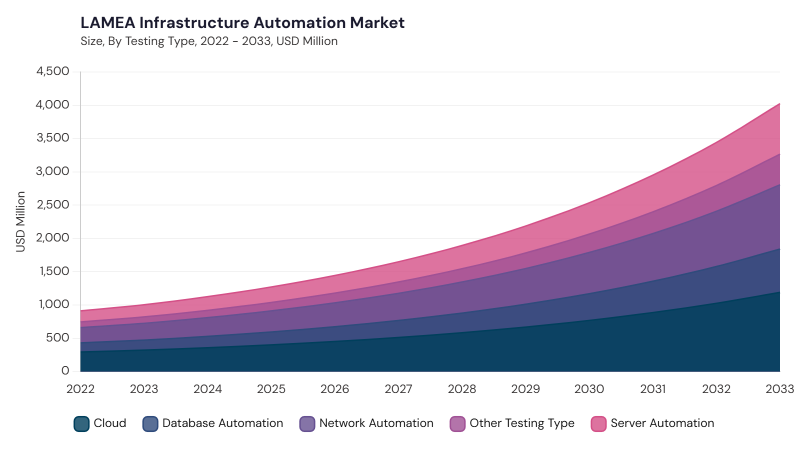
Based on Testing Type, the market is segmented into Cloud, Network Automation, Server Automation, Database Automation, and Other Testing Type. Cloud remains the leading testing type through automated functional, performance, and security assessments for public, private, and hybrid cloud platforms, orchestration workflows, API integrations, container environments, cloud-native services, CI/CD pipelines, infrastructure as code, and AI-powered test automation. Network Automation holds a substantial share through automated configuration, provisioning, failover testing, network security policies, NFV, SDN, 5G service validation, network slicing, and AI-enabled predictive network analytics.
Server Automation maintains a considerable presence through automated provisioning, patch management, firmware updates, workload management, regression testing, capacity scaling, and AI-enabled diagnostics. Database Automation holds a noteworthy standing through database provisioning, backup and recovery, query optimization, performance benchmarking, security compliance, regression testing, test data management, and synthetic data generation. Other Testing Type includes middleware, storage infrastructure, security infrastructure, convergence platforms, automated penetration testing, compliance verification, and specialized validation of cross-domain infrastructure components.
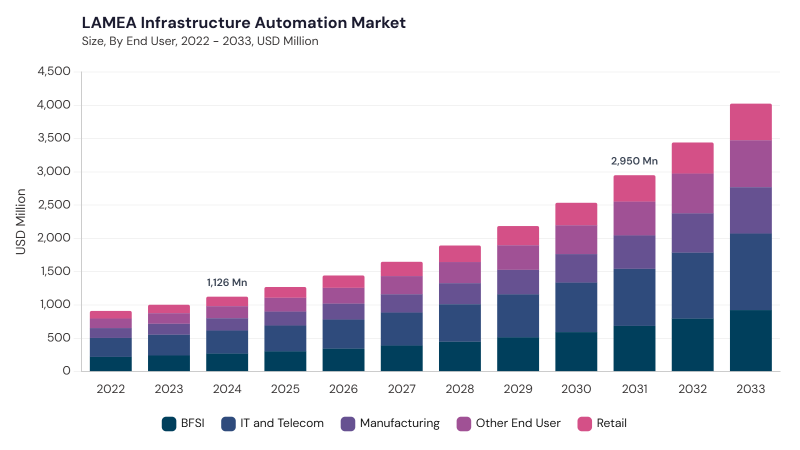
Based on End User, the market is segmented into IT and Telecom, BFSI, Manufacturing, Retail, and Other End User. IT and Telecom remain the leading end-user segment through network configuration, system provisioning, service assurance, cloud-native architectures, edge computing, 5G network slicing, AI and machine learning, predictive maintenance, fault detection, and legacy-modern infrastructure interoperability. BFSI holds a significant share through secure data flows, digital banking platforms, transaction processing, compliance monitoring, audit trails, real-time monitoring, disaster recovery, hybrid cloud, and RPA-enabled infrastructure workflows.
Manufacturing maintains a meaningful foothold through IoT devices, connected equipment, predictive maintenance, real-time production monitoring, machine-to-machine connectivity, Industry 4.0, digital twins, and cloud-based monitoring. Retail represents the smallest but promising segment through e-commerce, digital payments, omnichannel systems, cloud resources, content delivery networks, backend databases, supply chain visibility, AI-driven demand forecasting, and customer data management. Other End User includes energy, government services, healthcare, transportation, education, utilities, public service delivery, smart city projects, telemedicine infrastructure, hybrid learning platforms, grid monitoring, and regulatory compliance.
Free Valuable Insights: Infrastructure Automation Market Size Worth USD 48.7 Billion billion by 2033
Based on Country, the market is segmented into Brazil, Argentina, UAE, Saudi Arabia, South Africa, Nigeria, and Rest of LAMEA. The Brazil market dominated the LAMEA Infrastructure Automation Market by Country in 2025, and would continue to be a dominant market till 2033; thereby, achieving a market value of USD 646.8 million by 2029, growing at a CAGR of 14.6 % during the forecast period. The Argentina market is expected to witness a CAGR of 16.7% during (2026 - 2033). Additionally, The UAE market is expected to witness a CAGR of 14.8% during (2026 - 2033).
Brazil is shaped by AI, IoT, cloud computing, Industry 4.0, smart city frameworks, predictive maintenance, sustainable automation, and localized automation solutions, while Argentina reflects cloud-based automation, remote sensing, AI-driven predictive analytics, energy and water-sector automation, and sustainability-led infrastructure management. The UAE is supported by AI and machine learning, sustainable automation, digital twins, predictive maintenance, edge computing, 5G connectivity, and smart-city aligned infrastructure platforms, whereas Saudi Arabia is driven by Vision 2030, AI-powered analytics, interoperability, cloud-based automation, IoT, predictive maintenance, and localized digital infrastructure. South Africa is advancing through AI and machine learning, IoT networks, SCADA, cybersecurity, industrial robotics, remote monitoring, and localized infrastructure modernization; Nigeria is influenced by AI-based automation tools, robotics, cloud computing, project management automation, workforce development, and SME-focused automation adoption; and Rest of LAMEA is shaped by cognitive automation, cloud-based platforms, M2M communication, IoT, RPA, smart city initiatives, clean energy trials, and AI-driven autonomous infrastructure management.

By Enterprise Type
By Component
By Testing Type
By End User
By Country
Set to reach $2186.3 Million by 2029, growing at 15.8% CAGR during 2026-2033.
Brazil leads with $646.8 million by 2029, growing at a 14.6% CAGR during the forecast period.
Large Enterprises segment dominates with $1454.9 million by 2029, growing at 15.9% CAGR during 2026-2033.
Solution component reaches $1489.6 million by 2029, growing at a 15.6% CAGR during 2026-2033.
The UAE market is expected to witness a CAGR of 14.8% during 2026-2033.
Services component is expected to witness a CAGR of 16.2% during 2026-2033.
Our team of dedicated experts can provide you with attractive expansion opportunities for your business.




 Unique Offerings
