The sample copy of this report is available for access.
The Europe Infrastructure Automation Market is expected to reach USD 10.2 billion by 2031, growing at a CAGR of 13.3% during (2026 - 2033).
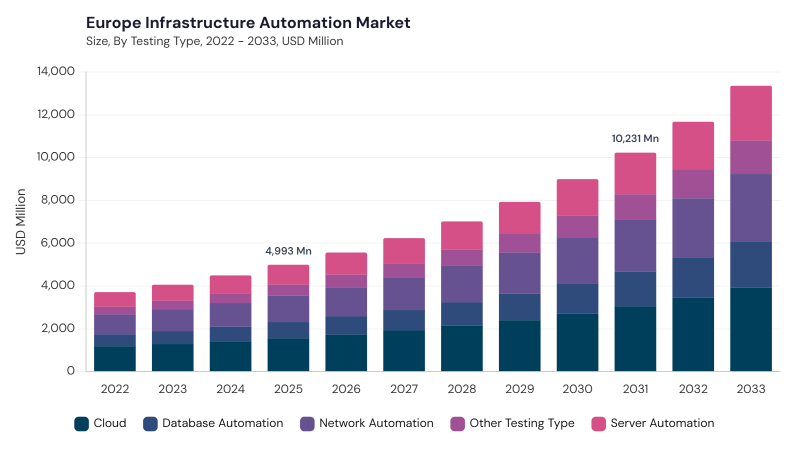
The Europe Infrastructure Automation Market originated from early digital transformation efforts focused on automating data centers and system configurations to reduce manual intervention and improve operational consistency. Over time, cloud computing, virtualization, software-defined infrastructure, hybrid cloud, multi-cloud adoption, and EU-led data sovereignty requirements shifted the market from isolated on-premises automation toward interconnected and policy-aligned automation platforms. The market now reflects secure, intelligent, and distributed infrastructure automation solutions designed for complex European regulatory and operational environments.
Current market growth is shaped by cloud sovereignty, AI and machine learning integration, edge computing, cybersecurity, sustainability, and hybrid infrastructure modernization. Enterprises are increasingly adopting automation tools that support localized data processing, predictive maintenance, self-healing systems, resource optimization, edge-based orchestration, and compliance management. Demand is also rising for platforms that combine cloud-native automation, regulatory readiness, AI-driven analytics, real-time monitoring, and interoperability across heterogeneous infrastructure environments.
Based on Enterprise Type, the market is segmented into Large Enterprises and SMEs. The Large Enterprises market dominated the Europe Infrastructure Automation Market by Enterprise Type in 2025, and would continue to be a dominant market till 2033; thereby, achieving a market value of USD 6.7 billion by 2031, growing at a CAGR of 13.4 % during the forecast period. The SMEs market is expected to witness a CAGR of 13.1% during (2026 - 2033).
Large Enterprises remain the leading segment as they deploy infrastructure-as-code, automated configuration, policy-based orchestration, AI-driven monitoring, cybersecurity automation, hybrid cloud integration, smart grid automation, and compliance-focused infrastructure management across large-scale operations. SMEs hold the smaller but promising presence through cloud-delivered automation tools, managed services, SaaS-based platforms, modular architectures, low-code/no-code automation, open-source tools, and simplified infrastructure workflows that reduce dependence on large internal IT teams.
Based on Component, the market is segmented into Solution and Services. The Solution market dominated the Europe Infrastructure Automation Market by Component in 2025, and would continue to be a dominant market till 2033; thereby, achieving a market value of USD 6.8 billion by 2031, growing at a CAGR of 13.1 % during the forecast period. The Services market is expected to witness a CAGR of 13.7% during (2026 - 2033).
Solution remains central as organizations use automation software platforms, configuration management, orchestration tools, workflow automation, cloud automation, network automation, infrastructure monitoring, AI-driven predictive analytics, intent-based automation, and DevSecOps-enabled infrastructure lifecycle tools. Services hold the smaller but emerging foothold through consulting, integration, support, managed services, architecture assessment, migration, workflow redesign, training, change management, and compliance-focused implementation support for complex legacy and hybrid environments.
Based on Testing Type, the market is segmented into Cloud, Network Automation, Server Automation, Database Automation, and Other Testing Type. Cloud remains the leading testing type through automated provisioning validation, infrastructure-as-code testing, regression testing, CI/CD verification, container orchestration, microservices, policy-as-code, and AI-based defect detection. Network Automation holds a substantial share through SDN, NFV, 5G infrastructure, configuration compliance testing, latency measurement, real-time telemetry, AI-based anomaly detection, and multi-vendor network validation.
Server Automation maintains a considerable presence through server deployment, configuration, patch management, security baseline testing, load testing, cloud-edge hybrid environments, and legacy-modern hardware validation. Database Automation holds a noteworthy role through database provisioning, migration, backup and restore validation, schema migration, replication, data governance, DBaaS, and compliance-driven database operations. Other Testing Type includes security testing automation, compliance testing, automated penetration testing, policy validation, test data provisioning, synthetic user simulation, DevSecOps testing, and zero-trust framework support.
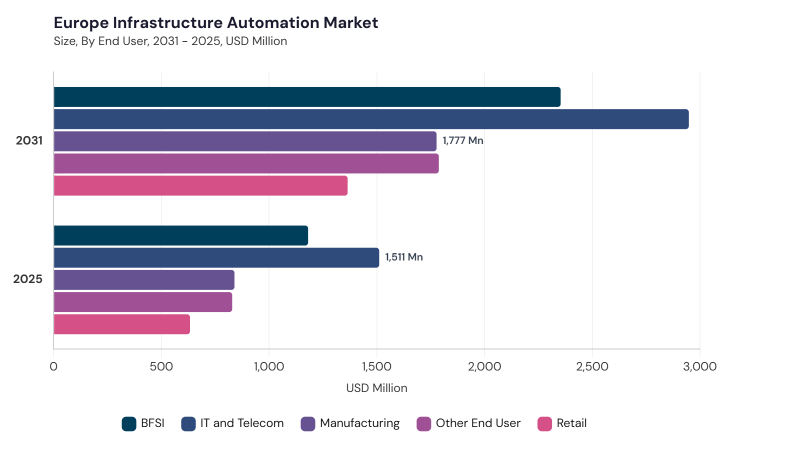
Based on End User, the market is segmented into IT and Telecom, BFSI, Manufacturing, Retail, and Other End User. IT and Telecom remain the leading end-user segment through data center management, network configuration, fault detection, security infrastructure, edge computing, 5G, AI/ML-enabled orchestration, cloud services, and hybrid infrastructure management. BFSI holds a significant share through data center operations, security infrastructure management, transaction processing, risk tools, auditability, real-time monitoring, fraud detection, digital payments, RPA, and regulatory compliance.
Manufacturing maintains a meaningful presence through Industrial IoT, smart factories, supply chain automation, IT/OT integration, predictive maintenance, real-time analytics, and connected production systems. Retail represents the smallest but promising segment through e-commerce, connected stores, omnichannel infrastructure, inventory systems, cloud resource allocation, dynamic pricing support, data security, and scalable transaction processing. Other End User includes healthcare, education, public administration, transportation, professional organizations, telemedicine, e-learning, government digital services, utility management, and critical infrastructure operations.
Free Valuable Insights: The Worldwide Infrastructure Automation Market is projected to reach USD 48.7 Billion billion by 2033, at a CAGR of 13.7%
Based on Country, the market is segmented into Germany, UK, France, Russia, Spain, Italy, and Rest of Europe. The Germany market dominated the Europe Infrastructure Automation Market by Country in 2025, and would continue to be a dominant market till 2033; thereby, achieving a market value of USD 1.9 billion by 2031, growing at a CAGR of 11.7 % during the forecast period. The UK market is expected to witness a CAGR of 12.3% during (2026 - 2033). Additionally, The France market is expected to witness a CAGR of 14.2% during (2026 - 2033).
Germany is shaped by Industry 4.0, edge computing, renewable energy integration, 5G expansion, IoT-enabled infrastructure, AI analytics, and predictive maintenance, while the UK reflects Infrastructure as Code, modular architectures, AI and machine learning, interoperability, edge computing, sustainability controls, and compliance-driven automation. France is supported by AI-driven analytics, sovereign cloud, hybrid AI architectures, public-private collaboration, IoT sensors, cybersecurity, and localized infrastructure automation platforms. Russia emphasizes localized automation, cybersecurity, AI integration, energy distribution optimization, predictive maintenance, and self-reliant technology platforms, whereas Spain is advancing through AI and ML algorithms, renewable energy hubs, hydrogen infrastructure, IoT, edge computing, modular automation, and cybersecurity upgrades. Italy is driven by AI-powered predictive maintenance, digital twins, sensor networks, laser mapping, green infrastructure automation, and modernization of legacy assets, while Rest of Europe is influenced by cloud compliance, data sovereignty, AI-driven orchestration, Industry 4.0, edge computing, compliance automation, cybersecurity, and hybrid cloud deployment.

By Enterprise Type
By Component
By Testing Type
By End User
By Country
Set to reach $10.2 Billion by 2031, growing at 13.3% CAGR during 2026-2033.
Germany leads with a market value of USD 1.9 billion by 2031, growing at 11.7% CAGR during the forecast period.
Rising demand from Large Enterprises, reaching USD 6.7 billion by 2031, at 13.4% CAGR during 2026-2033.
Solution segment will achieve USD 6.8 billion by 2031, growing at 13.1% CAGR during the forecast period.
The UK market is expected to witness a CAGR of 12.3% during 2026-2033.
The France market is expected to witness a CAGR of 14.2% during 2026-2033.
Our team of dedicated experts can provide you with attractive expansion opportunities for your business.




 Unique Offerings
