The sample copy of this report is available for access.
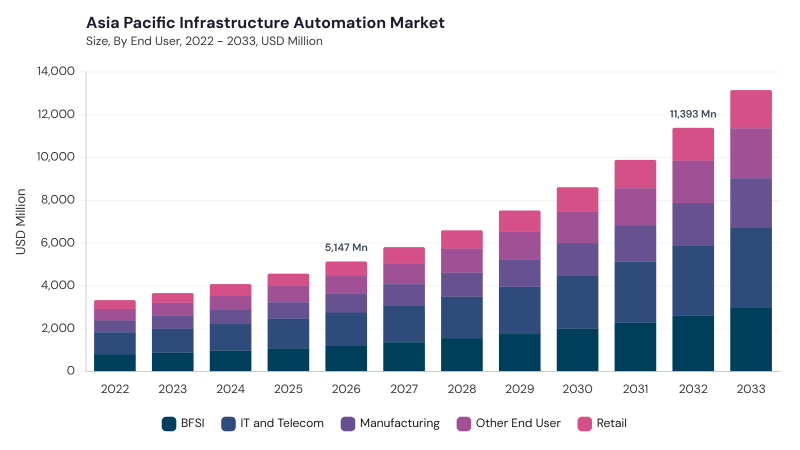
The Asia Pacific Infrastructure Automation Market is expected to reach USD 8.6 billion by 2030, growing at a CAGR of 14.3% during (2026 - 2033).
The Asia Pacific Infrastructure Automation Market originated from rapid industrialization and digital transformation efforts, where early automation focused on legacy network and industrial systems to improve operational efficiency. Over time, 4G expansion, early cloud adoption, 5G networks, IoT deployment, AI-driven predictive maintenance, network orchestration, hybrid cloud architectures, and software-defined infrastructure shifted the market from reactive automation toward proactive and intelligent infrastructure management. The market now functions as a critical enabler of digital economy frameworks, supporting agility, resilience, real-time service delivery, and operational cost reduction across diverse regional sectors.
Current market growth is shaped by AI-driven predictive network management, cloud-native automation platforms, multi-cloud and edge computing frameworks, and hyperautomation combining AI, RPA, and analytics. Organizations are increasingly adopting intelligent systems that anticipate failures, optimize network performance, automate complex operations, and support silicon- and workload-agnostic infrastructure. Demand is also rising for infrastructure automation solutions that improve scalability, interoperability, service quality, workforce efficiency, and operational flexibility across telecommunications, data centers, manufacturing, logistics, and urban infrastructure.
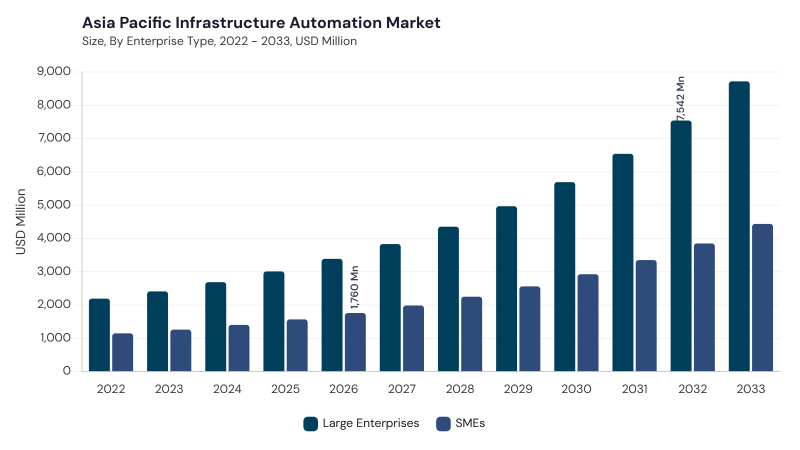
Based on Enterprise Type, the market is segmented into Large Enterprises and SMEs. The Large Enterprises market dominated the Asia Pacific Infrastructure Automation Market by Enterprise Type in 2025, and would continue to be a dominant market till 2033; thereby, achieving a market value of USD 5.6 billion by 2030, growing at a CAGR of 14.5 % during the forecast period. The SMEs market is expected to witness a CAGR of 14.1% during (2026 - 2033).
Large Enterprises remain the leading segment as they deploy infrastructure-as-code, container orchestration, automated provisioning, intelligent operations, data center automation, network orchestration, cloud infrastructure management, AI, machine learning, edge computing, and automated compliance monitoring across complex infrastructure environments. SMEs hold the smaller but promising presence through affordable cloud services, low-code automation, managed infrastructure offerings, turnkey automation tools, cloud service integration, simplified workflow automation, and scalable platforms that reduce dependence on extensive in-house expertise.
Based on Component, the market is segmented into Solution and Services. The Solution market dominated the Asia Pacific Infrastructure Automation Market by Component in 2025, and would continue to be a dominant market till 2033; thereby, achieving a market value of USD 5.8 billion by 2030, growing at a CAGR of 14.2 % during the forecast period. The Services market is expected to witness a CAGR of 14.8% during (2026 - 2033).
Solution remains central as organizations adopt PLCs, SCADA systems, distributed control systems, network automation platforms, AI-driven analytical tools, cloud-based solutions, modular automation tools, software-defined infrastructure, and real-time monitoring systems across utilities, transport, smart cities, and data centers. Services hold the smaller but emerging foothold through consultation, system integration, maintenance, managed services, project advisory, installation, testing, training, lifecycle support, cloud migration assistance, automation architecture, platform integration, and technical skill development.
Based on Testing Type, the market is segmented into Cloud, Network Automation, Server Automation, Database Automation, and Other Testing Type. Cloud remains the leading testing type through infrastructure-as-code validation, security compliance verification, performance benchmarking, Kubernetes, OpenStack, AWS CloudFormation, CI/CD pipelines, multi-cloud environments, hybrid cloud models, and AI-enabled testing frameworks. Network Automation holds a substantial share through automated configuration, provisioning, orchestration, routers, switches, firewalls, load balancers, 5G deployments, edge computing, NFV environments, service chaining, latency testing, and failover validation.
Server Automation maintains a considerable foothold through server provisioning, configuration, patching, health monitoring, operating system deployment, resource allocation, compliance validation, recovery testing, and hybrid infrastructure support. Database Automation holds a noteworthy standing through database deployment, schema migration, backup, performance tuning, rollback testing, data masking, multi-cloud synchronization, and transaction reliability. Other Testing Type includes integration testing, security testing, compliance testing, penetration testing, AI-assisted vulnerability scanning, and customized validation for regulated infrastructure environments.
Based on End User, the market is segmented into IT and Telecom, BFSI, Manufacturing, Retail, and Other End User. IT and Telecom remain the leading end-user segment through network management, data storage, service delivery automation, infrastructure orchestration, hybrid cloud management, AI-driven network management, 5G infrastructure, SDN, NFV, and self-healing networks. BFSI holds a significant share through data center optimization, disaster recovery, secure network infrastructure, compliance monitoring, risk management, automated backups, digital banking, blockchain, RPA, and AI-based anomaly detection.
Manufacturing maintains a meaningful presence through MES, industrial IoT infrastructure, robotics deployment management, predictive maintenance, smart factories, resource optimization, and Industry 4.0 adoption. Retail represents the smallest but promising segment through e-commerce platforms, supply chain logistics, warehouse management, digital payments, customer data platforms, real-time inventory updates, and cloud-enabled scalable infrastructure. Other End User includes healthcare, education, government, logistics, patient data management, campus network management, traffic control systems, public sector digitization, and resilient infrastructure operations.
Free Valuable Insights: Infrastructure Automation Market is Predicted to reach USD 48.7 Billion billion by 2033, at a CAGR of 13.7%
Based on Country, the market is segmented into China, Japan, India, South Korea, Singapore, Malaysia, and Rest of Asia Pacific. The China market dominated the Asia Pacific Infrastructure Automation Market by Country in 2025, and would continue to be a dominant market till 2033; thereby, achieving a market value of USD 2.9 billion by 2030, growing at a CAGR of 12.7 % during the forecast period. The Japan market is expected to witness a CAGR of 13.6% during (2026 - 2033). Additionally, The India market is expected to witness a CAGR of 15.1% during (2026 - 2033).
China is shaped by smart city integration, AI, IoT, SCADA systems, cybersecurity compliance, humanoid robotics, machine learning, and autonomous infrastructure decision-making, while Japan reflects AI and machine learning, real-time anomaly detection, automated repair scheduling, cybersecurity frameworks, interoperability, open standards, and modular automation platforms. India is supported by IoT-enabled devices, AI frameworks, smart city development, energy efficiency, renewable energy infrastructure, water treatment, waste management, and localized automation packages. South Korea is advancing through AI-enabled manufacturing, smart factories, BIM, intelligent transportation systems, liquid-cooled data centers, renewable energy management, and smart grid development, whereas Singapore is influenced by hybrid cloud adoption, AI-powered automation, IoT integration, continuous monitoring, cyber threat mitigation, predictive maintenance, and strict data governance. Malaysia is progressing through Industry 4.0, data center growth, energy-efficient automation, AI and machine learning, IoT connectivity, semiconductor and automation clusters, and localized R&D support, while Rest of Asia Pacific is shaped by AI-powered automation, 5G, edge computing, sustainable technologies, interoperable platforms, cybersecurity frameworks, and cloud-connected infrastructure management.

By Enterprise Type
By Component
By Testing Type
By End User
By Country
Set to reach $8.6 Billion by 2030, growing at 14.3% CAGR during 2026-2033.
China leads with a market value of USD 2.9 billion by 2030, growing at a CAGR of 12.7% during 2026-2033.
Rising adoption of automation solutions in large enterprises, projected to hit USD 5.6 billion by 2030.
The solution segment is projected to reach USD 5.8 billion by 2030, growing at a CAGR of 14.2% during 2026-2033.
The India market is expected to witness a CAGR of 15.1% during 2026-2033.
The services segment is expected to witness a CAGR of 14.8% during 2026-2033.
Our team of dedicated experts can provide you with attractive expansion opportunities for your business.




 Unique Offerings
