The sample copy of this report is available for access.
“Global Infrastructure Automation Market to reach a market value of USD 3870.47 Million by 2033 growing at a CAGR of %”
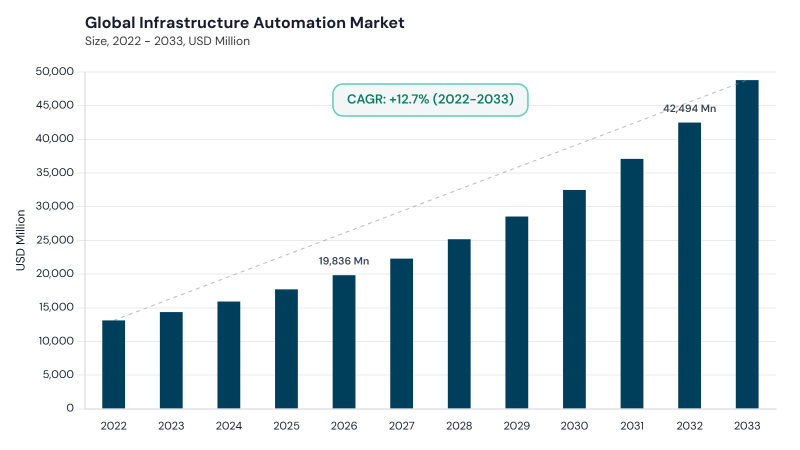
The Global Infrastructure Automation Market is expected to reach USD 48.7 billion by 2033, growing at a CAGR of 13.7% during (2026 - 2033).
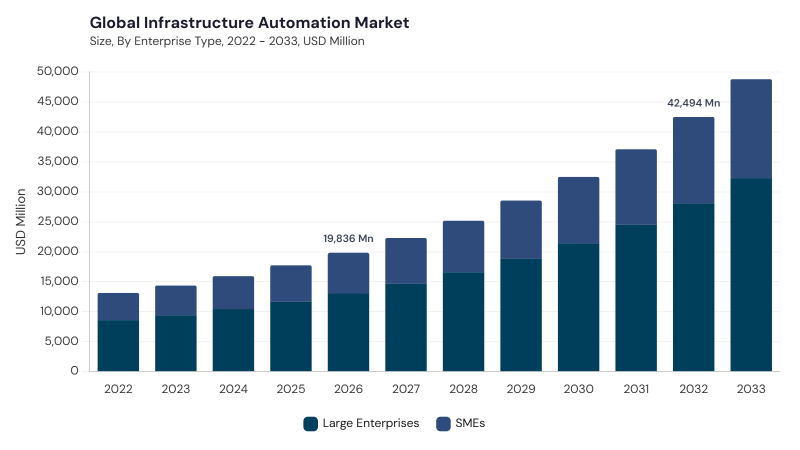
Infrastructure automation is gaining wider enterprise traction as cloud computing, hybrid and multi-cloud operations, DevOps practices, software-defined infrastructure, and infrastructure-as-code reshape IT management. Organizations are adopting these platforms to minimize manual work, speed up provisioning, maintain consistent configurations, and manage distributed infrastructure across servers, networks, storage, cloud resources, and application environments. Market momentum is further supported by AI-driven automation, orchestration, policy enforcement, configuration management, and continuous monitoring.
Increasing complexity across hybrid cloud, edge computing, on-premises infrastructure, and distributed digital operations is accelerating the need for automated provisioning, orchestration, monitoring, and remediation. Organizations are adopting automation to improve agility, reduce manual errors, manage configuration drift, and support consistent infrastructure deployment across multiple environments. Agentic AI is strengthening the market by enabling predictive maintenance, autonomous workflow execution, resource optimization, and faster incident response. Edge computing expansion is also widening demand for decentralized automation across remote nodes, IoT environments, private 5G networks, and latency-sensitive workloads.
Competition in the Infrastructure Automation Market is shaped by platform depth, integration capability, AI-enabled automation, hybrid-cloud support, infrastructure-as-code maturity, and pricing flexibility. Large global vendors compete through broad enterprise portfolios, cloud ecosystems, network automation, IT operations management, and service orchestration, while specialized providers differentiate through configuration management, multicloud provisioning, and policy-based automation. Strategic partnerships, acquisitions, and platform expansions are helping vendors connect infrastructure provisioning with observability, security, compliance, and remediation. Regional providers compete through localization, regulatory expertise, and tailored implementation support.
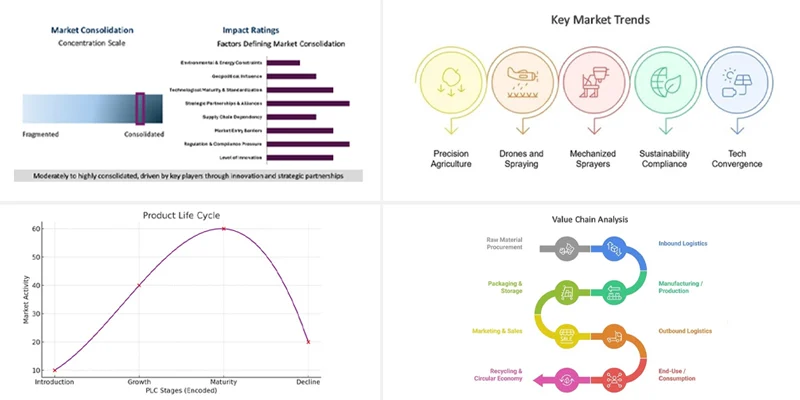


The global Infrastructure Automation Market is moderately consolidated, with major enterprise software, cloud, network automation, hybrid-cloud, and IT operations vendors holding strong positions. IBM leads through its Terraform, Red Hat Ansible, hybrid-cloud, provisioning, configuration, and lifecycle automation capabilities. Broadcom, Cisco, Hewlett Packard Enterprise, Microsoft, and ServiceNow compete through private-cloud automation, network orchestration, hybrid-cloud platforms, Azure-native automation, and IT operations workflows. BMC Helix, Nutanix, Oracle, and Perforce strengthen competition through AIOps, self-service provisioning, OCI Terraform automation, and Puppet-based configuration management. Market share is influenced by ecosystem depth, interoperability, AI integration, multicloud reach, governance, and the ability to automate infrastructure consistently across cloud, data-center, network, and edge environments.
Based on enterprise type, the market is segmented into Large Enterprises and SMEs. The Large Enterprises market dominated the Global Infrastructure Automation Market by Enterprise Type in 2025, and would continue to be a dominant market till 2033; thereby, achieving a market value of USD 32.2 billion by 2033, growing at a CAGR of 13.8 % during the forecast period. The SMEs market is expected to witness a CAGR of 13.5% during (2026 - 2033).
Large enterprises rely on infrastructure automation to manage complex, distributed, and hybrid technology estates across multiple business units and geographies. These organizations require scalable orchestration, strong governance, role-based controls, configuration consistency, and integration with security and compliance systems. Automation helps large enterprises reduce operational bottlenecks, accelerate provisioning, and maintain consistent infrastructure policies. SMEs adopt automation to reduce manual IT administration, improve resource efficiency, and simplify infrastructure management with limited internal technical teams. Cloud-hosted automation tools, managed services, and simplified platforms are making advanced automation more accessible for smaller organizations. Across both groups, demand is shaped by digital transformation, cost control, operational resilience, and the need to manage growing infrastructure complexity.
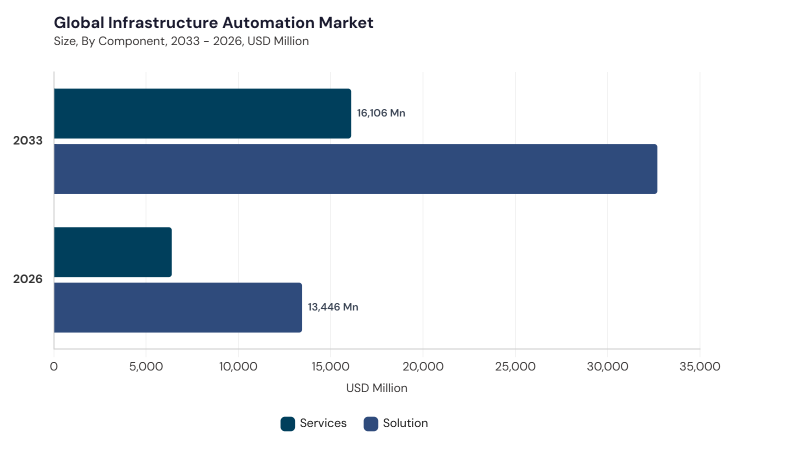
Based on component, the market is segmented into Solution and Services. The Solution market dominated the Global Infrastructure Automation Market by Component in 2025, and would continue to be a dominant market till 2033; thereby, achieving a market value of USD 32.6 billion by 2033, growing at a CAGR of 13.5 % during the forecast period. The Services market is expected to witness a CAGR of 14.1% during (2026 - 2033).
Solution includes infrastructure-as-code platforms, orchestration tools, configuration management systems, monitoring platforms, automation engines, and policy-based infrastructure management capabilities. These solutions support repeatable provisioning, automated configuration, resource optimization, compliance checks, and lifecycle control across cloud, data-center, server, network, and application environments. Services include consulting, system integration, deployment, migration, training, maintenance, and managed automation support. Service providers help organizations design automation strategies, connect legacy systems, customize workflows, and operate complex environments with reduced internal burden. As infrastructure automation becomes more strategic, organizations increasingly combine platform adoption with expert services to improve implementation quality, interoperability, governance, and long-term operational performance.
Based on testing type, the market is segmented into Cloud, Network Automation, Server Automation, Database Automation, and Other Testing Type. The Cloud market dominated the Global Infrastructure Automation Market by Testing Type in 2025, and would continue to be a dominant market till 2033; thereby, achieving a market value of USD 14.2 billion by 2033, growing at a CAGR of 12.8 % during the forecast period. The Network Automation market is expected to witness a CAGR of 13.2% during (2026 - 2033). Additionally, The Server Automation market is expected to witness highest CAGR of 14.1% during (2026 - 2033).
Cloud automation supports provisioning, resource scaling, policy enforcement, and lifecycle management across public, private, hybrid, and multi-cloud environments. Network Automation focuses on configuration, service orchestration, policy control, assurance, and remediation across physical and virtual networks. Server Automation helps standardize administration, patching, configuration, workload deployment, and operational monitoring across expanding compute estates. Database Automation supports provisioning, backup, compliance, patching, performance management, and reliable data-platform operations. Other Testing Type covers specialized infrastructure automation and validation activities that help organizations extend automated control into niche operational areas. Together, these segments reflect the shift from manual infrastructure administration toward programmable, policy-driven, and intelligent infrastructure management.
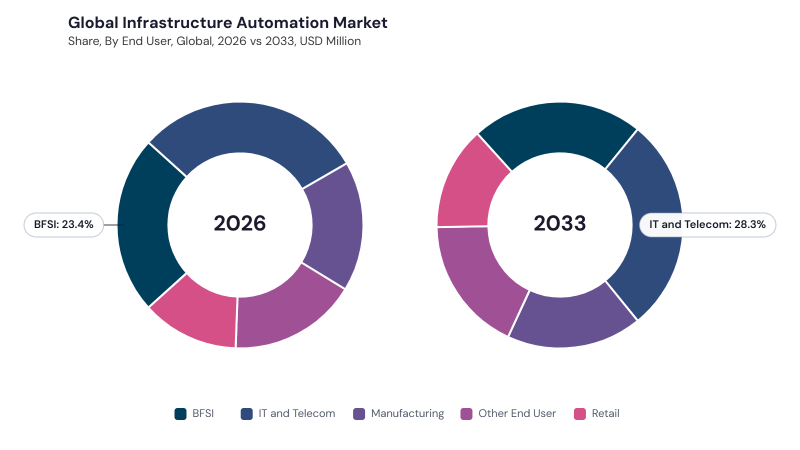
Based on end user, the market is segmented into IT and Telecom, BFSI, Manufacturing, Retail, and Other End User. The IT and Telecom market dominated the Global Infrastructure Automation Market by End User in 2025, and would continue to be a dominant market till 2033; thereby, achieving a market value of USD 13.8 billion by 2033, growing at a CAGR of 12.8 % during the forecast period. The BFSI market is expected to witness a CAGR of 13.2% during (2026 - 2033). Additionally, The Manufacturing market is expected to witness highest CAGR of 14.4% during (2026 - 2033).
IT and Telecom organizations use infrastructure automation to manage data centers, cloud platforms, network resources, service operations, and increasingly complex communications infrastructure. BFSI adoption is driven by digital banking, secure transaction systems, regulatory compliance, high availability, and resilient technology operations. Manufacturing uses automation to support smart factories, connected equipment, edge computing, predictive maintenance, and digitally coordinated production systems. Retail relies on automation for e-commerce infrastructure, point-of-sale systems, omnichannel operations, inventory platforms, and demand spikes. Other End User includes healthcare, education, government, energy, logistics, and additional sectors adopting automation for secure infrastructure management, public service continuity, operational efficiency, and digital modernization.
Free Valuable Insights: Infrastructure Automation Market Size to reach $48.7 Billion by 2033
Region-wise, the Infrastructure Automation Market is analyzed across North America, Europe, Asia Pacific, and LAMEA. The North America market dominated the Global Infrastructure Automation Market by Region in 2025, and would continue to be a dominant market till 2033; thereby, achieving a market value of USD 18.2 billion by 2033, growing at a CAGR of 13.2 % during the forecast period. The Europe market is expected to witness a CAGR of 13.3% during (2026 - 2033). Additionally, The Asia Pacific market is expected to witness a CAGR of 14.3% during (2026 - 2033).
North America leads due to mature cloud adoption, strong enterprise technology investment, data-center modernization, DevOps maturity, and early adoption of AI-enabled infrastructure operations. Europe is supported by digital transformation, compliance-driven automation, data protection requirements, and modernization of enterprise and public-sector infrastructure. Asia Pacific benefits from rapid urbanization, smart city programs, cloud expansion, telecom investment, manufacturing digitalization, and growing use of AI, IoT, and edge computing. LAMEA is gaining traction through 5G infrastructure, cloud adoption, cost-efficiency pressures, digital public infrastructure, and increasing interest in remote monitoring and intelligent automation. Across all regions, cybersecurity, interoperability, technical skill availability, and regulatory requirements influence deployment models and vendor selection.
| Report Attribute | Details |
|---|---|
| Market size value in 2026 | USD 19.8 billion |
| Market size forecast in 2033 | USD 48.7 billion |
| Base Year | 2025 |
| Historical Period | 2022 to 2024 |
| Forecast Period | 2026 to 2033 |
| Revenue Growth Rate | CAGR of 13.7% from 2026 to 2033 |
| Number of Pages | XX |
| Tables | XX |
| Report Coverage | Market Trends, Revenue Estimation and Forecast, Segmentation Analysis, Regional and Country Breakdown, Competitive Landscape, Market Share Analysis, Company Profiling, Companies Strategic Developments, SWOT Analysis, Product Life Cycle Analysis, Value Chain Analysis, Market Consolidation Analysis, Key Customer Criteria, Pandemic Impact Analysis, and Winning Imperatives |
| Segments Covered | Enterprise Type, Component, Testing Type, End User, and Geography |
| Country Scope |
|
| Companies Included | IBM; Broadcom; Cisco; Hewlett Packard Enterprise; Microsoft; ServiceNow; BMC Helix; Nutanix; Oracle; Perforce |
By Enterprise Type
By Component
By Testing Type
By End User
By Geography
Expected to reach USD 48.7 billion by 2033, growing at 13.7% CAGR during 2026-2033.
Large Enterprises lead with a market value of USD 32.2 billion by 2033.
IBM, Broadcom, Cisco, Hewlett Packard Enterprise, Microsoft, ServiceNow, BMC Helix, Nutanix, Oracle, Perforce.
North America leads with a market value of USD 18.2 billion by 2033.
Increased IT infrastructure complexity and agentic AI adoption are boosting automation demand.
The Solution segment leads with a market value of USD 32.6 billion by 2033.
Our team of dedicated experts can provide you with attractive expansion opportunities for your business.






 Unique Offerings
