The sample copy of this report is available for access.
The North America In-Vehicle AI Assistants Market is expected to reach USD 4.5 Billion by 2032, growing at a CAGR of 16.8% during (2026 – 2033).
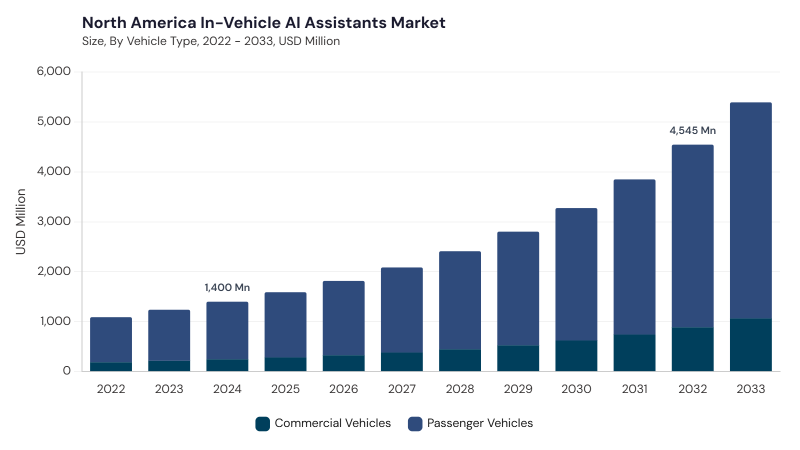
The North America In-Vehicle AI Assistants Market has developed from early voice-command infotainment systems into an advanced digital mobility interface supporting connected, software-defined, and increasingly intelligent vehicles. In the initial stage, in-car assistant functions were mostly limited to hands-free calling, basic navigation input, media control, and simple voice prompts. As automotive electronics, cloud connectivity, natural language processing, machine learning, and sensor integration improved, these systems became more capable of understanding driver intent, responding to real-time conditions, and supporting personalized in-cabin interactions. The market gained stronger momentum as automakers and technology providers began integrating AI assistants with navigation, infotainment, vehicle diagnostics, driver assistance, safety alerts, and connected services. This transformation has made AI assistants an important part of the digital cockpit, helping vehicles move from static infotainment platforms toward adaptive, interactive, and continuously updated mobility environments.
The regional market is currently shaped by strong consumer demand for hands-free control, safer interaction, connected entertainment, real-time navigation, and personalized driving experiences. North America’s mature automotive sector, high adoption of connected vehicles, strong electric vehicle growth, and advanced software-defined vehicle development are supporting wider deployment of AI assistants across passenger and commercial vehicles. Automakers are increasingly using AI assistants to improve user engagement, support over-the-air feature updates, integrate with smart devices, and strengthen brand differentiation through intelligent cabin experiences. At the same time, data privacy, cybersecurity, response accuracy, low-latency processing, and compliance with vehicle safety expectations are becoming central to product development. The market is therefore moving toward more contextual, multimodal, privacy-aware, and safety-linked AI assistants that can operate across infotainment, vehicle control, navigation, driver monitoring, and predictive service functions.
Based on Vehicle Type, the market is segmented into Passenger Vehicles and Commercial Vehicles. The Passenger Vehicles market dominated the North America In-Vehicle AI Assistants Market by Vehicle Type in 2025, and would continue to be a dominant market till 2033; thereby, achieving a market value of USD 3.7 Billion by 2032, growing at a CAGR of 16.5 % during the forecast period. The Commercial Vehicles market is expected to witness a CAGR of 18.3% during (2026 - 2033).
Passenger vehicles represent the leading vehicle type because consumers increasingly expect vehicles to provide connected entertainment, voice-enabled control, personalized settings, navigation support, and smart safety assistance. AI assistants are becoming common across premium, electric, connected, and mass-market vehicle models as OEMs enhance digital cockpit experiences and reduce driver distraction through hands-free interaction. These systems support functions such as music control, route planning, climate operation, smartphone integration, cabin personalization, vehicle status updates, and safety alerts. Commercial vehicles are also gaining adoption as fleet operators use AI assistants for route optimization, driver coaching, predictive maintenance, compliance monitoring, fuel efficiency support, and real-time operational communication. The segment is developing steadily as logistics, delivery, public transport, and fleet management operators seek safer and more efficient vehicle operations.
Based on Sales Channel, the market is segmented into OEM and Aftermarket. The OEM market dominated the North America In-Vehicle AI Assistants Market by Sales Channel in 2025, and would continue to be a dominant market till 2033; thereby, achieving a market value of USD 3.8 Billion by 2032, growing at a CAGR of 16.6 % during the forecast period. The Aftermarket market is expected to witness a CAGR of 18.2% during (2026 - 2033).
OEMs hold the primary position because factory-installed AI assistants can be deeply integrated with infotainment units, vehicle control systems, telematics, driver assistance platforms, connectivity modules, and software update frameworks. Automakers prefer OEM integration to deliver reliable performance, stronger cybersecurity, brand-specific user experiences, and better compatibility across vehicle electronics. OEM-based AI assistants also support software-defined vehicle strategies, allowing automakers to update features and improve functionality after vehicle purchase. The aftermarket channel serves owners of existing vehicles who want AI-enabled infotainment upgrades, voice control modules, smart accessories, or connected assistant functions without buying a new vehicle. This channel is supported by consumer interest in affordable digital upgrades, but adoption depends on compatibility, installation ease, system reliability, and integration depth with existing vehicle platforms.
Based on Level of Integration, the market is segmented into Embedded (OEM-installed) AI Assistants, Cloud-based AI Assistants, and Hybrid (Edge + Cloud) Assistants. Embedded AI assistants lead the market because they offer reliable response, low latency, offline functionality, closer integration with vehicle electronics, and stronger control over safety-critical interactions. These assistants are especially useful for vehicle control, emergency support, driver alerts, and functions that require consistent performance even when network connectivity is weak.
Cloud-based AI assistants are gaining importance as connected vehicle infrastructure expands and consumers expect real-time traffic updates, smarter recommendations, cloud learning, content streaming, and integration with digital ecosystems. Hybrid assistants are emerging as automakers combine edge and cloud processing to balance responsiveness, data privacy, advanced AI capabilities, and continuous improvement. This model is expected to become increasingly relevant as vehicles require both onboard intelligence for safety and cloud intelligence for personalization, navigation, and software evolution.
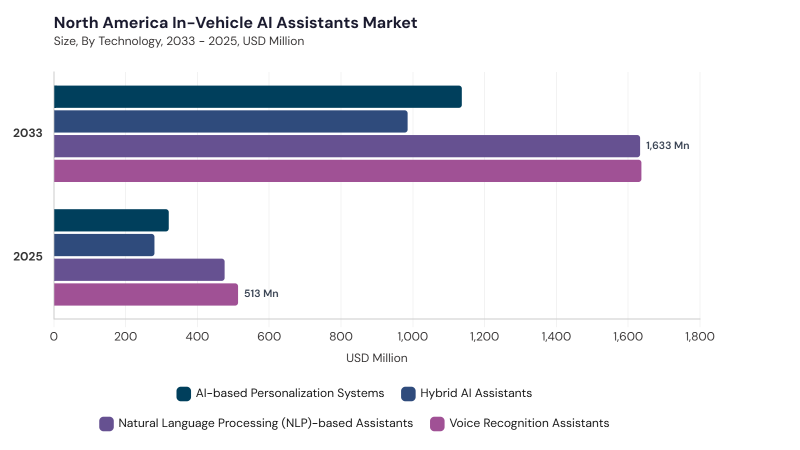
Based on Technology, the market is segmented into Voice Recognition Assistants, Natural Language Processing (NLP)-based Assistants, AI-based Personalization Systems, and Hybrid AI Assistants. Voice Recognition Assistants remain the dominant technology because hands-free operation is one of the most widely adopted and safety-relevant functions in modern vehicles. These systems allow users to control calls, music, messages, navigation, and selected vehicle functions without taking attention away from the road.
NLP-based assistants are becoming more important as drivers expect conversational systems that understand intent, follow-up questions, accents, and contextual commands. AI-based Personalization Systems support adaptive user experiences by learning preferences related to routes, entertainment, seat positions, climate settings, and driving habits. Hybrid AI Assistants combine voice recognition, NLP, machine learning, contextual intelligence, and predictive features to deliver a more complete digital companion. Their adoption is developing as automakers build more unified AI platforms for connected and software-defined vehicles.
Based on End User, the market is segmented into Infotainment & Media Control, Navigation & Traffic Assistance, Driver Assistance & Safety Alerts, Vehicle Control, and Personalization & User Profiling. Infotainment & Media Control represents the leading application area as drivers and passengers increasingly use AI assistants to manage music, podcasts, calls, messages, entertainment apps, and connected media services through voice-based interaction. Navigation & Traffic Assistance is strongly supported by real-time route optimization, traffic updates, parking guidance, charging station search, weather alerts, and location-based recommendations.
Driver Assistance & Safety Alerts are gaining importance as AI assistants translate sensor and ADAS data into useful warnings related to driver fatigue, collision risks, lane behavior, speed conditions, and surrounding hazards. Vehicle Control applications are expanding as users prefer voice-based operation of climate, lighting, windows, seats, and selected cabin functions. Personalization & User Profiling is developing as AI assistants learn driver preferences, frequent destinations, entertainment choices, cabin settings, and mobility habits to create more individualized in-vehicle experiences.
Free Valuable Insights: The Global In-Vehicle AI Assistants Market will hit USD 15.2 Billion billion by 2033, at a CAGR of 17.4%
Based on Country, the market is segmented into US, Canada, Mexico, and Rest of North America. The US market dominated the North America In-Vehicle AI Assistants Market by Country in 2025, and would continue to be a dominant market till 2033; thereby, achieving a market value of USD 3.4 Billion by 2032, growing at a CAGR of 16.1 % during the forecast period. The Canada market is expected to witness a CAGR of 19.7% during (2026 - 2033). Additionally, The Mexico market is expected to witness a CAGR of 18.3% during (2026 - 2033).
The US remains the leading country market due to its strong automotive OEM presence, advanced connected vehicle ecosystem, software-defined vehicle development, electric vehicle adoption, AI technology base, and consumer demand for premium digital cockpit experiences. AI assistants in the US are increasingly linked with personalization, smart infrastructure integration, vehicle safety features, infotainment, cloud services, and hands-free connectivity. Canada supports market growth through bilingual AI requirements, data privacy focus, connected mobility adoption, V2X communication development, and demand for secure, low-latency in-vehicle systems. Mexico is gaining momentum through automotive manufacturing strength, growing adoption of connected vehicle technologies, urban mobility needs, younger tech-oriented drivers, road safety priorities, and rising integration of generative AI with vehicle sensor data. Rest of North America contributes through broader adoption of privacy-conscious AI, edge processing, V2X integration, connected car platforms, and localized digital mobility solutions.

By Vehicle Type
By Sales Channel
By Level of Integration
By Technology
By End User
By Country
Set to reach USD 4.5 Billion by 2033, growing at 16.8% CAGR during 2026-2033.
The US leads with USD 3.4 Billion by 2032, growing at 16.1% CAGR during 2026-2033.
Passenger Vehicles segment will achieve USD 3.7 Billion by 2032, growing at 16.5% CAGR during 2026-2033.
OEM market will reach USD 3.8 Billion by 2032, growing at 16.6% CAGR during 2026-2033.
The Canada market is expected to witness a CAGR of 19.7% during 2026-2033.
The Commercial Vehicles market is expected to witness a CAGR of 18.3% during 2026-2033.
Our team of dedicated experts can provide you with attractive expansion opportunities for your business.




 Unique Offerings