The sample copy of this report is available for access.
The Europe In-Vehicle AI Assistants Market is expected to reach USD 2.8 Billion by 2031, growing at a CAGR of 17% during (2026 – 2033).
The Europe In-Vehicle AI Assistants Market has evolved from conventional infotainment and voice-command features into a more advanced layer of intelligent vehicle interaction. Early systems in European vehicles mainly supported limited hands-free calling, basic media control, and navigation commands, with restricted ability to understand natural language or adapt to driver behavior. As European automakers moved toward connected platforms, electric mobility, software-defined vehicles, and advanced safety systems, AI assistants started gaining a broader role inside the vehicle cabin. The market has gradually shifted from simple command execution to intelligent support involving multilingual conversations, predictive maintenance alerts, driver assistance, personalized cabin settings, and real-time mobility information.
The regional market is being shaped by the rise of generative AI, edge computing, software-defined vehicle platforms, multilingual voice interfaces, and privacy-focused digital cockpit technologies. European consumers increasingly expect vehicles to offer natural conversation, hands-free control, route intelligence, media access, smart comfort settings, and safety-linked alerts without increasing driver distraction. Automakers are also placing more emphasis on AI systems that can comply with GDPR, cybersecurity requirements, EU AI-related rules, and vehicle safety standards. This creates strong demand for assistants that combine conversational accuracy, low-latency response, data security, and seamless integration with infotainment, telematics, ADAS, and cloud services.
Based on Vehicle Type, the market is segmented into Passenger Vehicles and Commercial Vehicles. The Passenger Vehicles market dominated the Europe In-Vehicle AI Assistants Market by Vehicle Type in 2025, and would continue to be a dominant market till 2033; thereby, achieving a market value of USD 2.2 Billion by 2031, growing at a CAGR of 16.6 % during the forecast period. The Commercial Vehicles market is expected to witness a CAGR of 18.5% during (2026 - 2033).
Passenger vehicles account for the leading position as European consumers increasingly prefer connected, safe, and personalized driving experiences. AI assistants in passenger cars support infotainment control, navigation, cabin comfort, driver alerts, route recommendations, voice-based communication, and smartphone integration. Their use is especially strong in premium cars, electric vehicles, connected vehicles, and models equipped with advanced digital cockpit systems. Commercial vehicles are also adopting AI assistants for more practical operational purposes, including fleet communication, driver monitoring, route optimization, predictive maintenance, fatigue alerts, and regulatory compliance support. This segment is gradually expanding as logistics, public transport, and delivery operators look for tools that can improve safety, reduce downtime, and support more efficient vehicle operations across Europe.
Based on Sales Channel, the market is segmented into OEM and Aftermarket. The OEM market dominated the Europe In-Vehicle AI Assistants Market by Sales Channel in 2025, and would continue to be a dominant market till 2033; thereby, achieving a market value of USD 2.3 Billion by 2031, growing at a CAGR of 16.7 % during the forecast period. The Aftermarket market is expected to witness a CAGR of 18.5% during (2026 - 2033).
The OEM channel holds the dominant position because European automakers are increasingly embedding AI assistants directly into factory-installed infotainment, telematics, digital cockpit, and software-defined vehicle platforms. OEM integration enables stronger compatibility with vehicle electronics, better cybersecurity control, reliable system performance, and smoother compliance with safety and data privacy standards. It also allows automakers to offer brand-specific digital experiences and support future upgrades through software updates. The aftermarket channel serves consumers and fleet owners who want to add AI-enabled connectivity, infotainment upgrades, or smart voice functions to existing vehicles. Its growth is supported by modular devices, digital retail channels, and consumer interest in affordable technology upgrades, although adoption depends on compatibility, installation quality, warranty concerns, and data security assurance.
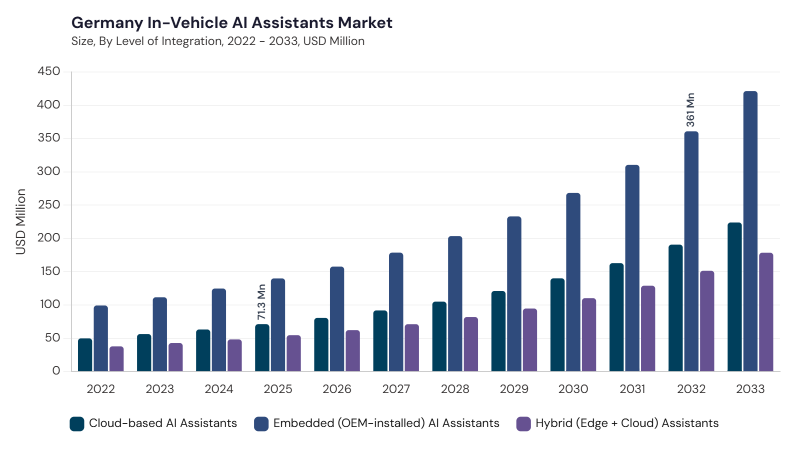
Based on Level of Integration, the market is segmented into Embedded (OEM-installed) AI Assistants, Cloud-based AI Assistants, and Hybrid (Edge + Cloud) Assistants. Embedded AI Assistants lead the market because they provide low-latency operation, stronger reliability, offline functionality, and closer integration with vehicle controls and safety-related systems. These assistants are especially suitable for functions requiring stable performance, such as voice control, emergency alerts, vehicle status updates, driver support, and in-cabin operations.
Cloud-based AI Assistants are gaining attention as connected vehicle infrastructure, 5G networks, and real-time data services expand across Europe. They support advanced language processing, live traffic intelligence, multimedia services, cloud learning, and continuous feature improvement. Hybrid assistants are developing as a balanced model, combining onboard processing for privacy and responsiveness with cloud support for advanced AI functions, personalization, map updates, and broader service integration. This approach fits Europe’s need for secure, responsive, and continuously improving AI systems.
Based on Technology, the market is segmented into Voice Recognition Assistants, Natural Language Processing (NLP)-based Assistants, AI-based Personalization Systems, and Hybrid AI Assistants. Voice Recognition Assistants remain the most widely adopted technology because hands-free operation is strongly aligned with safety, convenience, and driver-distraction reduction. These systems allow users to control calling, navigation, media, messages, climate, and selected vehicle functions through spoken commands. NLP-based assistants are becoming more important as European vehicles require more natural, multilingual, and context-aware interactions across diverse languages and accents.
AI-based Personalization Systems are expanding as consumers expect vehicles to remember preferences for cabin settings, routes, entertainment, charging behavior, and driving habits while maintaining strong data protection. Hybrid AI Assistants are gaining momentum as automakers combine voice recognition, NLP, machine learning, contextual intelligence, and multimodal interaction into unified platforms. Their adoption is supported by software-defined vehicles, edge computing, and the growing need for AI systems that can manage multiple in-cabin and safety-related functions.
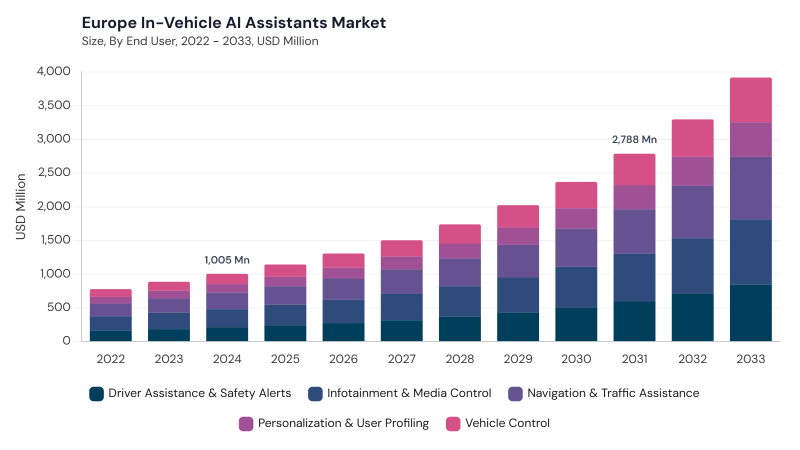
Based on End User, the market is segmented into Infotainment & Media Control, Navigation & Traffic Assistance, Driver Assistance & Safety Alerts, Vehicle Control, and Personalization & User Profiling. Infotainment & Media Control is the leading end-user application as European drivers and passengers increasingly use AI assistants to access music, radio, calls, messages, podcasts, streaming platforms, and connected services through safer voice-based interaction. Navigation & Traffic Assistance is highly relevant due to dense city networks, cross-border travel, low-emission zones, parking challenges, toll routes, charging station needs, and real-time traffic conditions.
Driver Assistance & Safety Alerts have a strong role in Europe because AI assistants help communicate warnings related to speed limits, driver attention, lane behavior, collision risks, pedestrians, and road hazards. Vehicle Control is growing through voice-based operation of climate, lighting, seats, cabin comfort, and software-defined features. Personalization & User Profiling is gaining recognition as vehicles become more adaptive, but adoption depends on transparent consent, secure data use, and privacy-focused design.
Free Valuable Insights: The Global In-Vehicle AI Assistants Market will hit USD 15.2 Billion billion by 2033, at a CAGR of 17.4%
Based on Country, the market is segmented into Germany, UK, France, Russia, Spain, Italy, and Rest of Europe. The Germany market dominated the Europe In-Vehicle AI Assistants Market by Country in 2025, and would continue to be a dominant market till 2033; thereby, achieving a market value of USD 602.4 million by 2031, growing at a CAGR of 15.5 % during the forecast period. The UK market is expected to witness a CAGR of 15.8% during (2026 - 2033). Additionally, The France market is expected to witness a CAGR of 17.9% during (2026 - 2033).
Germany leads the Europe market due to its strong automotive manufacturing base, software-defined vehicle development, premium vehicle production, AI research activity, and emphasis on safe, connected, and personalized mobility. German automakers are integrating AI assistants into digital cockpits, infotainment systems, predictive maintenance platforms, and advanced driver support functions. The UK market is supported by edge AI adoption, connected car platforms, sensor-based intelligence, generative AI integration, and strong interest in privacy-conscious vehicle technologies. France is progressing through AI innovation, regulatory alignment, connected mobility development, and strong focus on safe and ethical AI deployment in vehicles. Russia shows adoption around localized language assistants, connected car technologies, privacy-oriented systems, and domestic AI interfaces. Spain is supported by hands-free safety functions, multimodal interfaces, language localization, and growing demand for connected in-car services. Italy benefits from contextual AI, smart city integration, voice-based vehicle control, and connected vehicle adoption.

By Vehicle Type
By Sales Channel
By Level of Integration
By Technology
By End User
By Country
Set to reach USD 2.8 Billion by 2033, growing at 17% CAGR during 2026-2033.
Germany leads with USD 602.4 million by 2031, growing at 15.5% CAGR during the forecast period.
Passenger Vehicles segment dominates, reaching USD 2.2 Billion by 2031 at 16.6% CAGR during 2026-2033.
Commercial Vehicles segment will grow at 18.5% CAGR during 2026-2033.
France market is expected to witness a CAGR of 17.9% during 2026-2033.
Aftermarket sales channel is expected to grow at 18.5% CAGR during 2026-2033.
Our team of dedicated experts can provide you with attractive expansion opportunities for your business.




 Unique Offerings