The sample copy of this report is available for access.
The LAMEA In-Vehicle AI Assistants Market is expected to reach USD 623.4 Million by 2029, growing at a CAGR of 19.4% during (2026 – 2033).
The LAMEA In-Vehicle AI Assistants Market has progressed from basic infotainment controls and simple voice-command systems into a developing intelligent mobility layer across Latin America, the Middle East, and Africa. In the early phase, adoption was mainly limited to navigation support, hands-free calling, music control, and entry-level connected vehicle features, largely concentrated in premium and imported vehicle models. As artificial intelligence, machine learning, natural language processing, edge computing, and cloud connectivity improved, these assistants began supporting more practical functions such as contextual commands, driver alerts, vehicle diagnostics, predictive maintenance, and personalized in-cabin responses. The region’s evolution is shaped by uneven digital infrastructure, cost-sensitive vehicle demand, linguistic diversity, and growing interest in connected mobility.
The market is currently influenced by rising demand for localized voice interaction, affordable connected vehicle features, smart cockpit systems, driver safety support, and cloud-edge AI deployment. LAMEA presents a different adoption pattern because consumers and fleet operators require systems that can work across varied road conditions, different languages, inconsistent network coverage, and multiple vehicle price categories. Automakers and technology providers are therefore focusing on scalable AI platforms, multilingual speech recognition, low-latency response, data security, regional compliance, and integration with infotainment, telematics, navigation, and safety systems. Growth is also supported by increasing smartphone usage, improving 4G and 5G networks, urban mobility projects, AI-focused government initiatives, and the gradual rise of connected and electric vehicles.
Based on Vehicle Type, the market is segmented into Passenger Vehicles and Commercial Vehicles. The Passenger Vehicles market dominated the LAMEA In-Vehicle AI Assistants Market by Vehicle Type in 2025, and would continue to be a dominant market till 2033; thereby, achieving a market value of USD 513.2 Million by 2029, growing at a CAGR of 19.1 % during the forecast period. The Commercial Vehicles market is expected to witness a CAGR of 21.2% during (2026 - 2033).
Passenger Vehicles hold the leading position as consumers increasingly prefer connected infotainment, hands-free controls, navigation support, smart cabin features, and AI-enabled safety alerts in personal mobility. Adoption is supported by rising sales of connected passenger vehicles, expansion of global automotive brands, growing interest in electric vehicles, and consumer familiarity with smartphone-based voice assistants. AI assistants in passenger vehicles support media control, route guidance, climate settings, driver alerts, vehicle information, and personalized user preferences. Commercial Vehicles are gaining importance as logistics companies, fleet operators, public transport providers, and delivery networks use AI assistants for driver behavior monitoring, route planning, fleet tracking, predictive maintenance, fuel efficiency support, and safety alerts. This segment is developing steadily as businesses seek better visibility, lower downtime, and improved operational control.
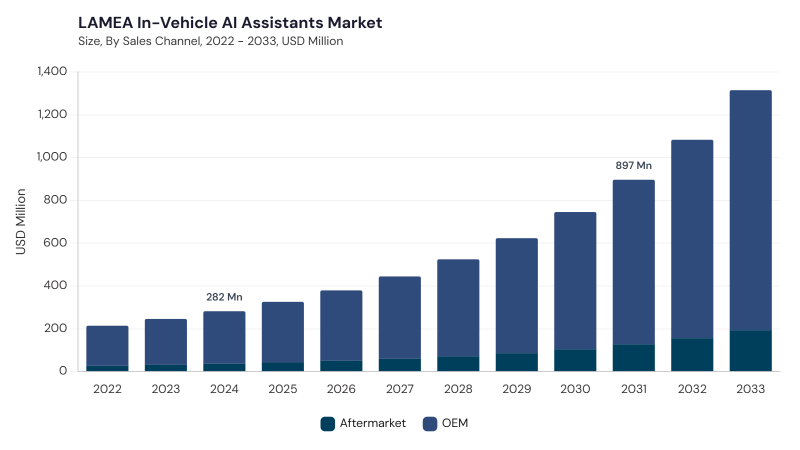
Based on Sales Channel, the market is segmented into OEM and Aftermarket. The OEM market dominated the LAMEA In-Vehicle AI Assistants Market by Sales Channel in 2025, and would continue to be a dominant market till 2033; thereby, achieving a market value of USD 537.3 Million by 2029, growing at a CAGR of 19.2 % during the forecast period. The Aftermarket market is expected to witness a CAGR of 21.1% during (2026 - 2033).
The OEM channel leads the market because factory-installed AI assistants provide better integration with infotainment systems, vehicle electronics, telematics platforms, sensors, navigation tools, and cybersecurity frameworks. Automakers prefer OEM integration to deliver reliable performance, brand-specific user experiences, smoother software updates, and better compatibility with connected vehicle architectures. OEM adoption is also supported by growing investments in smart cockpits, locally assembled connected vehicles, and premium vehicle technologies across key LAMEA economies. The Aftermarket channel is expanding as owners of existing vehicles look for affordable AI-enabled infotainment upgrades, plug-and-play voice modules, smartphone-connected systems, and smart automotive accessories. This channel is attractive in markets with long vehicle replacement cycles and strong cost sensitivity, but adoption depends on installation quality, compatibility, data security, product reliability, and consumer awareness.
Based on Level of Integration, the market is segmented into Embedded (OEM-installed) AI Assistants, Cloud-based AI Assistants, and Hybrid (Edge + Cloud) Assistants. Embedded AI Assistants dominate as they offer dependable performance, lower latency, offline operation, stronger data control, and closer integration with vehicle systems. These assistants are particularly useful in LAMEA markets where internet coverage can be inconsistent and users need reliable access to voice commands, vehicle settings, safety alerts, and basic assistance functions.
Cloud-based AI Assistants are gaining traction in urban centers where mobile broadband, connected vehicle services, and cloud platforms are improving. They support richer natural language processing, real-time updates, infotainment services, traffic information, remote diagnostics, and personalized experiences. Hybrid Assistants are emerging as a practical architecture for the region because they combine onboard processing for critical and privacy-sensitive functions with cloud intelligence for advanced learning, updates, and connected services. This approach helps address the region’s mixed connectivity conditions while supporting future-ready AI capabilities.
Based on Technology, the market is segmented into Voice Recognition Assistants, Natural Language Processing (NLP)-based Assistants, AI-based Personalization Systems, and Hybrid AI Assistants. Voice Recognition Assistants remain the leading technology because they provide a simple and practical way for drivers to use navigation, calling, music, media, and vehicle functions without manual distraction. Their adoption is supported by demand for hands-free operation and improving speech recognition for regional languages and accents.
NLP-based Assistants are gaining market relevance as users expect more conversational, accurate, and context-aware systems that can understand intent rather than only fixed commands. AI-based Personalization Systems are developing as consumers show interest in adaptive settings, preferred routes, infotainment choices, cabin comfort, language selection, and personalized recommendations. Hybrid AI Assistants are progressing as automakers integrate voice recognition, NLP, personalization, contextual awareness, and multimodal interaction into broader smart cockpit platforms. Their future growth is linked to connected vehicles, autonomous features, cloud-edge architectures, and regional localization.
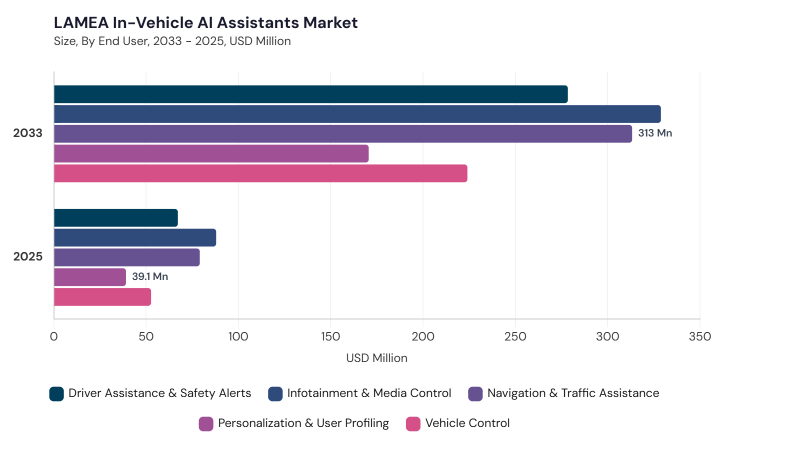
Based on End User, the market is segmented into Infotainment & Media Control, Navigation & Traffic Assistance, Driver Assistance & Safety Alerts, Vehicle Control, and Personalization & User Profiling. Infotainment & Media Control represents the leading end-user application as consumers increasingly use AI assistants to manage music, radio, calls, messages, streaming services, smartphone connectivity, and multimedia platforms through voice-enabled interaction. Navigation & Traffic Assistance is also important due to growing urban congestion, developing road infrastructure, and rising need for route guidance, traffic updates, fuel station search, parking support, service center information, and location-based recommendations.
Driver Assistance & Safety Alerts are gaining relevance as AI assistants provide warnings related to driver fatigue, collision risks, speed conditions, road hazards, vehicle diagnostics, and surrounding traffic. Vehicle Control is expanding through voice-based operation of climate settings, windows, lighting, seat comfort, and selected in-cabin functions. Personalization & User Profiling is emerging as connected vehicle users begin to prefer adaptive routes, entertainment preferences, cabin settings, language choices, and driver-specific profiles, although data security and user trust remain important adoption factors.
Free Valuable Insights: The Global In-Vehicle AI Assistants Market will hit USD 15.2 Billion billion by 2033, at a CAGR of 17.4%
Based on Country, the market is segmented into Brazil, Argentina, UAE, Saudi Arabia, South Africa, Nigeria, and Rest of LAMEA. The Brazil market dominated the LAMEA In-Vehicle AI Assistants Market by Country in 2025, and would continue to be a dominant market till 2033; thereby, achieving a market value of USD 123.9 Million by 2029, growing at a CAGR of 17.5 % during the forecast period. The Argentina market is expected to witness a CAGR of 20.9% during (2026 - 2033). Additionally, The UAE market is expected to witness a CAGR of 18.5% during (2026 - 2033).
Brazil remains the leading country market, supported by connected vehicle adoption, Portuguese-language AI localization, smart mobility development, infotainment upgrades, cloud-edge platforms, and growing use of AI for diagnostics and driver assistance. Argentina is gaining traction through rising demand for personalized driving experiences, multimodal AI assistants, safety-focused features, and localized Latin American language models. The UAE shows strong potential due to smart city initiatives, premium vehicle demand, generative AI adoption, Arabic language localization, electric mobility pilots, and integration of AI assistants with intelligent transport systems. Saudi Arabia is advancing through Vision 2030-linked digital transformation, smart mobility investments, Arabic voice assistant development, 5G connectivity, autonomous vehicle initiatives, and cloud-enabled vehicle intelligence. South Africa contributes through connected vehicle growth, driver safety demand, multilingual support, 5G-enabled services, and fleet modernization. Nigeria is emerging through smartphone penetration, expanding mobile connectivity, localized AI development, traffic adaptation needs, and demand for affordable smart mobility features.

By Vehicle Type
By Sales Channel
By Level of Integration
By Technology
By End User
By Country
Set to reach USD 623.4 Million by 2033, growing at 19.4% CAGR during 2026-2033.
Brazil leads with a market value of USD 123.9 Million by 2029, growing at 17.5% CAGR during 2026-2033.
Passenger Vehicles segment achieves USD 513.2 Million by 2029, growing at 19.1% CAGR during 2026-2033.
OEM market reaches USD 537.3 Million by 2029, growing at 19.2% CAGR during 2026-2033.
The UAE market is expected to witness a CAGR of 18.5% during 2026-2033.
Commercial Vehicles market is expected to witness a CAGR of 21.2% during 2026-2033.
Our team of dedicated experts can provide you with attractive expansion opportunities for your business.




 Unique Offerings