The sample copy of this report is available for access.
“Global In-Vehicle AI Assistants Market to reach a market value of USD 15206.14 Million by 2033 growing at a CAGR of 17.4%”
The Global In-Vehicle AI Assistants Market is expected to reach USD 15.2 Billion by 2033, growing at a CAGR of 17.4% during (2026 - 2033).
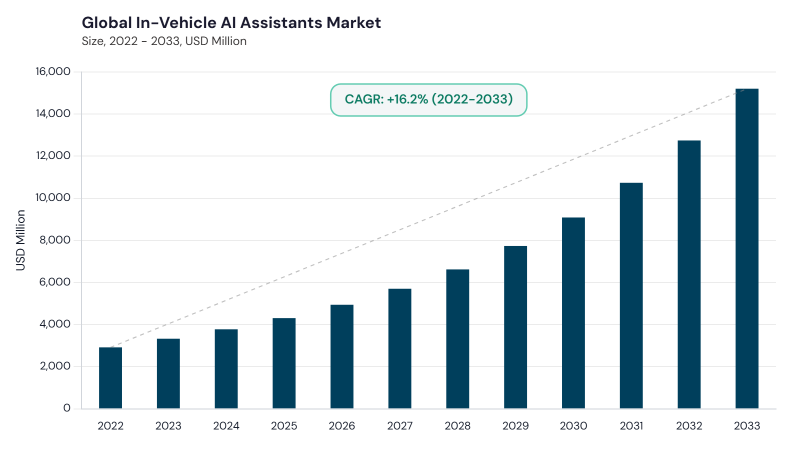
The In-Vehicle AI Assistants Market is growing due to rising demand for connected, intelligent, and safer in-car digital experiences. These assistants are being adopted across passenger vehicles, commercial fleets, electric vehicles, and autonomous mobility platforms. The market started with basic infotainment systems offering navigation, entertainment, and simple voice commands. Over time, these systems evolved into smart, context-aware assistants that understand driver needs and support real-time navigation, diagnostics, and predictive alerts. Automakers are now focusing on natural language processing, cloud connectivity, infotainment access, and advanced human-machine interfaces. The market is also shaped by generative AI, edge AI, software-defined vehicles, and multilingual voice systems. Rising consumer expectations for seamless digital interaction are further supporting market growth.
The In-Vehicle AI Assistants Market is witnessing strong expansion as vehicles increasingly transform into intelligent, software-defined, and connected digital platforms. AI assistants help drivers and passengers manage infotainment, navigation, media, communication, climate control, vehicle functions, driver alerts, and personalized preferences through voice, contextual understanding, and automated interaction. The market is also benefiting from integration with ADAS, electric vehicle ecosystems, cloud services, smart cockpits, vehicle diagnostics, and over-the-air software updates. Growing demand for hands-free interaction, safer driving, real-time route assistance, and adaptive user experiences continues to strengthen adoption across global automotive markets.
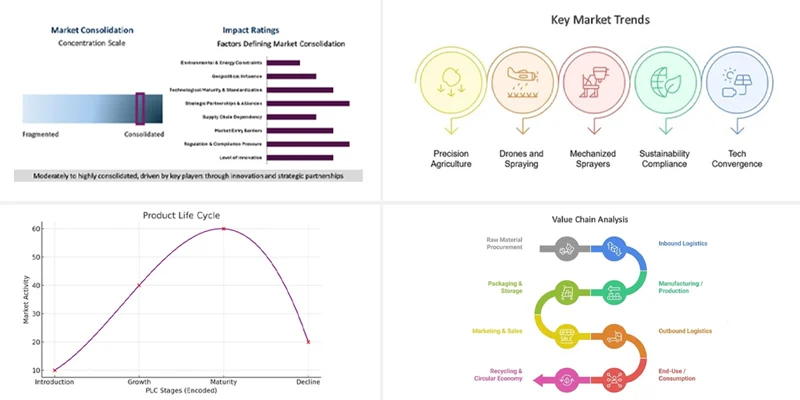
The In-Vehicle AI Assistants Market is characterized by a moderately consolidated and software-defined automotive technology competitive environment consisting of automotive conversational AI providers, cloud computing companies, premium OEMs, AI infrastructure companies, semiconductor providers, and voice intelligence specialists. Competition is centered on natural language processing accuracy, contextual awareness, multilingual capabilities, cloud-edge integration, data privacy, cybersecurity, vehicle system interoperability, user personalization, and real-time responsiveness. Technology firms compete through AI models, cloud ecosystems, and software platforms, while automotive OEMs compete through proprietary intelligent cockpit experiences and deeper integration with vehicle functions.

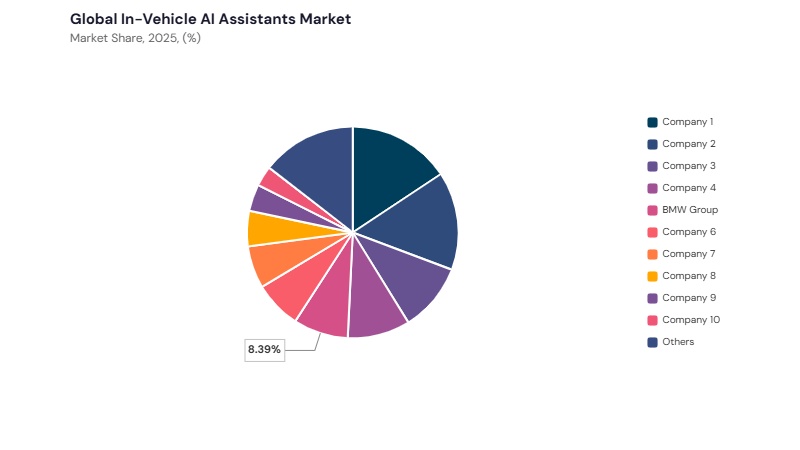
The global In-Vehicle AI Assistants Market exhibits a relatively concentrated and software-defined automotive technology-driven competitive structure, led by major AI platform providers, automotive conversational intelligence companies, premium vehicle manufacturers, cloud infrastructure providers, and voice technology specialists. Google LLC holds a leading position in the market, supported by Android Automotive OS, Google Assistant, Gemini-powered in-vehicle AI capabilities, cloud-native automotive services, mapping strength, and partnerships with global automakers. Cerence, Inc. also maintains a strong position due to its specialization in automotive conversational AI, multilingual voice recognition, embedded assistant platforms, and long-standing OEM relationships. Mercedes-Benz Group AG, Amazon Web Services, BMW Group, NVIDIA Corporation, Volkswagen AG, General Motors Co., Apple Inc., and SoundHound AI, Inc. also represent important participants in the market.
Based on Vehicle Type, the market is segmented into Passenger Vehicles and Commercial Vehicles. The Passenger Vehicles market dominated the Global In-Vehicle AI Assistants Market by Vehicle Type in 2025, and would continue to be a dominant market till 2033; thereby, achieving a market value of USD 12.3 Billion by 2033, growing at a CAGR of 17.1 % during the forecast period. The Commercial Vehicles market is expected to witness a CAGR of 19% during (2026 - 2033).
Passenger vehicles lead the market due to widespread integration of AI-powered infotainment, smart cockpit platforms, voice assistants, connected navigation, and personalized in-car experiences. Automakers are increasingly installing AI assistants in passenger cars to enhance convenience, safety, entertainment, vehicle control, and digital engagement. Commercial vehicles are witnessing faster growth as fleet operators adopt AI assistants for route optimization, driver monitoring, predictive maintenance, vehicle diagnostics, productivity support, and operational efficiency. As connected fleet platforms expand, AI assistants are expected to become increasingly important in commercial vehicle management.
Based on Sales Channel, the market is segmented into OEM and Aftermarket. The OEM market dominated the Global In-Vehicle AI Assistants Market by Sales Channel in 2025, and would continue to be a dominant market till 2033; thereby, achieving a market value of USD 12.9 Billion by 2033, growing at a CAGR of 17.2 % during the forecast period. The Aftermarket market is expected to witness a CAGR of 18.9% during (2026 - 2033).
OEM sales dominate as automakers increasingly integrate AI assistants directly into factory-installed infotainment systems, digital cockpit platforms, connected vehicle architectures, and software-defined vehicle platforms. OEM integration enables smoother performance, deeper vehicle system access, stronger cybersecurity control, and better brand-specific user experiences. The aftermarket segment is expanding as consumers seek to upgrade existing vehicles with AI-enabled infotainment, smart voice modules, connected assistants, and retrofit digital cockpit solutions. Rising vehicle longevity and demand for affordable AI upgrades continue to support aftermarket growth.
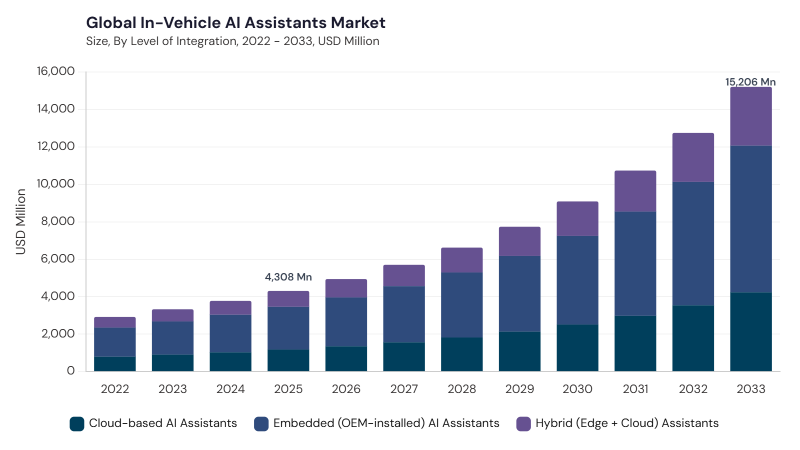
Based on Level of Integration, the market is segmented into Embedded OEM-installed AI Assistants, Cloud-based AI Assistants, and Hybrid Edge + Cloud Assistants. The Embedded (OEM-installed) AI Assistants market dominated the Global In-Vehicle AI Assistants Market by Level of Integration in 2025, and would continue to be a dominant market till 2033; thereby, achieving a market value of USD 7.8 Billion by 2033, growing at a CAGR of 17 % during the forecast period. The Cloud-based AI Assistants market is expected to witness a CAGR of 17.7% during (2026 - 2033). The Hybrid (Edge + Cloud) Assistants market is expected to witness a CAGR of 18.1% during (2026 - 2033).
Embedded AI assistants are widely adopted due to low latency, strong vehicle integration, improved reliability, and enhanced data security. These systems support direct interaction with infotainment, vehicle control, ADAS, navigation, and diagnostic functions. Cloud-based AI assistants benefit from real-time updates, advanced conversational intelligence, cloud learning, and broader access to digital services. Hybrid assistants are gaining momentum because they combine the responsiveness and privacy advantages of edge processing with the scalability, intelligence, and continuous improvement capabilities of cloud platforms.
Based on Technology, the market is segmented into Voice Recognition Assistants, Natural Language Processing-based Assistants, AI-based Personalization Systems, and Hybrid AI Assistants. The Voice Recognition Assistants market dominated the Global In-Vehicle AI Assistants Market by Technology in 2025, and would continue to be a dominant market till 2033; thereby, achieving a market value of USD 4.6 Billion by 2033, growing at a CAGR of 16.5 % during the forecast period. The Natural Language Processing (NLP)-based Assistants market is expected to witness a CAGR of 17.6% during (2026 - 2033). Additionally, The AI-based Personalization Systems market is expected to witness highest CAGR of 18.1% during (2026 - 2033).
Voice recognition assistants dominate due to strong demand for hands-free control, safer driving, infotainment access, calling, messaging, navigation commands, and vehicle function control. NLP-based assistants are gaining demand as users expect more natural, conversational, and context-aware interaction. AI-based personalization systems are growing rapidly as vehicles learn driver preferences, routes, seating positions, media choices, climate settings, charging behavior, and user profiles. Hybrid AI assistants combine voice recognition, NLP, personalization, contextual analytics, and multimodal intelligence to support advanced connected and autonomous vehicle use cases.
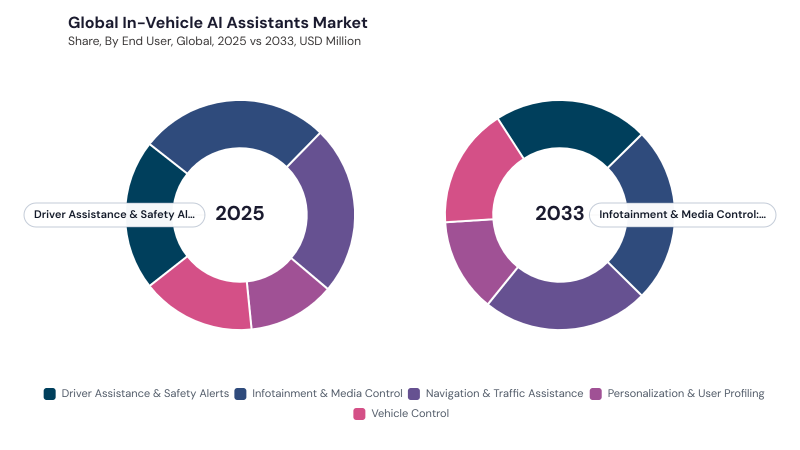
Based on End User, the market is segmented into Infotainment & Media Control, Navigation & Traffic Assistance, Driver Assistance & Safety Alerts, Vehicle Control, and Personalization & User Profiling. The Infotainment & Media Control market dominated the Global In-Vehicle AI Assistants Market by End User in 2025, and would continue to be a dominant market till 2033; thereby, achieving a market value of USD 3.8 Billion by 2033, growing at a CAGR of 16.3 % during the forecast period. The Navigation & Traffic Assistance market is expected to witness a CAGR of 17.2% during (2026 - 2033). Additionally, The Driver Assistance & Safety Alerts market is expected to witness highest CAGR of 17.8% during (2026 - 2033).
Infotainment and media control lead the market as consumers increasingly expect vehicles to provide voice-controlled access to music, radio, podcasts, calls, messages, streaming platforms, and connected applications. Navigation and traffic assistance are strongly supported by real-time route guidance, parking assistance, traffic alerts, charging station support, and road condition updates. Driver assistance and safety alerts are gaining importance as AI assistants convert sensor data into usable driver warnings related to collision risk, lane movement, fatigue, speed, and hazards. Vehicle control and personalization applications are also expanding as AI assistants increasingly manage climate, lighting, seating, driving modes, and user-specific preferences.
Free Valuable Insights: In-Vehicle AI Assistants Market Size to reach $15.2 Billion by 2033
Region-wise, the In-Vehicle AI Assistants Market is analyzed across North America, Europe, Asia Pacific, and LAMEA. The North America market dominated the Global In-Vehicle AI Assistants Market by Region in 2025, and would continue to be a dominant market till 2033; thereby, achieving a market value of USD 5.3 Billion by 2033, growing at a CAGR of 16.8 % during the forecast period. The Europe market is expected to witness a CAGR of 17% during (2026 - 2033). Additionally, The Asia Pacific market is expected to witness a CAGR of 18% during (2026 - 2033).
North America benefits from early connected vehicle adoption, strong AI innovation, premium vehicle penetration, cloud service maturity, software-defined vehicle development, and strong presence of major technology and automotive companies. Europe is supported by software-defined vehicle deployment, strict automotive safety standards, connected cockpit innovation, and strong participation from premium OEMs. Asia Pacific is witnessing rapid growth due to rising vehicle production, increasing smart mobility adoption, EV expansion, digital cockpit investment, and strong demand for connected car features in China, Japan, South Korea, and India. LAMEA remains smaller but is expected to grow rapidly as connected vehicle infrastructure, digital automotive adoption, and premium mobility demand improve.
| Report Attribute | Details |
|---|---|
| Market size value in 2026 | USD 5.0 Billion |
| Market size forecast in 2033 | USD 15.2 Billion |
| Base Year | 2025 |
| Historical Period | 2022 to 2024 |
| Forecast Period | 2026 to 2033 |
| Revenue Growth Rate | CAGR of 17.4% from 2026 to 2033 |
| Number of Pages | 731 |
| Tables | 870 |
| Report Coverage | Market Trends, Revenue Estimation and Forecast, Segmentation Analysis, Regional and Country Breakdown, Competitive Landscape, Market Share Analysis, Company Profiling, Companies Strategic Developments, SWOT Analysis, Product Life Cycle Analysis, Value Chain Analysis, Market Consolidation Analysis, Key Customer Criteria, Pandemic Impact Analysis, and Winning Imperatives |
| Segments Covered | Vehicle Type, Sales Channel, Level of Integration, Technology, End User, Region |
| Country Scope |
|
| Companies Included | Google LLC, Cerence, Inc., Mercedes-Benz Group AG, Amazon Web Services, Inc., BMW Group, NVIDIA Corporation, Volkswagen AG, General Motors Co., Apple Inc., and SoundHound AI, Inc. |
By Vehicle Type
By Sales Channel
By Level of Integration
By Technology
By End User
By Geography
Expected to reach USD 15.2 billion by 2033, growing at 17.4% CAGR during 2026-2033.
Passenger vehicles lead, projected to hit USD 12.3 billion by 2033.
Google LLC, Cerence, Inc., Mercedes-Benz Group AG, and Amazon Web Services dominate the market.
OEM sales dominate, expected to reach USD 12.9 billion by 2033.
North America leads, projected to achieve USD 5.3 billion by 2033.
Voice recognition assistants lead, expected to reach USD 4.6 billion by 2033.
Our team of dedicated experts can provide you with attractive expansion opportunities for your business.








 Unique Offerings