The sample copy of this report is available for access.
The Asia Pacific In-Vehicle AI Assistants Market is expected to reach USD 2.7 Billion by 2030, growing at a CAGR of 18% during (2026 – 2033).
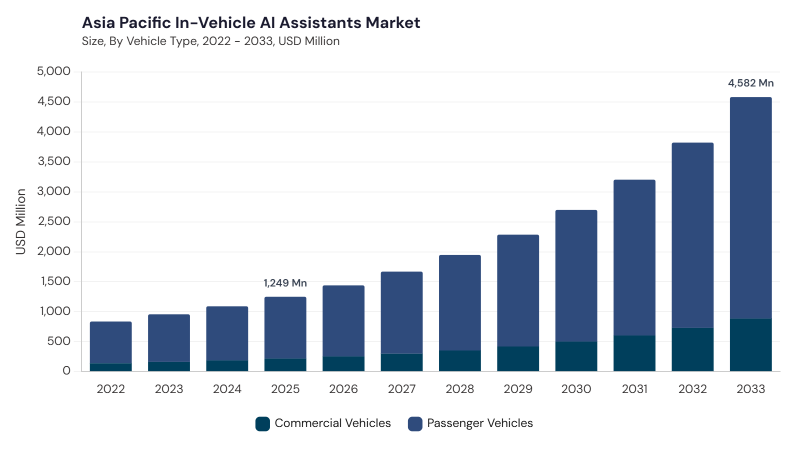
The Asia Pacific In-Vehicle AI Assistants Market has expanded from early infotainment voice-command features into a fast-moving intelligent mobility interface shaped by connected vehicles, electric mobility, smart city programs, and localized digital ecosystems. In the early phase, in-vehicle assistant functions were mostly limited to basic navigation commands, phone connectivity, media control, and telematics support. As natural language processing, machine learning, cloud services, edge AI, and vehicle sensor integration improved, AI assistants became more capable of understanding driver behavior, processing real-time vehicle information, and offering personalized responses.
The regional market is now driven by a combination of multilingual user demand, expanding 5G infrastructure, rising passenger vehicle production, electric vehicle growth, smart fleet development, and consumer preference for digital cockpit experiences. Asia Pacific is highly diverse, which makes localization more important than in many other regions. AI assistants must support different languages, accents, traffic environments, user habits, regulatory expectations, and affordability levels across developed and emerging markets. Automakers and technology providers are therefore focusing on voice accuracy, regional language processing, cloud-edge balance, cybersecurity, low-latency response, and scalable AI-as-a-Service models.
Based on Vehicle Type, the market is segmented into Passenger Vehicles and Commercial Vehicles. The Passenger Vehicles market dominated the Asia Pacific In-Vehicle AI Assistants Market by Vehicle Type in 2025, and would continue to be a dominant market till 2033; thereby, achieving a market value of USD 2.1 Billion by 2030, growing at a CAGR of 17.6 % during the forecast period. The Commercial Vehicles market is expected to witness a CAGR of 19.6% during (2026 - 2033).
Passenger Vehicles hold the leading position as consumers across China, Japan, South Korea, India, and Southeast Asia increasingly prefer vehicles with smart infotainment, voice-enabled controls, navigation support, personalized cabin settings, and safety-linked digital features. AI assistants are becoming especially relevant in connected cars, electric vehicles, premium models, and urban mobility-focused vehicles where buyers expect seamless interaction similar to smartphones and smart devices. These systems support hands-free communication, entertainment access, traffic updates, climate control, driver monitoring, and customized recommendations. Commercial Vehicles are developing steadily as fleet operators, logistics companies, delivery networks, and public transport providers adopt AI assistants for route optimization, driver behavior monitoring, predictive maintenance, safety alerts, vehicle health updates, and telematics integration. This segment is supported by the growth of e-commerce logistics, smart fleet management, and digital transport operations across the region.
Based on Sales Channel, the market is segmented into OEM and Aftermarket. The OEM market dominated the Asia Pacific In-Vehicle AI Assistants Market by Sales Channel in 2025, and would continue to be a dominant market till 2033; thereby, achieving a market value of USD 2.3 Billion by 2030, growing at a CAGR of 17.7 % during the forecast period. The Aftermarket market is expected to witness a CAGR of 19.5% during (2026 - 2033).
The OEM channel remains dominant because automakers are increasingly installing AI assistants directly into new vehicles to improve digital cockpit performance, safety functions, infotainment integration, and connected vehicle capabilities. Factory-installed systems offer stronger compatibility with vehicle electronics, better software-hardware coordination, lower reliability risks, and smoother integration with navigation, telematics, ADAS, and vehicle control systems. OEM adoption is also supported by competition among automakers to differentiate new models through smart cabin features and AI-enabled user experiences. The Aftermarket channel serves consumers who want to upgrade older vehicles with AI-enabled infotainment systems, plug-and-play voice modules, connected accessories, and smart navigation tools. This channel has scope in Asia Pacific because many countries have long vehicle replacement cycles and large existing vehicle fleets, although growth depends on affordability, installation quality, platform compatibility, cybersecurity, and ease of use.
Based on Level of Integration, the market is segmented into Embedded (OEM-installed) AI Assistants, Cloud-based AI Assistants, and Hybrid (Edge + Cloud) Assistants. Embedded AI Assistants lead the market as they provide reliable operation, local processing, lower latency, better offline performance, and closer connection with vehicle electronics. These assistants are useful for immediate commands, safety alerts, driver monitoring, navigation support, and selected vehicle control functions where response time and dependability are important.
Cloud-based AI Assistants are growing as 5G networks, connected car platforms, cloud infrastructure, and AI-as-a-Service models expand across the region. They support advanced conversational capabilities, real-time updates, predictive services, cloud learning, traffic intelligence, entertainment services, and third-party digital integration. Hybrid Assistants are gaining attention as automakers combine edge processing with cloud intelligence to improve responsiveness, data security, personalization, and continuous feature upgrades. This model is particularly suitable for Asia Pacific because network quality, privacy expectations, and vehicle technology levels vary widely across countries.
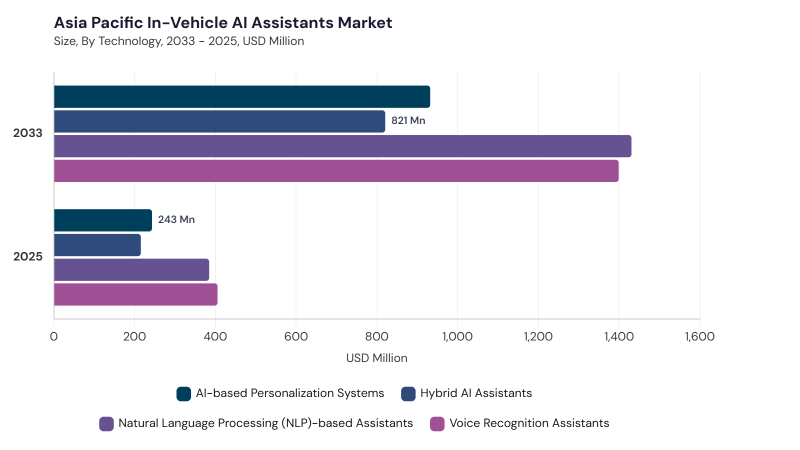
Based on Technology, the market is segmented into Voice Recognition Assistants, Natural Language Processing (NLP)-based Assistants, AI-based Personalization Systems, and Hybrid AI Assistants. Voice Recognition Assistants remain the leading technology because hands-free operation is one of the most practical and widely accepted AI functions inside vehicles. These systems allow users to manage calls, messages, music, navigation, climate settings, and selected vehicle functions through spoken commands. NLP-based Assistants are becoming increasingly important as drivers expect systems that can understand natural conversation, multiple languages, regional dialects, follow-up questions, and context-based requests.
AI-based Personalization Systems are expanding as vehicles begin to learn user preferences related to infotainment, seat settings, route choices, climate behavior, driving habits, and frequently visited locations. Hybrid AI Assistants are developing as a more advanced category by combining voice recognition, NLP, contextual intelligence, machine learning, and personalization into unified platforms. Their role is expected to grow as connected, electric, and semi-autonomous vehicles require more complete human-machine interaction.
Based on End User, the market is segmented into Infotainment & Media Control, Navigation & Traffic Assistance, Driver Assistance & Safety Alerts, Vehicle Control, and Personalization & User Profiling. Infotainment & Media Control represents the leading end-user application as consumers across Asia Pacific are highly engaged with smartphones, streaming platforms, social connectivity, music apps, and digital entertainment. AI assistants help users control media, calls, messages, podcasts, connected applications, and in-cabin entertainment through safer voice-based interaction. Navigation & Traffic Assistance is strongly supported by dense urban traffic, complex road networks, smart city initiatives, digital mapping platforms, ride-hailing services, toll systems, parking needs, and electric vehicle charging support.
Driver Assistance & Safety Alerts are gaining importance as AI assistants provide warnings related to driver fatigue, collision risks, pedestrians, lane movement, road conditions, speed issues, and nearby vehicles. Vehicle Control is expanding through voice-enabled management of air conditioning, lighting, windows, seats, drive modes, charging-related functions, and other smart cabin features. Personalization & User Profiling is developing as vehicles adapt to user preferences, regional languages, entertainment behavior, mobility routines, and personalized recommendations while maintaining data security expectations.
Free Valuable Insights: The Global In-Vehicle AI Assistants Market will hit USD 15.2 Billion billion by 2033, at a CAGR of 17.4%
Based on Country, the market is segmented into China, Japan, India, South Korea, Singapore, Malaysia, and Rest of Asia Pacific. The China market dominated the Asia Pacific In-Vehicle AI Assistants Market by Country in 2025, and would continue to be a dominant market till 2033; thereby, achieving a market value of USD 840.4 million by 2030, growing at a CAGR of 16.2 % during the forecast period. The Japan market is expected to witness a CAGR of 17.2% during (2026 - 2033). Additionally, The India market is expected to witness a CAGR of 18.8% during (2026 - 2033).
China remains the leading country market due to its large automotive production base, rapid connected car adoption, smart mobility ecosystem, local AI platforms, strong electric vehicle momentum, and demand for advanced human-vehicle interaction. Chinese automakers and technology firms are focusing on localized AI assistants, natural language interfaces, gesture recognition, cloud connectivity, and integration with broader digital mobility services. Japan contributes through its advanced automotive electronics, reliability-focused AI design, edge computing adoption, culturally refined user interfaces, and strong emphasis on safe and subtle driver support. India is gaining momentum through rising connected vehicle adoption, smartphone-linked driving expectations, multilingual voice assistant development, predictive maintenance use cases, and growing demand for affordable AI-enabled vehicle features. South Korea supports growth through advanced automotive manufacturing, smart city connectivity, local language optimization, AI-based safety functions, and integration with digital ecosystems. Singapore is progressing through smart mobility initiatives, 5G readiness, multimodal AI interfaces, cloud-enabled services, and urban traffic intelligence. Malaysia is developing through electric vehicle adoption, AI policy support, smart cabin technologies, and localization for regional languages.

By Vehicle Type
By Sales Channel
By Level of Integration
By Technology
By End User
By Country
Set to reach USD 2.7 Billion by 2033, growing at 18% CAGR during 2026-2033.
China leads with USD 840.4 million by 2030, growing at 16.2% CAGR during the forecast period.
Passenger Vehicles segment will achieve USD 2.1 Billion by 2030, growing at 17.6% CAGR during 2026-2033.
Expected to witness a CAGR of 19.6% during 2026-2033.
India market is expected to witness a CAGR of 18.8% during 2026-2033.
OEM market will achieve USD 2.3 Billion by 2030, growing at 17.7% CAGR during 2026-2033.
Our team of dedicated experts can provide you with attractive expansion opportunities for your business.




 Unique Offerings