The sample copy of this report is available for access.
The North America Hybrid Printing Technologies Market is expected to reach USD 4.4 billion by 2032, growing at a CAGR of 13.3% during (2026 - 2033).
North America Hybrid Printing Technologies Market originated from the convergence of traditional analog printing processes and advanced digital techniques, emerging prominently in the early 2000s. Early adoption was driven by the need to combine digital printing’s customization and speed with the cost-effectiveness and quality advantages of offset and flexographic methods. Technological progress in digital inkjet heads, flexo pre-coating, offset base layers, UV-curable inks, specialty inks, and workflow software enabled smoother integration of digital and analog printing steps. The market has now evolved into a mature printing ecosystem serving packaging, labels, and commercial print applications.
Sustainability, personalization, short-run production, workflow automation, and digital transformation are shaping current market development. Hybrid printing technologies are increasingly used to reduce waste, support eco-friendly inks and substrates, enable customized labels and packaging, and accelerate turnaround times. Automation, software, sensors, AI-driven quality control, and integrated production workflows are improving productivity while reducing errors. However, high capital investment, technical integration complexity, skilled-labor needs, regulatory compliance, environmental standards, and workflow disruption continue to influence adoption across North America.
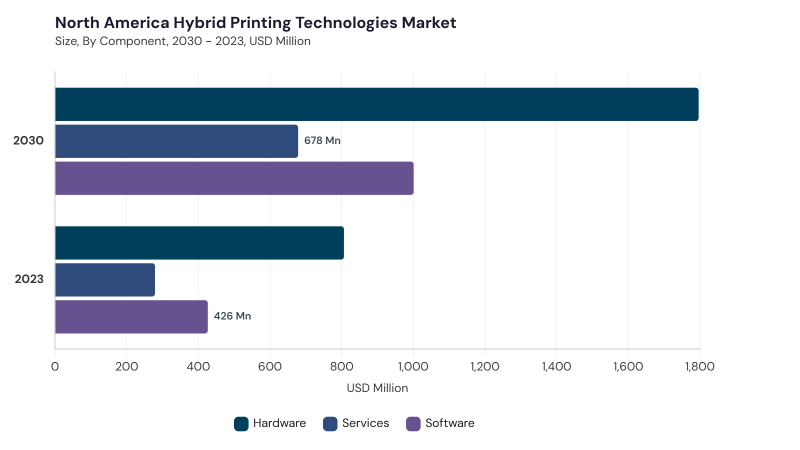
Based on Component, the market is segmented into Hardware, Software, and Services. The Hardware market dominated the North America Hybrid Printing Technologies Market by Component in 2025, and would continue to be a dominant market till 2033; thereby, achieving a market value of USD 2.2 billion by 2032, growing at a CAGR of 12.8 % during the forecast period. The Software market is expected to witness a CAGR of 13.7% during (2026 - 2033). The Services market is expected to witness a CAGR of 14.1% during (2026 - 2033).
Hardware includes hybrid presses, inkjet and laser print heads, finishing devices, curing systems, and substrate-handling equipment that determine print quality, speed, registration accuracy, and production reliability. Software garnered a significant share through workflow automation, color management, prepress optimization, production analytics, and digital front-end systems that coordinate multiple printing processes. Services maintained a promising presence as customers require equipment integration, installation, maintenance, workflow configuration, training, technical support, environmental-compliance assistance, and operator enablement for complex hybrid printing environments.
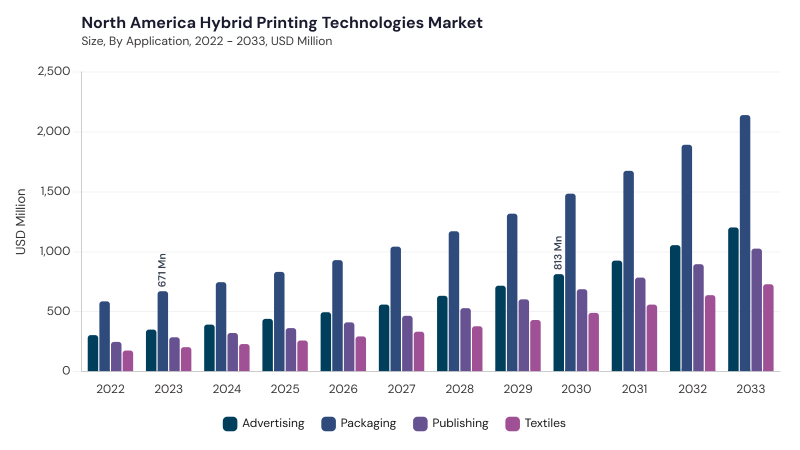
Based on Application, the market is segmented into Packaging, Advertising, Publishing, and Textiles. Packaging applications cover labels, cartons, flexible packaging, promotional packaging, food, beverage, personal care, pharmaceutical, and consumer goods uses where variable data, fast design changes, and high-quality graphics are important. Advertising secured a substantial share through point-of-sale displays, banners, posters, direct mail, promotional materials, and personalized campaigns.
Publishing established a considerable presence through short-run books, magazines, brochures, niche publications, and print-on-demand models. Textiles represented a promising segment, encouraged by customized fabrics, branded merchandise, décor applications, apparel, home textiles, and on-demand textile production.
Based on Substrate, the market is segmented into Paper and Cardboard, Plastics, Textile, Glass & Metal, and Other Substrate. Paper and Cardboard benefit from cost-effectiveness, recyclability, fiber-based packaging interest, coating compatibility, and broad use in consumer-facing applications. Plastics captured a substantial share through flexible packaging, films, shrink sleeves, durable labels, healthcare products, and consumer goods requiring moisture resistance and strong graphics.
Textile maintained a considerable presence across apparel, soft signage, interiors, and promotional products, while Glass & Metal recorded a noteworthy standing in containers, decorative surfaces, electronics, automotive parts, and industrial products. Other Substrate includes wood, ceramics, flexible electronics, specialty surfaces, and unconventional materials requiring adaptive hybrid workflows.
Free Valuable Insights: The Global Hybrid Printing Technologies Market will hit USD 15.2 Billion billion by 2033, at a CAGR of 13.9%
Based on Country, the market is segmented into US, Canada, Mexico, and Rest of North America. The US market dominated the North America Hybrid Printing Technologies Market by Country in 2025, and would continue to be a dominant market till 2033; thereby, achieving a market value of USD 3.0 billion by 2032, growing at a CAGR of 12.5 % during the forecast period. The Canada market is expected to witness a CAGR of 15.3% during (2026 - 2033). Additionally, The Mexico market is expected to witness a CAGR of 14.4% during (2026 - 2033).
Across North America, Hybrid Printing Technologies adoption varies with packaging demand, print modernization, substrate needs, sustainability pressure, automation readiness, and local service infrastructure. The US emphasizes operational efficiency, digital-analog integration, sustainable inks, smart workflow systems, personalized print runs, predictive maintenance, and strong packaging and label applications. Canada focuses on eco-friendly inks, recyclable substrates, AI-enabled production planning, smart packaging, QR codes, security features, connected workflows, and responsive service networks. Mexico is advancing through modular hybrid presses, nearshoring-linked production, food and beverage packaging, pharmaceutical labeling, localized service, sustainable process upgrades, and agile print capabilities. Rest of North America remains shaped by sustainability, customization, on-demand printing, software-driven process control, real-time quality monitoring, and gradual adoption of integrated hybrid printing systems.

By Component
By Application
By Substrate
By Country
Set to reach $4.4 Billion by 2032, growing at 13.3% CAGR during 2026-2033.
The US leads with $3.0 billion by 2032, growing at 12.5% CAGR during 2026-2033.
The hardware segment will dominate, reaching $2.2 billion by 2032 at 12.8% CAGR during 2026-2033.
Canada is expected to witness a 15.3% CAGR during 2026-2033.
The software segment is expected to grow at a 13.7% CAGR during 2026-2033.
Our team of dedicated experts can provide you with attractive expansion opportunities for your business.




 Unique Offerings
