The sample copy of this report is available for access.
The LAMEA Hybrid Printing Technologies Market is expected to reach USD 913.2 million by 2029, growing at a CAGR of 15.4% during (2026 - 2033).
LAMEA Hybrid Printing Technologies Market originated from early printing innovations that merged traditional and digital methods to improve production efficiency and printing versatility. Offset and screen printing initially dominated the region, while hybrid printing emerged as digital inkjet and electrophotographic systems became easier to integrate with conventional processes. Digital print heads, automation, and advanced control systems helped move hybrid printing from pilot projects toward commercial-scale use. The market now combines traditional print quality and material compatibility with digital speed, flexibility, customization, and multi-surface printing across packaging, textiles, advertising, and commercial print.
Sustainability, digital transformation, flexible packaging, smart print software, and automation are shaping current market development. Demand is rising for eco-friendly inks, energy-efficient equipment, reduced waste, just-in-time production, and hybrid systems that manage diverse substrates with high print fidelity. Food, pharmaceuticals, consumer goods, textiles, advertising, and packaging applications are expanding the commercial relevance of hybrid platforms. However, high capital investment, operational costs, technical integration complexity, limited standardization, regulatory variation, and environmental compliance pressure continue to influence adoption across LAMEA.
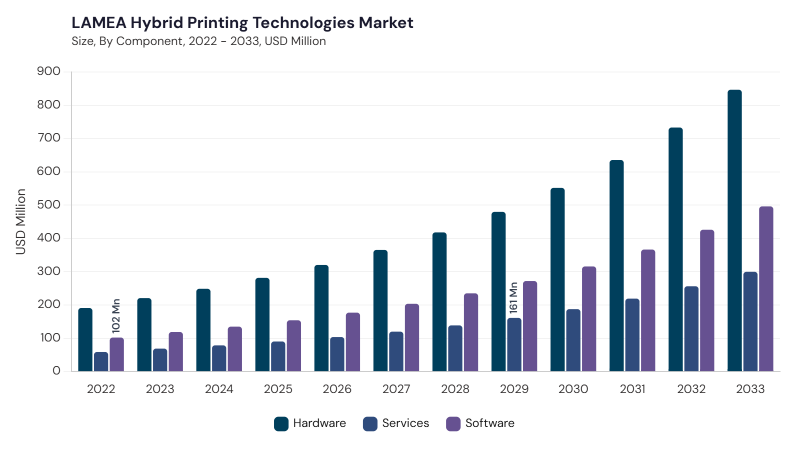
Based on Component, the market is segmented into Hardware, Software, and Services. The Hardware market dominated the LAMEA Hybrid Printing Technologies Market by Component in 2025, and would continue to be a dominant market till 2033; thereby, achieving a market value of USD 479.8 million by 2029, growing at a CAGR of 14.9 % during the forecast period. The Software market is expected to witness a CAGR of 15.9% during (2026 - 2033). The Services market is expected to witness a CAGR of 16.4% during (2026 - 2033).
Hardware includes hybrid presses, print heads, curing systems, substrate-handling equipment, and multifunctional printing platforms that support both longer production runs and customized orders. Software secured a significant share through digital front ends, automated artwork preparation, production monitoring, workflow automation, color-control systems, and tools for multilingual designs and frequent job variations. Services represented a promising presence through press installation, refurbishment, technical assistance, operator training, workflow optimization, remote monitoring, predictive maintenance, and lifecycle support.
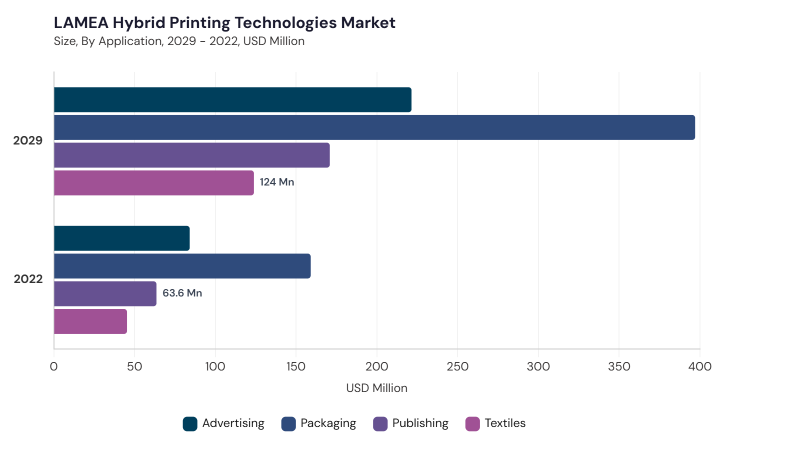
Based on Application, the market is segmented into Packaging, Advertising, Publishing, and Textiles. Packaging applications cover labels, cartons, flexible formats, food and beverage packaging, pharmaceutical packaging, cosmetics, FMCG, and consumer goods requiring shelf appeal, compliance, and brand differentiation. Advertising garnered a substantial share through retail expansion, tourism promotion, outdoor media, exhibitions, banners, vehicle wraps, point-of-sale displays, and localized brand campaigns.
Publishing maintained a considerable presence through educational content, regional publications, books, magazines, periodicals, and multilingual print requirements. Textiles formed a promising segment, supported by apparel production, customized fashion, hospitality fabrics, promotional merchandise, and decorative fabric applications.
Based on Substrate, the market is segmented into Paper and Cardboard, Plastics, Textile, Glass & Metal, and Other Substrate. Paper and Cardboard benefit from FMCG, e-commerce, food packaging, regulatory labeling, recyclability, and demand for personalized packaging campaigns. Plastics captured a substantial share through flexible food packaging, beverage labels, personal care formats, printed films, polyethylene, polypropylene, PET, and durable applications requiring moisture resistance and visual appeal.
Textile established a considerable presence across apparel, hospitality fabrics, home décor, fashion prototyping, and technical textiles, while Glass & Metal developed a noteworthy standing through beverage containers, cosmetic packaging, automotive, architectural, consumer electronics, and decorative uses. Other Substrate remained promising across wood, ceramics, leather, composite panels, specialty packaging, furniture, and artisanal applications.
Free Valuable Insights: Hybrid Printing Technologies Market Size Worth USD 15.2 Billion billion by 2033
Based on Country, the market is segmented into Brazil, Argentina, UAE, Saudi Arabia, South Africa, Nigeria, and Rest of LAMEA. The Brazil market dominated the LAMEA Hybrid Printing Technologies Market by Country in 2025, and would continue to be a dominant market till 2033; thereby, achieving a market value of USD 301.5 million by 2029, growing at a CAGR of 14.4 % during the forecast period. The Argentina market is expected to witness a CAGR of 16.2% during (2026 - 2033). Additionally, The UAE market is expected to witness a CAGR of 14.2% during (2026 - 2033).
Across LAMEA, Hybrid Printing Technologies adoption varies with industrial maturity, packaging demand, printing modernization, digital readiness, sustainability pressure, and technical-service access. Brazil emphasizes sustainable printing, UV-curable and water-based inks, on-demand production, digital commerce integration, localized service centers, and packaging customization, while Argentina focuses on short-run products, e-commerce-led personalization, eco-friendly inks, workflow automation, and flexible financing. The UAE prioritizes on-demand production, environmental compliance, smart manufacturing, IoT-enabled quality control, AI-driven workflows, and regional service support. Saudi Arabia advances through Vision 2030, Industry 4.0, sustainability, localization, hybrid printing in construction and healthcare, and advanced manufacturing integration. South Africa focuses on variable-data printing, water-based and UV-curable inks, AI-driven workflow management, inline quality control, packaging, textiles, and label printing. Nigeria is developing through automation, digital workflow integration, sustainable substrates, water-based inks, customized marketing, retail, FMCG, and workforce training. Rest of LAMEA remains shaped by sustainable printing, digital-analog integration, UV and LED curing, localized solutions, modular systems, regional service hubs, and gradual hybrid printing adoption.

By Component
By Application
By Substrate
By Country
Set to reach $913.2 Million by 2029, growing at 15.4% CAGR during 2026-2033.
Brazil leads with $301.5 million by 2029, growing at a 14.4% CAGR during the forecast period.
Hardware segment dominates, reaching $479.8 million by 2029, growing at 14.9% CAGR during the forecast period.
Software segment expected to grow at 15.9% CAGR during 2026-2033.
The UAE market is expected to witness a CAGR of 14.2% during 2026-2033.
Services segment is expected to grow at 16.4% CAGR during 2026-2033.
Our team of dedicated experts can provide you with attractive expansion opportunities for your business.




 Unique Offerings
