The sample copy of this report is available for access.
The Europe Hybrid Printing Technologies Market is expected to reach USD 2847.8 million by 2031, growing at a CAGR of 13.4% during (2026 - 2033).
Europe Hybrid Printing Technologies Market originated from the convergence of traditional analog printing techniques and emerging digital solutions, driven by demand for better print quality, versatility, and efficiency. Early printing was dominated by offset and screen methods, but rising demand for shorter runs, customization, and faster turnaround encouraged hybrid approaches. Inkjet and electrophotographic components were gradually combined with analog platforms, supported by variable data printing, color management, and automation. The market has now evolved into a flexible print ecosystem serving packaging, retail graphics, commercial printing, and industrial applications.
Sustainability, Industry 4.0, automation, mass customization, and short-run production are shaping current market development. European demand increasingly favors eco-friendly inks, energy-efficient machinery, recyclable substrates, IoT-connected workflows, real-time quality assurance, and lower-waste production. Hybrid systems help converters and brand owners shift between digital and analog modes while maintaining output consistency. However, high capital expenditure, complex integration, regulatory compliance, certification requirements, fragmented infrastructure, and limited standardization continue to influence adoption across Europe.
Based on Component, the market is segmented into Hardware, Software, and Services. The Hardware market dominated the Europe Hybrid Printing Technologies Market by Component in 2025, and would continue to be a dominant market till 2033; thereby, achieving a market value of USD 1473.2 million by 2031, growing at a CAGR of 12.9 % during the forecast period. The Software market is expected to witness a CAGR of 13.9% during (2026 - 2033). The Services market is expected to witness a CAGR of 14.2% during (2026 - 2033).
Hardware includes hybrid presses, inkjet heads, electrophotographic systems, flexographic units, curing systems, and substrate-handling equipment that directly influence speed, quality, and production scale. Software attained a significant share through automated job scheduling, centralized color control, artwork versioning, print-quality monitoring, workflow automation, and data analytics. Services maintained a promising presence through press retrofitting, system calibration, technical training, preventive maintenance, remote diagnostics, sustainability audits, and integration with existing production lines.
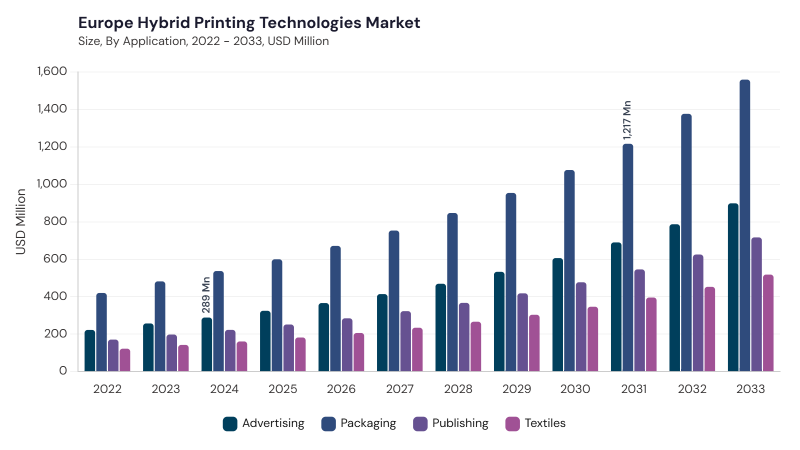
Based on Application, the market is segmented into Packaging, Advertising, Publishing, and Textiles. Packaging applications cover flexible films, cartons, labels, corrugated containers, food, beverages, cosmetics, pharmaceuticals, luxury goods, and other consumer products requiring visual quality and regulatory compliance. Advertising garnered a substantial share through localized campaigns, retail graphics, event materials, posters, banners, signage, and personalized promotional communication.
Publishing retained a considerable presence through specialized titles, regional editions, catalogs, brochures, magazines, newspapers, and print-on-demand models. Textiles represented a promising segment, supported by customized fashion, interior fabrics, technical fabrics, soft signage, and short-cycle textile collections.
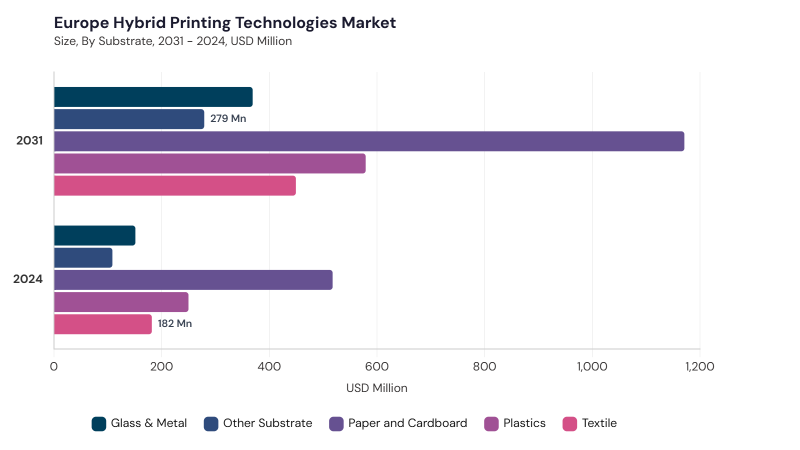
Based on Substrate, the market is segmented into Paper and Cardboard, Plastics, Textile, Glass & Metal, and Other Substrate. Paper and Cardboard benefit from recyclable packaging demand, circular-economy priorities, biodegradable inks, eco-friendly coatings, and compatibility with flexographic and digital printing units. Plastics secured a substantial share through flexible packaging, films, labels, shrink sleeves, blister packs, and premium graphics requiring durability and adhesion.
Textile established a considerable presence across fashion, interiors, sportswear, upholstery, and promotional textiles, while Glass & Metal developed a noteworthy standing in premium beverage containers, cosmetic packaging, decorative products, electronics, automotive, and industrial surfaces. Other Substrate remained promising across wood, ceramics, specialty films, printed electronics, functional surfaces, and emerging recyclable materials.
Free Valuable Insights: The Worldwide Hybrid Printing Technologies Market is projected to reach USD 15.2 Billion billion by 2033, at a CAGR of 13.9%
Based on Country, the market is segmented into Germany, UK, France, Russia, Spain, Italy, and Rest of Europe. The Germany market dominated the Europe Hybrid Printing Technologies Market by Country in 2025, and would continue to be a dominant market till 2033; thereby, achieving a market value of USD 927.8 million by 2031, growing at a CAGR of 12.5 % during the forecast period. The UK market is expected to witness a CAGR of 12.5% during (2026 - 2033). Additionally, The France market is expected to witness a CAGR of 14.3% during (2026 - 2033).
Across Europe, Hybrid Printing Technologies adoption varies with printing maturity, sustainability pressure, packaging demand, automation readiness, regulatory compliance, and service infrastructure. Germany emphasizes precision manufacturing, eco-friendly hybrid printing, automation, Industry 4.0, variable-data packaging, and advanced workflow systems, while the UK focuses on sustainable inks, digital imaging, automation, IoT-enabled workflows, and short-run customization. France prioritizes water-based and UV-curable inks, smart workflows, AI-powered quality control, fashion, automotive interiors, decorative surfaces, and packaging applications. Russia focuses on legacy equipment replacement, automation, AI-driven workflow software, eco-friendly inks, flexible packaging, and security printing. Spain advances through sustainability, Industry 4.0, IoT connectivity, personalized packaging, fashion applications, and modular hybrid systems. Italy emphasizes luxury goods, labels, packaging, decorative surfaces, UV and LED curing, inline finishing, IoT connectivity, and agile mixed-run workflows. Rest of Europe remains shaped by smart manufacturing, eco-friendly materials, automation, personalization, short-run production, and digital workflow integration.

By Component
By Application
By Substrate
By Country
Set to reach $2847.8 Million by 2031, growing at 13.4% CAGR during 2026-2033.
Germany leads with $927.8 million by 2031, growing at a CAGR of 12.5% during the forecast period.
The hardware segment will dominate, reaching $1473.2 million by 2031 at a 12.9% CAGR during 2026-2033.
The software segment is expected to witness a CAGR of 13.9% during 2026-2033.
France is expected to witness a CAGR of 14.3% during 2026-2033.
The services segment is expected to witness a CAGR of 14.2% during 2026-2033.
Our team of dedicated experts can provide you with attractive expansion opportunities for your business.




 Unique Offerings
