Global Hybrid Printing Technologies Market Size, Share & Industry Analysis Report By Component (Hardware, and Software), By Application (Packaging, and Advertising), By Substrate (Paper and Cardboard, and Plastics), By Regional Outlook and Forecast, 2026 - 2033
Report Id: KBV-31996Publication Date: October-2026Number of Pages: 576Report Format: PDF + Excel + Interactive Dashboard
Special Offering:
Industry Insights | Market Trends Highest number of Tables | 24/7 Analyst Support
Sample Report Available
The sample copy of this report is available for access.
Growing demand for flexible, high-quality, and cost-efficient printing solutions is driving the Hybrid Printing Technologies Market across packaging, advertising, publishing, textiles, labels, and industrial applications. Businesses are prioritizing shorter production runs, faster turnaround times, customization, variable data printing, and consistent print quality, encouraging investment in systems that combine conventional and digital printing processes. Growth is further strengthened by personalized packaging demand, e-commerce expansion, premium label growth, sustainable printing practices, and production flexibility.
Key Market Trends & Insights
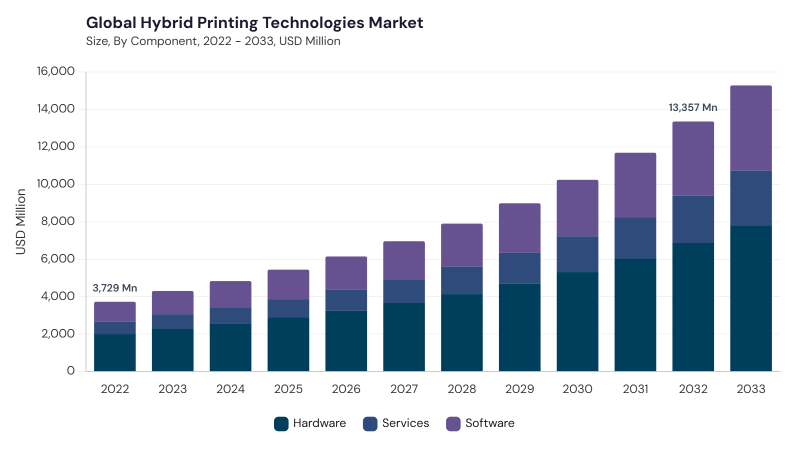
By component, Hardware dominated with a revenue share of 53.11% in 2025 and is projected to reach USD 7.8 billion by 2033, growing at a CAGR of 13.4% during (2026 - 2033).
Services is projected to be the fastest-growing component, reaching USD 2.9 billion by 2033 at a CAGR of 14.7% during (2026 - 2033), supported by rising demand for installation, maintenance, and workflow support.
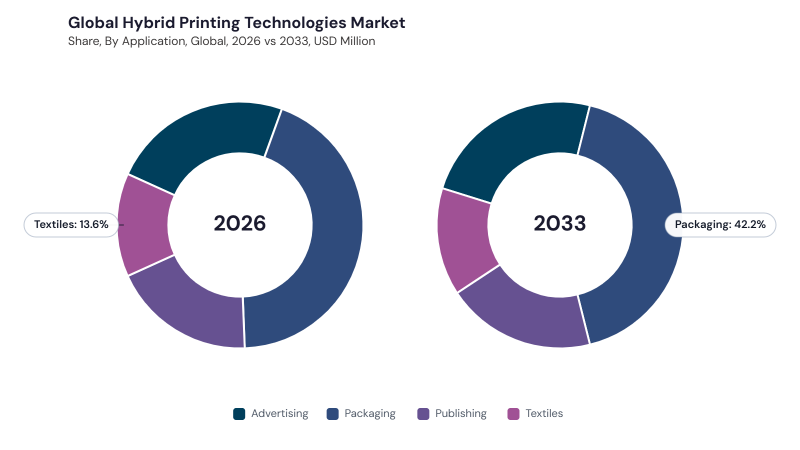
By application, Packaging led with a revenue share of 44.11% in 2025 and is projected to reach USD 6.4 billion by 2033, growing at a CAGR of 13.3% during (2026 - 2033).
Publishing is projected to register the highest CAGR among applications at 14.6% during (2026 - 2033), reaching USD 2.9 billion by 2033.
By substrate, Paper and Cardboard dominated with a revenue share of 42.51% in 2025 and is projected to reach USD 6.2 billion by 2033, growing at a CAGR of 13.2% during (2026 - 2033).
Other Substrate is projected to register the fastest substrate growth, reaching USD 1.5 billion by 2033 at a CAGR of 15.2% during (2026 - 2033).
Regionally, North America dominated with a revenue share of 34.80% in 2025 and is projected to reach USD 5.0 billion by 2033, growing at a CAGR of 13.3% during (2026 - 2033).
LAMEA is projected to record the fastest regional CAGR of 15.4% during (2026 - 2033), while Asia Pacific is projected to reach USD 4.8 billion by 2033 at a CAGR of 14.4%.
Growing demand for customized packaging, versioned labels, short-run production, and efficient multi-substrate printing is encouraging converters and print service providers to adopt hybrid platforms. These systems help combine conventional productivity with digital flexibility, enabling producers to manage variable data, rapid artwork changes, multiple SKUs, and shorter order cycles without sacrificing quality or throughput. Automation, machine vision, intelligent workflow management, predictive maintenance, and inline finishing are improving production economics and reducing manual intervention. Sustainability requirements are also increasing the relevance of hybrid workflows because precise digital imaging and optimized conventional processes can reduce setup waste, inventory exposure, and resource consumption.
Competition is shaped by print quality, production speed, substrate compatibility, automation depth, workflow integration, modularity, and total cost of ownership. Global printing technology suppliers compete alongside conventional press specialists, digital inkjet companies, label and packaging equipment providers, and industrial printing firms. Larger companies differentiate through broad installed bases, integrated hardware and software ecosystems, technical support networks, and partnerships with finishing, inspection, ink, and workflow vendors. Specialist players compete through narrow-web expertise, high-speed hybrid label systems, modular press designs, and application-specific solutions.
Expansion of Multi-Technology Integration to Enhance Print Versatility and Efficiency
Advancements in Automation and Intelligent Workflow Solutions
Rising Demand for Sustainable and Eco-Friendly Printing Solutions
Growing Market Demand for Customization and Short-Run Production
Restraints
High Initial Capital Investment and Operational Costs
Technological Complexity and Integration Challenges
Lack of Standardization and Regulatory Barriers
Opportunities
Integration of Advanced 3D Printing with Traditional Print Processes
Expansion into Sustainable and Eco-Friendly Hybrid Printing Solutions
Leveraging Functional Printing for Smart and Connected Product Solutions
Challenges
Market Share Analysis
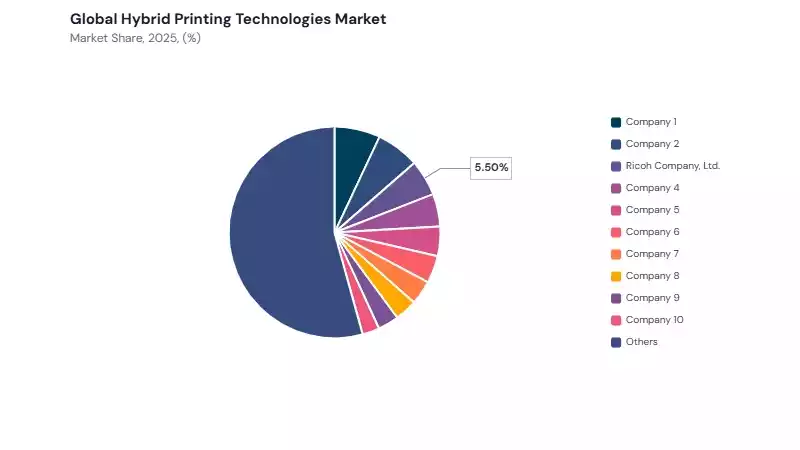
The market is highly competitive and fragmented, with digital printing system manufacturers, conventional press specialists, label and packaging equipment companies, and industrial inkjet technology providers serving overlapping applications. HP/HP Indigo leads the provided distribution, while Fujifilm and Ricoh form another major technology tier through inkjet systems, printheads, workflow capabilities, and production printing portfolios. BOBST, Konica Minolta, Heidelberger/Gallus, Mark Andy, Flint Group/Xeikon, Durst, and SCREEN maintain meaningful positions across labels, packaging, commercial printing, and industrial applications. Competition is increasingly shaped by digital-conventional integration, inkjet performance, automation, variable-data capability, sustainable production, workflow software, substrate flexibility, and the ability to economically handle shorter and customized print runs.
Component Outlook
Based on component, the market is segmented into Hardware, Software, and Services. The Hardware market dominated the Global Hybrid Printing Technologies Market by Component in 2025, and would continue to be a dominant market till 2033; thereby, achieving a market value of USD 7.8 billion by 2033, growing at a CAGR of 13.4 % during the forecast period. The Software market is expected to witness a CAGR of 14.3% during (2026 - 2033). The Services market is expected to witness a CAGR of 14.7% during (2026 - 2033).
Hardware forms the core of hybrid printing by combining flexographic, offset, screen, digital inkjet, curing, web-handling, inspection, and inline finishing technologies within integrated systems. Software coordinates the digital front end, color management, workflow automation, variable-data processing, job scheduling, performance monitoring, and production analytics needed to manage complex hybrid jobs. Services support equipment installation, integration, maintenance, workflow optimization, operator training, color management, and lifecycle support. Together, these components enable printers and converters to improve flexibility, reduce setup time, maintain quality consistency, and connect hybrid presses with broader production environments.
Application Outlook
Based on application, the market is segmented into Packaging, Advertising, Publishing, and Textiles. The Packaging market dominated the Global Hybrid Printing Technologies Market by Application in 2025, and would continue to be a dominant market till 2033; thereby, achieving a market value of USD 6.4 billion by 2033, growing at a CAGR of 13.3 % during the forecast period. The Advertising market is expected to witness a CAGR of 14.1% during (2026 - 2033). Additionally, The Publishing market is expected to witness highest CAGR of 14.6% during (2026 - 2033).
Packaging uses hybrid printing to combine high-volume base graphics with digital versioning, serialization, personalization, and rapid design changes across labels, cartons, flexible packaging, and promotional formats. Advertising benefits from the ability to produce standardized and personalized campaign materials, signage, point-of-sale displays, direct marketing pieces, and visually differentiated promotional content. Publishing uses hybrid workflows to manage targeted publications, shorter print cycles, customized content, and changing production volumes. Textiles benefit from customized patterns, shorter fashion cycles, branded merchandise, decorative fabrics, and flexible batch production where digital variation complements established textile-printing productivity.
Substrate Outlook
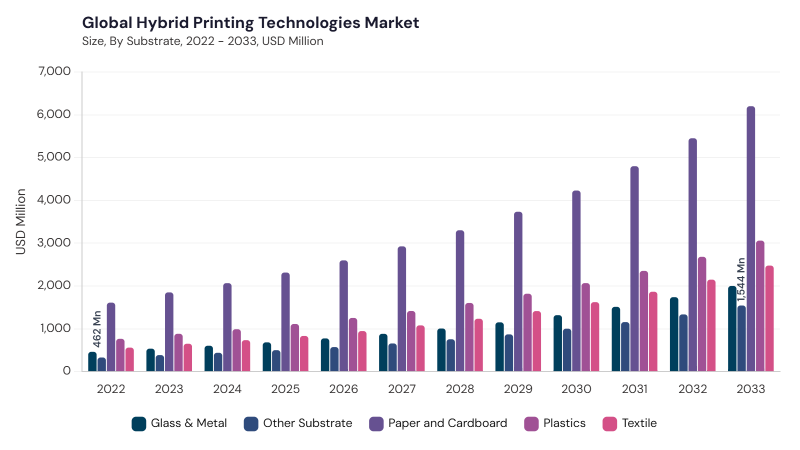
Based on substrate, the market is segmented into Paper and Cardboard, Plastics, Textile, Glass & Metal, and Other Substrate. The Paper and Cardboard market dominated the Global Hybrid Printing Technologies Market by Substrate in 2025, and would continue to be a dominant market till 2033; thereby, achieving a market value of USD 6.2 billion by 2033, growing at a CAGR of 13.2 % during the forecast period. The Plastics market is expected to witness a CAGR of 13.6% during (2026 - 2033). Additionally, The Textile market is expected to witness highest CAGR of 14.7% during (2026 - 2033).
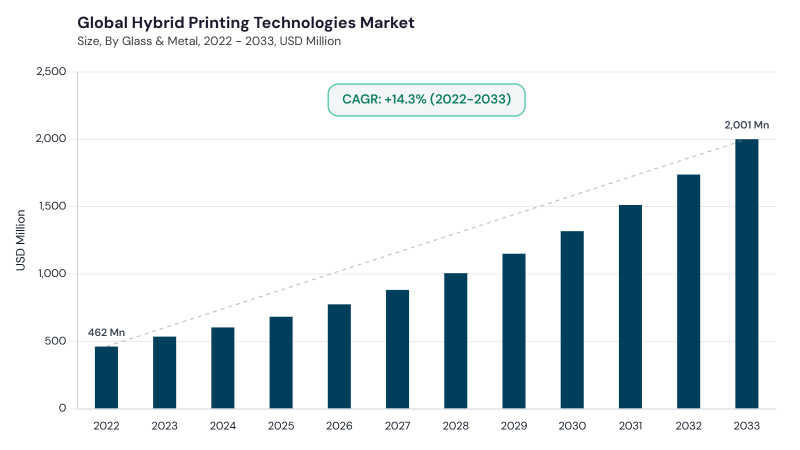
Paper and cardboard remain central across cartons, labels, commercial print products, corrugated packaging, publications, and promotional materials. Plastics support flexible films, pouches, sleeves, labels, and other packaging formats requiring durable and visually consistent printing. Textile applications include customized fabrics, apparel, promotional products, and interior materials where frequent design changes are important. Glass and metal applications cover containers, decorative products, industrial components, and premium packaging, while other substrates include specialty materials requiring tailored combinations of ink, curing, surface treatment, and printhead technology.
Regional Outlook
Region-wise, the Hybrid Printing Technologies Market is analyzed across North America, Europe, Asia Pacific, and LAMEA. The North America market dominated the Global Hybrid Printing Technologies Market by Region in 2025, and would continue to be a dominant market till 2033; thereby, achieving a market value of USD 5.0 billion by 2033, growing at a CAGR of 13.3 % during the forecast period. The Asia Pacific market is expected to witness a CAGR of 14.4% during (2026 - 2033). Additionally, The Europe market is expected to witness a CAGR of 13.4% during (2026 - 2033).
North America leads through mature packaging, commercial printing, advertising, and label-converting industries, supported by demand for personalized packaging, shorter runs, variable-data printing, and workflow automation. Asia Pacific benefits from expanding packaging production, textile manufacturing, consumer goods output, e-commerce, advertising activity, and modernization of printing infrastructure. Europe is supported by mature print industries, sustainable printing practices, automation, material efficiency, and shorter-run economics. LAMEA adoption is supported by modernization of packaging, commercial printing, advertising, and consumer-product manufacturing operations, with gradual uptake of digital and hybrid production platforms.
Hybrid Printing Technologies Market - Get online access to the report
The market is highly competitive and fragmented, with digital printing system manufacturers, conventional press specialists, label and packaging equipment companies, and industrial inkjet technology providers serving overlapping applications. HP/HP Indigo leads the provided distribution, while Fujifilm and Ricoh form another major technology tier through inkjet systems, printheads, workflow capabilities, and production printing portfolios. BOBST, Konica Minolta, Heidelberger/Gallus, Mark Andy, Flint Group/Xeikon, Durst, and SCREEN maintain meaningful positions across labels, packaging, commercial printing, and industrial applications. Competition is increasingly shaped by digital-conventional integration, inkjet performance, automation, variable-data capability, sustainable production, workflow software, substrate flexibility, and the ability to economically handle shorter and customized print runs.
Based on component, the market is segmented into Hardware, Software, and Services. The Hardware market dominated the Global Hybrid Printing Technologies Market by Component in 2025, and would continue to be a dominant market till 2033; thereby, achieving a market value of USD 7.8 billion by 2033, growing at a CAGR of 13.4 % during the forecast period. The Software market is expected to witness a CAGR of 14.3% during (2026 - 2033). The Services market is expected to witness a CAGR of 14.7% during (2026 - 2033).
Hardware forms the core of hybrid printing by combining flexographic, offset, screen, digital inkjet, curing, web-handling, inspection, and inline finishing technologies within integrated systems. Software coordinates the digital front end, color management, workflow automation, variable-data processing, job scheduling, performance monitoring, and production analytics needed to manage complex hybrid jobs. Services support equipment installation, integration, maintenance, workflow optimization, operator training, color management, and lifecycle support. Together, these components enable printers and converters to improve flexibility, reduce setup time, maintain quality consistency, and connect hybrid presses with broader production environments.
Application Outlook
Based on application, the market is segmented into Packaging, Advertising, Publishing, and Textiles. The Packaging market dominated the Global Hybrid Printing Technologies Market by Application in 2025, and would continue to be a dominant market till 2033; thereby, achieving a market value of USD 6.4 billion by 2033, growing at a CAGR of 13.3 % during the forecast period. The Advertising market is expected to witness a CAGR of 14.1% during (2026 - 2033). Additionally, The Publishing market is expected to witness highest CAGR of 14.6% during (2026 - 2033).
Packaging uses hybrid printing to combine high-volume base graphics with digital versioning, serialization, personalization, and rapid design changes across labels, cartons, flexible packaging, and promotional formats. Advertising benefits from the ability to produce standardized and personalized campaign materials, signage, point-of-sale displays, direct marketing pieces, and visually differentiated promotional content. Publishing uses hybrid workflows to manage targeted publications, shorter print cycles, customized content, and changing production volumes. Textiles benefit from customized patterns, shorter fashion cycles, branded merchandise, decorative fabrics, and flexible batch production where digital variation complements established textile-printing productivity.
Substrate Outlook
Based on substrate, the market is segmented into Paper and Cardboard, Plastics, Textile, Glass & Metal, and Other Substrate. The Paper and Cardboard market dominated the Global Hybrid Printing Technologies Market by Substrate in 2025, and would continue to be a dominant market till 2033; thereby, achieving a market value of USD 6.2 billion by 2033, growing at a CAGR of 13.2 % during the forecast period. The Plastics market is expected to witness a CAGR of 13.6% during (2026 - 2033). Additionally, The Textile market is expected to witness highest CAGR of 14.7% during (2026 - 2033).
Paper and cardboard remain central across cartons, labels, commercial print products, corrugated packaging, publications, and promotional materials. Plastics support flexible films, pouches, sleeves, labels, and other packaging formats requiring durable and visually consistent printing. Textile applications include customized fabrics, apparel, promotional products, and interior materials where frequent design changes are important. Glass and metal applications cover containers, decorative products, industrial components, and premium packaging, while other substrates include specialty materials requiring tailored combinations of ink, curing, surface treatment, and printhead technology.
Region-wise, the Hybrid Printing Technologies Market is analyzed across North America, Europe, Asia Pacific, and LAMEA. The North America market dominated the Global Hybrid Printing Technologies Market by Region in 2025, and would continue to be a dominant market till 2033; thereby, achieving a market value of USD 5.0 billion by 2033, growing at a CAGR of 13.3 % during the forecast period. The Asia Pacific market is expected to witness a CAGR of 14.4% during (2026 - 2033). Additionally, The Europe market is expected to witness a CAGR of 13.4% during (2026 - 2033).
North America leads through mature packaging, commercial printing, advertising, and label-converting industries, supported by demand for personalized packaging, shorter runs, variable-data printing, and workflow automation. Asia Pacific benefits from expanding packaging production, textile manufacturing, consumer goods output, e-commerce, advertising activity, and modernization of printing infrastructure. Europe is supported by mature print industries, sustainable printing practices, automation, material efficiency, and shorter-run economics. LAMEA adoption is supported by modernization of packaging, commercial printing, advertising, and consumer-product manufacturing operations, with gradual uptake of digital and hybrid production platforms.
Market Trends, Revenue Estimation and Forecast, Segmentation Analysis, Regional and Country Breakdown, Competitive Landscape, Market Share Analysis, Company Profiling, Companies Strategic Developments, SWOT Analysis, Product Life Cycle Analysis, Value Chain Analysis, Market Consolidation Analysis, Key Customer Criteria, Pandemic Impact Analysis, and Winning Imperatives
Segments Covered
Component, Application, Substrate, and Geography
Country Scope
North America: US, Canada, Mexico, Rest of North America
Europe: Germany, UK, France, Russia, Spain, Italy, Rest of Europe
Asia Pacific: China, Japan, India, South Korea, Australia, Malaysia, Rest of Asia Pacific
LAMEA: Brazil, Argentina, UAE, Saudi Arabia, South Africa, Nigeria, Rest of LAMEA
Companies Included
HP Inc.; FUJIFILM; Ricoh; BOBST; Konica Minolta; Heidelberger; Mark Andy; Xeikon; Durst; SCREEN Graphic Solutions
Need a report that reflects how COVID-19 has impacted this market and its growth? Download Free Sample Now
Recent Strategies Deployed in the Market
2025-October: BOBST introduced its FLEXJET module for DIGITAL MASTER presses, enabling additional digital printing on multiple surfaces for complex and multilayer labels within a modular single-pass workflow.
2025-September: Gallus and HEIDELBERG launched the Gallus Five high-performance hybrid label printing system, combining digital inkjet flexibility with Gallus conventional printing and converting capabilities.
2025-September: Durst showcased the Durst-Omet KJET, integrating Durst digital inkjet technology with conventional flexographic printing and inline finishing for label converters.
2025-September: Xeikon connected the PX3300HD digital inkjet press with its Label Converting Unit, expanding integrated printing and downstream converting for short-run label workflows.
2025-September: Durst and CERM partnered to connect Durst Analytics with CERM's Management Information System, linking press production data with business-management software.
2025-July: BOBST unveiled the DIGITAL MASTER 55 hybrid printing and converting platform, combining digital and flexographic printing with embellishment, quality control, and die-cutting for folding cartons.
2025-June: Mark Andy expanded and renovated its European Innovation Hub in Warsaw, strengthening access to hybrid printing demonstrations, technical consultation, and production testing.
2025-March: Mark Andy and Esko expanded hybrid label production workflow cooperation through an Innovation Day focused on integrated printing and workflow technologies.
2025-February: BOBST expanded DIGITAL MASTER adoption in Germany through deployment of the DIGITAL MASTER 340, strengthening its All-in-One digital and conventional label-production architecture.
2025-January: Mark Andy expanded its Digital Series HD HighSpeed 1200 hybrid platform, combining a high-resolution digital inkjet engine with servo-driven flexographic architecture and inline converting options.







 Unique Offerings
