The sample copy of this report is available for access.
The Asia Pacific Hybrid Printing Technologies Market is expected to reach USD 3.2 billion by 2030, growing at a CAGR of 14.4% during (2026 - 2033).
Asia Pacific Hybrid Printing Technologies Market originated from the gradual convergence of traditional and digital printing methods to meet regional demand for versatile, high-quality output. The market was initially dominated by gravure and flexographic printing, before digital printing introduced greater flexibility and efficiency. Hybrid systems combined digital precision and speed with analog scalability and cost-effectiveness. Advancements in automation, AI-driven processes, pigment-based inks, and Industry 4.0 integration strengthened adoption across packaging, textile, and commercial print sectors.
Industry 4.0 adoption, AI-enabled automation, sustainable printing, flexible packaging demand, and substrate versatility are shaping current market development. Hybrid systems help printers reduce manual intervention, improve precision, support eco-friendly inks, and serve complex packaging requirements across varied materials. Demand is also supported by e-commerce, packaged consumer goods, food delivery, pharmaceuticals, and export-oriented manufacturing. However, high capital investment, fragmented compliance standards, integration complexity, skill shortages, and cost sensitivity continue to influence adoption across Asia Pacific.
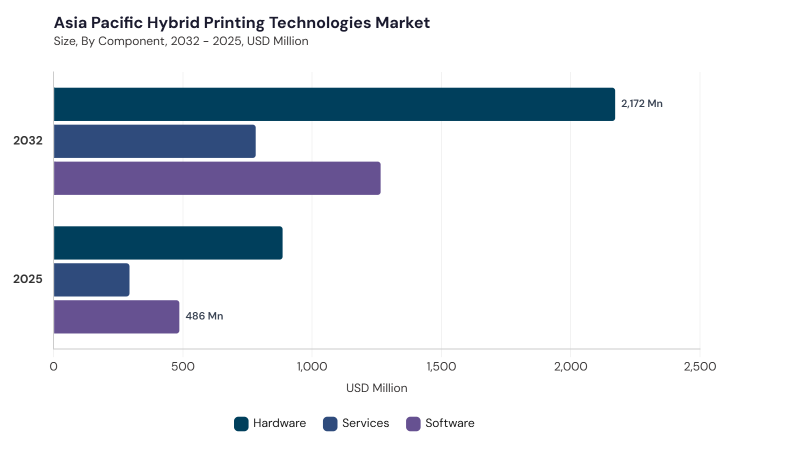
Based on Component, the market is segmented into Hardware, Software, and Services. The Hardware market dominated the Asia Pacific Hybrid Printing Technologies Market by Component in 2025, and would continue to be a dominant market till 2033; thereby, achieving a market value of USD 1.6 billion by 2030, growing at a CAGR of 13.9 % during the forecast period. The Software market is expected to witness a CAGR of 14.9% during (2026 - 2033). The Services market is expected to witness a CAGR of 15.2% during (2026 - 2033).
Hardware includes hybrid presses, print heads, curing systems, unwinding and rewinding units, and other equipment that combine analog productivity with digitally enabled customization. Software garnered a significant share through automated prepress systems, variable-data processing, production scheduling, web-to-print platforms, real-time quality management, RIP software, and workflow controls. Services represented a promising presence through commissioning, workflow integration, technical training, lifecycle maintenance, preventive support, consulting, and troubleshooting as printing businesses modernize production assets.
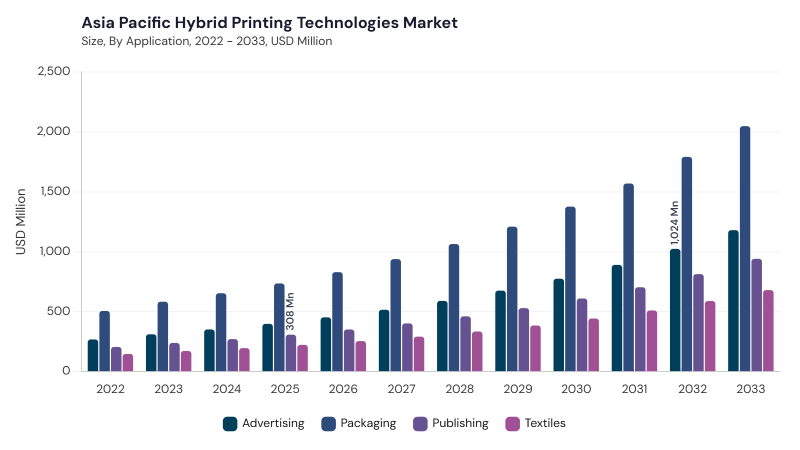
Based on Application, the market is segmented into Packaging, Advertising, Publishing, and Textiles. Packaging applications cover flexible and rigid formats for food and beverages, pharmaceuticals, personal care, labels, pouches, cartons, and products requiring differentiated graphics and adaptable runs. Advertising secured a substantial share through retail networks, outdoor promotions, event graphics, point-of-sale materials, billboards, and localized campaigns.
Publishing maintained a considerable presence through educational materials, commercial publications, short print cycles, customized books, magazines, and multilingual formats. Textiles formed a promising segment, supported by apparel manufacturing, home furnishings, promotional fabrics, fast fashion, and customized garments.
Based on Substrate, the market is segmented into Paper and Cardboard, Plastics, Textile, Glass & Metal, and Other Substrate. Paper and Cardboard benefit from e-commerce, retail activity, recyclable packaging demand, UV LED curing, water-based inks, and variable-data printing. Plastics attained a substantial share through flexible films, pouches, labels, food packaging, personal care, household products, electronics, and industrial products.
Textile established a considerable presence through apparel, home décor, sportswear, promotional goods, and technical textiles, while Glass & Metal recorded a noteworthy standing across beverage containers, electronics, automotive, signage, luxury packaging, and industrial decoration. Other Substrate remained promising across ceramics, wood, rigid plastics, composites, specialty films, and architectural panels.
Free Valuable Insights: Hybrid Printing Technologies Market is Predicted to reach USD 15.2 Billion billion by 2033, at a CAGR of 13.9%
Based on Country, the market is segmented into China, Japan, India, South Korea, Australia, Malaysia, and Rest of Asia Pacific. The China market dominated the Asia Pacific Hybrid Printing Technologies Market by Country in 2025, and would continue to be a dominant market till 2033; thereby, achieving a market value of USD 1.0 billion by 2030, growing at a CAGR of 12.7 % during the forecast period. The Japan market is expected to witness a CAGR of 13.6% during (2026 - 2033). Additionally, The India market is expected to witness a CAGR of 15.1% during (2026 - 2033).
Across Asia Pacific, Hybrid Printing Technologies adoption varies with manufacturing depth, packaging growth, digital readiness, sustainability regulation, service availability, and cost sensitivity. China emphasizes eco-friendly inks, AI-powered workflow optimization, domestic innovation, packaging, labeling, and commercial printing, while Japan focuses on automated inspection, water-based inks, energy-efficient processes, variable-data printing, and mature hybrid workflows. India advances through Industry 4.0, IoT connectivity, pigment-based inks, UV-curing, e-commerce packaging, and localized production. South Korea prioritizes precision printing, eco-friendly inks, AI-enabled color management, predictive maintenance, 3D-hybrid workflows, and high-value packaging. Australia focuses on sustainable inks, mass customization, AI-based workflow optimization, retail packaging, and localized service support. Malaysia emphasizes short-run customization, recyclable substrates, IoT-enabled workflows, Industry 4.0 adoption, packaging, textiles, and commercial print. Rest of Asia Pacific remains shaped by sustainability, digitalization, regional collaboration, flexible packaging, medical-device labeling, and gradual hybrid printing integration.

By Component
By Application
By Substrate
By Country
Set to reach $3.2 Billion by 2030, growing at 14.4% CAGR during 2026-2033.
China leads with a market value of USD 1.0 billion by 2030, growing at 12.7% CAGR during 2026-2033.
The Hardware segment will achieve a market value of USD 1.6 billion by 2030, growing at 13.9% CAGR during 2026-2033.
The Software segment is expected to witness a CAGR of 14.9% during 2026-2033.
The India market is expected to witness a CAGR of 15.1% during 2026-2033.
The Services segment is expected to witness a CAGR of 15.2% during 2026-2033.
Our team of dedicated experts can provide you with attractive expansion opportunities for your business.




 Unique Offerings
