The sample copy of this report is available for access.
The North America Hollow-Core Fiber Backbone Network Market is expected to reach USD 1659.2 million by 2032, growing at a CAGR of 35.6% during (2026 – 2033).
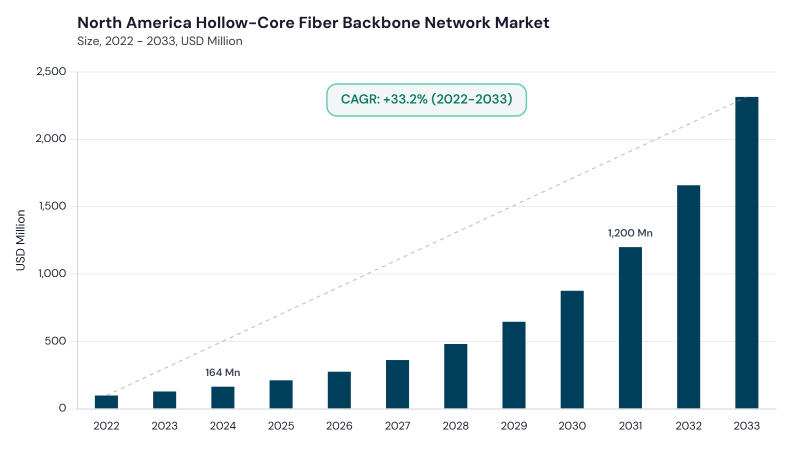
The North America Hollow-Core Fiber Backbone Network Market evolved from the region’s long-standing optical fiber infrastructure, which originally depended on solid-core glass fibers for high-bandwidth communication. As cloud computing, streaming, AI workloads, enterprise digitization, and data center expansion increased traffic pressure, conventional fiber began facing limits in latency, attenuation, and signal efficiency. Hollow-core fiber introduced a major architectural shift by enabling light to travel through an air-filled or vacuum core instead of solid glass. This reduced propagation delay and signal degradation, supporting ultra-fast and energy-efficient transmission.
The North America Hollow-Core Fiber Backbone Network Market is being shaped by ultra-low-latency demand, AI-driven data traffic, cloud interconnect expansion, sustainability goals, and next-generation telecom infrastructure upgrades. Telecom operators, hyperscalers, cloud providers, financial institutions, research organizations, and defense users are exploring hollow-core fiber for faster transmission, higher capacity, and improved signal integrity. Demand is supported by advances in manufacturing, splicing, connector compatibility, optical components, and commercial readiness. Vendors are focusing on lower attenuation, scalable production, interoperability, deployment reliability, standards alignment, and reduced total cost of ownership.
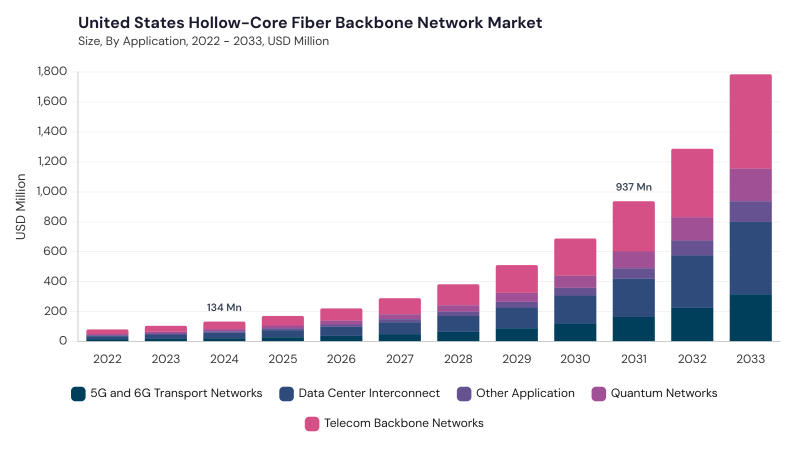
Based on Application, the market is segmented into Telecom Backbone Networks, Data Center Interconnect, 5G and 6G Transport Networks, Quantum Networks, and Other Application. The Telecom Backbone Networks market dominated the North America Hollow-Core Fiber Backbone Network Market by Application in 2025, and would continue to be a dominant market till 2033; thereby, achieving a market value of USD 591.4 million by 2032, growing at a CAGR of 34.7 % during the forecast period. The Data Center Interconnect market is expected to witness a CAGR of 35.3% during (2026 - 2033). The Other Application market is expected to witness a CAGR of 37.7% during (2026 - 2033).
Telecom Backbone Networks lead as carriers modernize long-haul and metropolitan optical infrastructure to support rising data traffic, broadband expansion, cloud access, and ultra-low-latency communication. Hollow-core fiber helps reduce signal delay, improve transmission speed, and enhance long-distance network efficiency. Data Center Interconnect remains significant as hyperscale and cloud facilities need high-capacity links for AI workloads, real-time processing, and data replication. 5G and 6G Transport Networks support fronthaul and backhaul upgrades, while Quantum Networks rely on precise optical transmission for secure communication research. Other Application includes defense, aerospace, scientific research, financial trading, and specialized high-performance networking.
Based on End User Industry, the market is segmented into Telecom Operators, Hyperscalers and Cloud Providers, Research and Defense Organizations, Enterprises and Financial Institutions, and Other End User Industry. The Telecom Operators market dominated the North America Hollow-Core Fiber Backbone Network Market by End User Industry in 2025, and would continue to be a dominant market till 2033; thereby, achieving a market value of USD 624.3 million by 2032, growing at a CAGR of 34.7 % during the forecast period. The Hyperscalers and Cloud Providers market is expected to witness a CAGR of 35.3% during (2026 - 2033). Additionally, The Research and Defense Organizations market is expected to witness highest CAGR of 36.2% during (2026 - 2033).
Telecom Operators lead as they invest in backbone modernization, broadband infrastructure, high-capacity transport, and next-generation optical networks. Hollow-core fiber supports lower latency, reduced attenuation, energy efficiency, and stronger long-distance data transport for carrier-grade networks. Hyperscalers and Cloud Providers remain significant due to expanding cloud computing, AI infrastructure, edge data centers, and high-speed interconnect needs. Research and Defense Organizations use hollow-core fiber for secure communications, quantum research, scientific data transfer, and resilient network systems. Enterprises and Financial Institutions adopt it for real-time trading, private networks, secure data exchange, and latency-sensitive digital operations.
Based on Fiber Type, the market is segmented into Anti-Resonant, Nested Anti-Resonant, Photonic Bandgap, and Other Fiber Type. Anti-Resonant fiber leads due to its simplified structure, low optical loss, reduced latency, and strong suitability for backbone upgrades requiring practical commercial deployment. Its balance of performance, manufacturability, and cost efficiency supports use in telecom, enterprise, metropolitan, and high-speed connectivity environments.
Nested Anti-Resonant fiber remains significant because it improves light confinement, bandwidth performance, attenuation control, and long-distance transmission reliability. Photonic Bandgap fiber supports specialized applications requiring precise optical guidance, controlled dispersion, and minimal signal distortion. Other Fiber Type includes emerging designs such as hybrid hollow-core structures, multi-core variants, and negative-curvature fibers for niche advanced networking needs.
Free Valuable Insights: The Global Hollow-Core Fiber Backbone Network Market will hit USD 6718.3 Million billion by 2033, at a CAGR of 36.3%
Based on Country, the market is segmented into US, Canada, Mexico, and Rest of North America. The US market dominated the North America Hollow-Core Fiber Backbone Network Market by Country in 2025, and would continue to be a dominant market till 2033; thereby, achieving a market value of USD 1287.3 million by 2032, growing at a CAGR of 34.7 % during the forecast period. The Canada market is expected to witness a CAGR of 39.1% during (2026 - 2033). Additionally, The Mexico market is expected to witness a CAGR of 37.8% during (2026 - 2033).
The US leads due to strong AI infrastructure growth, hyperscale data center expansion, cloud computing demand, 5G upgrades, financial trading connectivity, and advanced optical network investments. Canada supports market growth through digital infrastructure modernization, hybrid fiber deployment, ultra-low-latency data center interconnects, and research-driven network innovation. Mexico is advancing through telecom backbone upgrades, network densification, 5G readiness, cloud adoption, and rising demand for energy-efficient high-speed connectivity. Rest of North America benefits from specialized deployments, hybrid backbone integration, environmental efficiency goals, and growing use of hollow-core fiber in advanced digital infrastructure projects.

By Application
By End User Industry
By Fiber Type
By Country
Set to reach $1659.2 Million by 2032, growing at 35.6% CAGR during 2026-2033.
The US leads with $1287.3 million by 2032, growing at 34.7% CAGR during the forecast period.
Telecom operators dominate, reaching $624.3 million by 2032 with a 34.7% CAGR during the forecast period.
Expected to reach $591.4 million by 2032, growing at a 34.7% CAGR during the forecast period.
The Canada market is expected to witness a CAGR of 39.1% during 2026-2033.
Anticipated to have the highest CAGR of 36.2% during 2026-2033.
Our team of dedicated experts can provide you with attractive expansion opportunities for your business.




 Unique Offerings