The sample copy of this report is available for access.
The Asia Pacific Hollow-Core Fiber Backbone Network Market is expected to reach USD 716.0 million by 2030, growing at a CAGR of 37% during (2026 – 2033).
The Asia Pacific Hollow-Core Fiber Backbone Network Market emerged from the region’s broader shift from conventional solid-core optical fibers toward advanced air-core transmission technologies. Early hollow-core fiber use was limited to research institutions, scientific applications, and specialized communication trials due to manufacturing complexity and limited deployment maturity. As demand for faster, low-loss, and high-capacity networks increased, material science and fiber design improvements helped move the technology closer to commercial backbone use. The region’s rapid expansion of 5G, data centers, cloud platforms, and national digital infrastructure programs further accelerated interest in hollow-core fiber.
The Asia Pacific Hollow-Core Fiber Backbone Network Market is being shaped by 5G and future 6G transport needs, hyperscale data center growth, cloud computing, AI workloads, and demand for ultra-low-latency connectivity. Telecom operators, hyperscalers, cloud providers, research organizations, defense agencies, enterprises, and financial institutions are exploring hollow-core fiber to improve signal speed, reduce attenuation, and support higher reliability across complex networks. Demand is supported by government digital infrastructure initiatives, fiber modernization projects, photonic innovation, hybrid network architectures, and emerging quantum communication programs. Vendors are focusing on scalable manufacturing, lower deployment cost, fiber durability, interoperability, regional localization, and standards alignment.
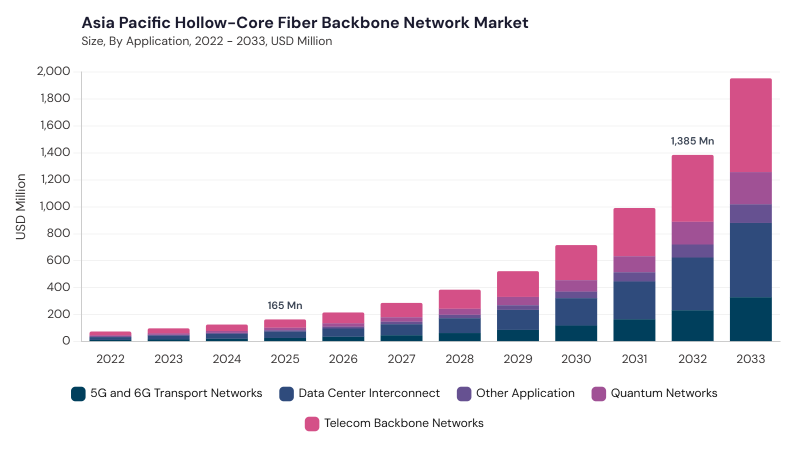
Based on Application, the market is segmented into Telecom Backbone Networks, Data Center Interconnect, 5G and 6G Transport Networks, Quantum Networks, and Other Application. The Telecom Backbone Networks market dominated the Asia Pacific Hollow-Core Fiber Backbone Network Market by Application in 2025, and would continue to be a dominant market till 2033; thereby, achieving a market value of USD 260.1 million by 2030, growing at a CAGR of 36 % during the forecast period. The Data Center Interconnect market is expected to witness a CAGR of 36.7% during (2026 - 2033). The Other Application market is expected to witness a CAGR of 39.3% during (2026 - 2033).
Telecom Backbone Networks lead as communication service providers expand optical infrastructure to support broadband growth, mobile traffic, digital services, and high-capacity intercity connectivity. Hollow-core fiber helps operators improve transmission efficiency, reduce latency, and support future-ready backbone upgrades. Data Center Interconnect remains significant due to rapid hyperscale data center expansion, AI workloads, cloud services, and rising need for ultra-fast links between distributed facilities. 5G and 6G Transport Networks are gaining traction as operators upgrade fronthaul, backhaul, and transport layers. Quantum Networks benefit from secure communication research, while Other Application includes laboratories, semiconductor research, smart infrastructure, defense, aerospace, and industrial communication systems.
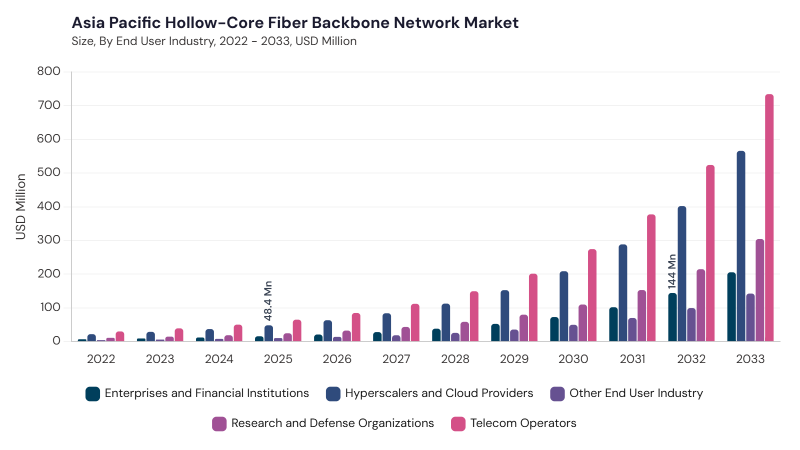
Based on End User Industry, the market is segmented into Telecom Operators, Hyperscalers and Cloud Providers, Research and Defense Organizations, Enterprises and Financial Institutions, and Other End User Industry. The Telecom Operators market dominated the Asia Pacific Hollow-Core Fiber Backbone Network Market by End User Industry in 2025, and would continue to be a dominant market till 2033; thereby, achieving a market value of USD 274.4 million by 2030, growing at a CAGR of 36.1 % during the forecast period. The Hyperscalers and Cloud Providers market is expected to witness a CAGR of 36.7% during (2026 - 2033). Additionally, The Research and Defense Organizations market is expected to witness highest CAGR of 37.6% during (2026 - 2033).
Telecom Operators lead due to extensive network modernization, broadband expansion, 5G rollout, rural connectivity programs, and rising demand for low-latency optical transport. Hollow-core fiber supports telecom operators by strengthening long-distance transmission, reducing signal loss, and improving backbone network responsiveness. Hyperscalers and Cloud Providers remain significant as cloud ecosystems, AI infrastructure, edge data centers, and digital enterprise workloads require faster and more reliable optical interconnects. Research and Defense Organizations use hollow-core fiber for photonics research, quantum communication, and secure data transmission. Enterprises and Financial Institutions adopt it for latency-sensitive transactions, cybersecurity, real-time analytics, and high-performance private networks.
Based on Fiber Type, the market is segmented into Anti-Resonant, Nested Anti-Resonant, Photonic Bandgap, and Other Fiber Type. Anti-Resonant fiber leads due to its lower transmission loss, reduced chromatic dispersion, improved scalability, and suitability for long-distance high-capacity communication infrastructure. Its adoption is supported by ongoing photonic research, improved manufacturing methods, and increasing use in telecom backbone and high-speed data transmission projects.
Nested Anti-Resonant fiber remains significant because it provides stronger optical confinement, improved bandwidth capacity, and better suitability for dense backbone corridors and cloud infrastructure. Photonic Bandgap fiber supports quantum computing, secure communication, precision sensing, and advanced scientific experimentation. Other Fiber Type includes hybrid designs, novel microstructured variants, and emerging hollow-core technologies for aerospace, defense, automation, and next-generation network platforms.
Free Valuable Insights: Hollow-Core Fiber Backbone Network Market is Predicted to reach USD 6718.3 Million billion by 2033, at a CAGR of 36.3%
Based on Country, the market is segmented into China, Japan, India, South Korea, Singapore, Malaysia, and Rest of Asia Pacific. The China market dominated the Asia Pacific Hollow-Core Fiber Backbone Network Market by Country in 2025, and would continue to be a dominant market till 2033; thereby, achieving a market value of USD 192.9 million by 2030, growing at a CAGR of 34.5 % during the forecast period. The Japan market is expected to witness a CAGR of 36% during (2026 - 2033). Additionally, The India market is expected to witness a CAGR of 38% during (2026 - 2033).
China leads due to smart city programs, 5G and future 6G readiness, quantum communication research, large-scale data traffic growth, and strong domestic fiber manufacturing capabilities. Japan supports market growth through advanced telecom infrastructure, low-latency network priorities, domestic fiber innovation, and integration of hollow-core fiber into high-performance backbone systems. India is advancing through national broadband initiatives, cloud infrastructure expansion, 5G transport demand, local production efforts, and sustainability-focused network upgrades. South Korea, Singapore, and Malaysia add momentum through dense fiber penetration, data center growth, smart city strategies, and hybrid fiber deployment, while Rest of Asia Pacific benefits from rural connectivity, cross-border backbone projects, and digital infrastructure modernization.

By Application
By End User Industry
By Fiber Type
By Country
Set to reach $716.0 Million by 2030, growing at 37% CAGR during 2026-2033.
China leads with $192.9 million by 2030, growing at 34.5% CAGR during the forecast period.
Rising demand in Telecom Backbone Networks, reaching $260.1 million by 2030 at 36% CAGR.
Telecom Operators segment reaches $274.4 million by 2030, growing at 36.1% CAGR during the forecast period.
The Japan market is expected to witness a CAGR of 36% during 2026-2033.
The Research and Defense Organizations segment is expected to witness the highest CAGR of 37.6% during 2026-2033.
Our team of dedicated experts can provide you with attractive expansion opportunities for your business.




 Unique Offerings