The sample copy of this report is available for access.
The LAMEA Hollow-Core Fiber Backbone Network Market is expected to reach USD 150.1 million by 2029, growing at a CAGR of 37.8% during (2026 – 2033).
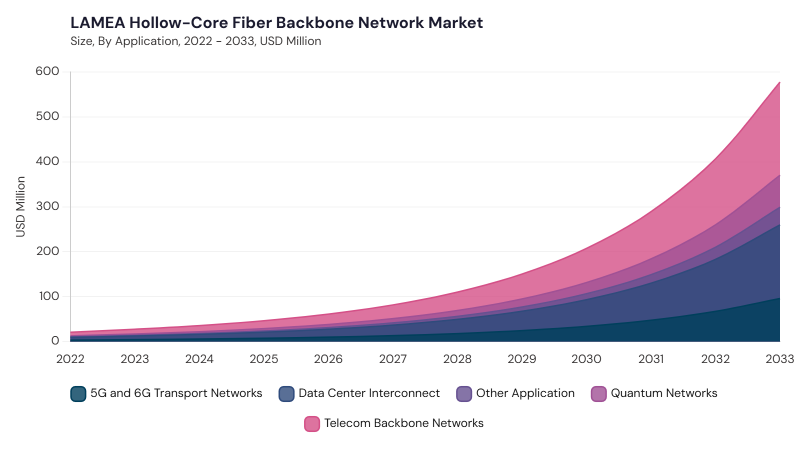
The LAMEA Hollow-Core Fiber Backbone Network Market developed from the region’s need to strengthen long-distance optical communication across diverse geographies and uneven infrastructure conditions. Traditional fiber networks supported early digital connectivity, but signal attenuation, latency, and limited backbone reach created pressure for more advanced optical solutions. Hollow-core fiber introduced a new pathway by guiding light through an air-filled core, helping reduce scattering, dispersion, and delay. Early adoption remained cautious due to cost, technical complexity, and limited ecosystem readiness across many markets.
The LAMEA Hollow-Core Fiber Backbone Network Market is being shaped by digital inclusion programs, 5G and future 6G readiness, cloud infrastructure growth, low-latency service demand, and sustainability priorities. Telecom operators, hyperscalers, cloud providers, enterprises, financial institutions, defense organizations, and governments are exploring hollow-core fiber for faster transmission, improved bandwidth, and stronger network resilience. Demand is supported by submarine cable connectivity, national broadband projects, data center interconnects, industrial modernization, and emerging smart infrastructure applications. Vendors are focusing on durable fiber designs, hybrid network architectures, localized deployment support, cost optimization, and regulatory alignment.
Based on Application, the market is segmented into Telecom Backbone Networks, Data Center Interconnect, 5G and 6G Transport Networks, Quantum Networks, and Other Application. The Telecom Backbone Networks market dominated the LAMEA Hollow-Core Fiber Backbone Network Market by Application in 2025, and would continue to be a dominant market till 2033; thereby, achieving a market value of USD 55.3 million by 2029, growing at a CAGR of 36.9 % during the forecast period. The Data Center Interconnect market is expected to witness a CAGR of 37.5% during (2026 - 2033). The Other Application market is expected to witness a CAGR of 40.5% during (2026 - 2033).
Telecom Backbone Networks lead as service providers expand national broadband infrastructure, submarine cable links, and high-capacity optical transmission networks across Latin America, the Middle East, and Africa. Hollow-core fiber supports lower latency, higher data throughput, and more reliable long-distance connectivity for modern telecom backbones. Data Center Interconnect remains significant due to growing cloud facilities, colocation centers, edge computing, and distributed digital workloads. 5G and 6G Transport Networks gain momentum as countries strengthen wireless transport infrastructure. Quantum Networks support secure communication research, while Other Application includes energy, oil and gas, aerospace, scientific research, utilities, and industrial communication systems.
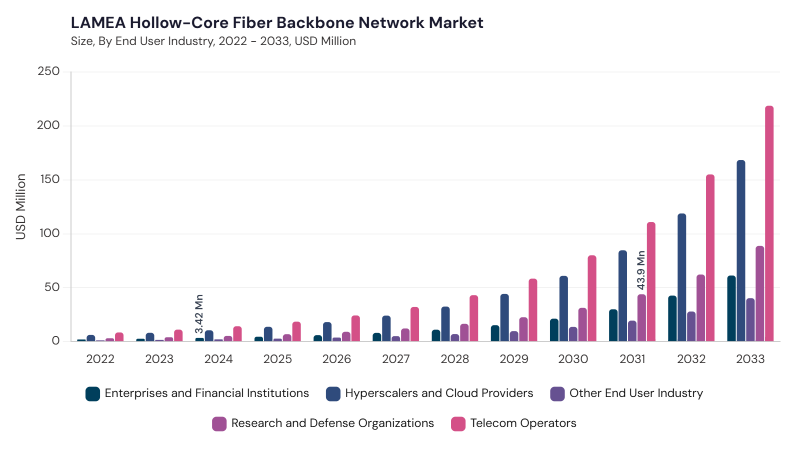
Based on End User Industry, the market is segmented into Telecom Operators, Hyperscalers and Cloud Providers, Research and Defense Organizations, Enterprises and Financial Institutions, and Other End User Industry. The Telecom Operators market dominated the LAMEA Hollow-Core Fiber Backbone Network Market by End User Industry in 2025, and would continue to be a dominant market till 2033; thereby, achieving a market value of USD 58.3 million by 2029, growing at a CAGR of 36.9 % during the forecast period. The Hyperscalers and Cloud Providers market is expected to witness a CAGR of 37.5% during (2026 - 2033). Additionally, The Research and Defense Organizations market is expected to witness highest CAGR of 38.5% during (2026 - 2033).
Telecom Operators lead as they invest in backbone expansion, broadband availability, international connectivity, 5G transport, and improved digital service delivery. Hollow-core fiber helps operators enhance network responsiveness, reduce signal loss, and support future-ready optical infrastructure across large and challenging territories. Hyperscalers and Cloud Providers remain significant due to rising regional cloud demand, data localization, AI workloads, and ultra-low-latency data center links. Research and Defense Organizations use hollow-core fiber for secure communication, defense modernization, and advanced photonic systems. Enterprises and Financial Institutions adopt it for real-time transactions, cybersecurity, high-speed enterprise applications, and resilient data exchange.
Based on Fiber Type, the market is segmented into Anti-Resonant, Nested Anti-Resonant, Photonic Bandgap, and Other Fiber Type. Anti-Resonant fiber leads due to its strong transmission efficiency, low latency, minimal signal distortion, and suitability for long-distance optical backbone networks. Its adoption is supported by telecom modernization, cloud networking, 5G backhaul, and growing interest in high-bandwidth infrastructure across major LAMEA economies.
Nested Anti-Resonant fiber remains significant because it offers stronger optical confinement, improved bandwidth range, better modal purity, and greater suitability for extended intercity and regional routes. Photonic Bandgap fiber supports defense communication, long-haul systems, secure networks, and precision optical applications. Other Fiber Type includes hybrid hollow-core designs and emerging variants for industrial communication, aerospace, sensing, and next-generation optical networking.
Free Valuable Insights: Hollow-Core Fiber Backbone Network Market Size Worth USD 6718.3 Million billion by 2033
Based on Country, the market is segmented into Brazil, Argentina, UAE, Saudi Arabia, South Africa, Nigeria, and Rest of LAMEA. The Brazil market dominated the LAMEA Hollow-Core Fiber Backbone Network Market by Country in 2025, and would continue to be a dominant market till 2033; thereby, achieving a market value of USD 33.8 million by 2029, growing at a CAGR of 35.9 % during the forecast period. The Argentina market is expected to witness a CAGR of 38.6% during (2026 - 2033). Additionally, The UAE market is expected to witness a CAGR of 36.8% during (2026 - 2033).
Brazil leads due to cloud service growth, 5G network expansion, sustainability-focused telecom upgrades, and demand for low-latency national backbone infrastructure. Argentina supports market growth through hybrid fiber architecture, high-speed optical transport, IPoDWDM integration, and localized backbone modernization across varied terrain. The UAE contributes through smart city programs, 5G integration, ultra-low-latency digital infrastructure, and energy-efficient network strategies. Saudi Arabia, South Africa, and Nigeria add momentum through national digital transformation, broadband expansion, smart infrastructure, public-private partnerships, and regional connectivity initiatives, while Rest of LAMEA benefits from hybrid deployments, rural inclusion, and resilient backbone upgrades.

By Application
By End User Industry
By Fiber Type
By Country
Set to reach $150.1 Million by 2029, growing at a CAGR of 37.8% during (2026 – 2033).
Brazil leads with $33.8 million by 2029, growing at a CAGR of 35.9% during the forecast period.
Telecom operators segment reaches $58.3 million by 2029, with a CAGR of 36.9% during the forecast period.
Expected to achieve $55.3 million by 2029, growing at a CAGR of 36.9% during the forecast period.
The UAE market is expected to witness a CAGR of 36.8% during (2026 - 2033).
The Other Application market is expected to witness a CAGR of 40.5% during (2026 - 2033).
Our team of dedicated experts can provide you with attractive expansion opportunities for your business.




 Unique Offerings