The sample copy of this report is available for access.
“Global Hollow-Core Fiber Backbone Network Market to reach a market value of USD 6,718.32 Million by 2033 growing at a CAGR of 36.3%”
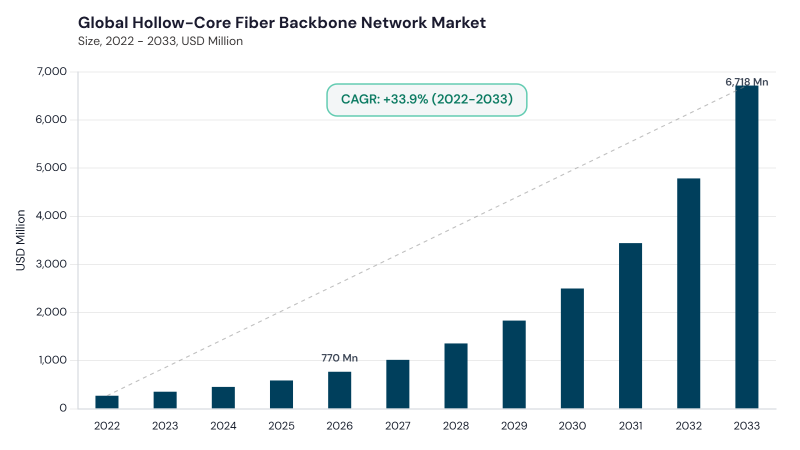
The Global Hollow-Core Fiber Backbone Network Market is expected to reach USD 6718.3 million by 2033, growing at a CAGR of 36.3% during (2026 - 2033).
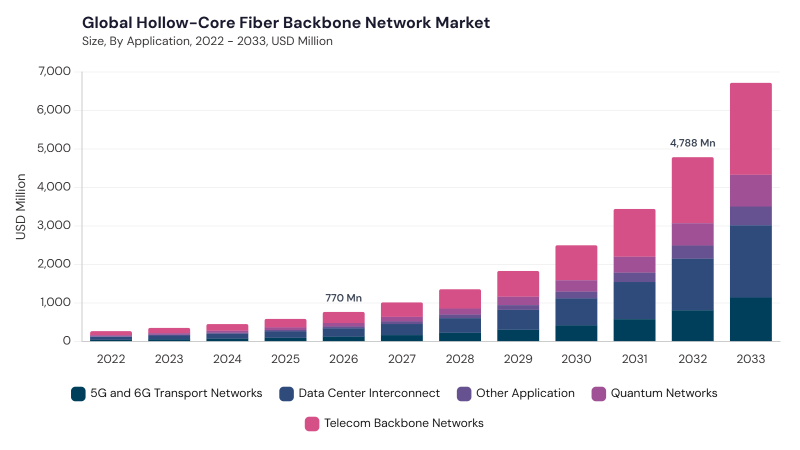
This market is supported by increasing demand for ultra-high-speed, low-latency, and high-capacity optical communication infrastructure across telecom networks, hyperscale data centers, research networks, and next-generation digital connectivity applications. Demand is also rising as network operators focus on faster transmission, lower signal loss, improved bandwidth efficiency, and energy-efficient backbone performance. The market originated from efforts to overcome latency, signal attenuation, and nonlinear limitations of conventional solid-core optical fiber. Early development focused on guiding light through an air-filled core instead of solid silica to improve transmission speed and signal fidelity.
The market is growing as hollow-core fiber becomes increasingly relevant for AI infrastructure, hyperscale cloud networks, high-frequency financial connectivity, quantum communication, and future 6G transport. Because hollow-core fibers guide light mainly through air, they can reduce latency and improve signal integrity compared to conventional solid-core fiber. Network operators are increasingly exploring hybrid deployments that combine hollow-core fiber with existing optical infrastructure to improve performance without full network replacement.
The competitive environment is highly concentrated and technology-intensive, shaped by specialty optical fiber manufacturers, photonics companies, hyperscale cloud infrastructure providers, and emerging low-latency networking specialists. Companies compete through attenuation reduction, scalable manufacturing, connectorization, splicing reliability, deployment readiness, and proven commercial network performance. Future competition is expected to depend on manufacturing scale, field reliability, AI data center adoption, telecom integration, and the ability to deliver commercial-grade ultra-low-latency optical backbone solutions.

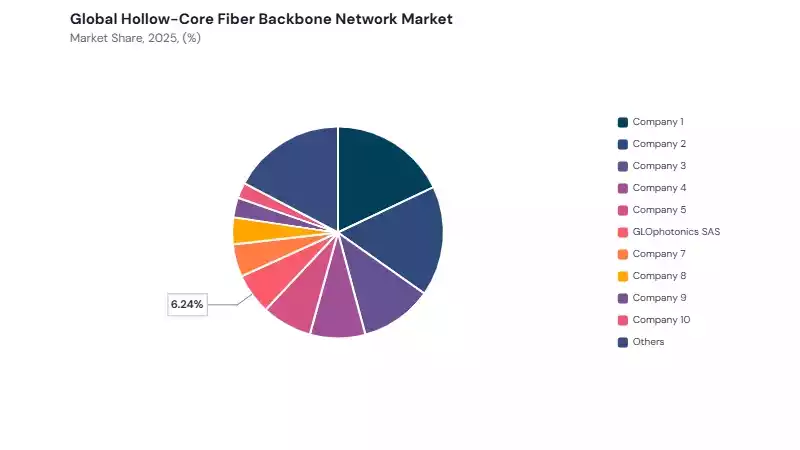
The Hollow-Core Fiber Backbone Network Market reflects a highly concentrated and technology-intensive competitive landscape led by specialty hollow-core fiber developers, optical fiber manufacturers, photonics companies, and hyperscale cloud infrastructure providers. Furukawa Electric including OFS leads through commercial hollow-core cable solutions, specialty fiber manufacturing capabilities, and established telecom and data center relationships. Microsoft Corporation, supported by Lumenisity, holds a strong position through hyperscale cloud integration and internal Azure network deployment opportunities. NKT Photonics, Relativity Networks, Linfiber Technology, GLOphotonics, YOFC, Corning, Fujikura, and Heraeus Holding further strengthen competition through specialty fiber engineering, advanced materials, low-latency networking, and commercial fiber manufacturing expertise.
Based on Application, the market is segmented into Telecom Backbone Networks, Data Center Interconnect, 5G and 6G Transport Networks, Quantum Networks, and Other Application. The Telecom Backbone Networks market dominated the Global Hollow-Core Fiber Backbone Network Market by Application in 2025, and would continue to be a dominant market till 2033; thereby, achieving a market value of USD 2388.7 million by 2033, growing at a CAGR of 35.4 % during the forecast period. The Data Center Interconnect market is expected to witness a CAGR of 36% during (2026 - 2033). The Other Application market is expected to witness a CAGR of 38.5% during (2026 - 2033).
Telecom Backbone Networks lead as operators modernize long-haul, metro, and intercity fiber routes to reduce latency and improve capacity. Data Center Interconnect supports hyperscale cloud traffic and AI workload movement, while 5G and 6G Transport Networks require advanced optical backhaul and fronthaul. Quantum Networks and Other Application support secure communication, research, high-performance computing, and specialized networking environments.
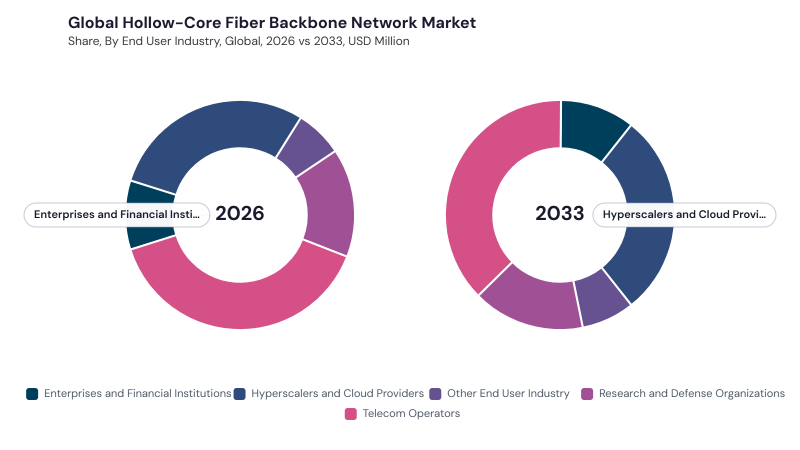
Based on End User Industry, the market is segmented into Telecom Operators, Hyperscalers and Cloud Providers, Research and Defense Organizations, Enterprises and Financial Institutions, and Other End User Industry. The Telecom Operators market dominated the Global Hollow-Core Fiber Backbone Network Market by End User Industry in 2025, and would continue to be a dominant market till 2033; thereby, achieving a market value of USD 2522.4 million by 2033, growing at a CAGR of 35.4 % during the forecast period. The Hyperscalers and Cloud Providers market is expected to witness a CAGR of 36% during (2026 - 2033). Additionally, The Research and Defense Organizations market is expected to witness highest CAGR of 36.9% during (2026 - 2033).
Telecom Operators lead due to backbone upgrades and high-capacity transmission needs across national and regional networks. Hyperscalers and Cloud Providers adopt hollow-core fiber for low-latency data center interconnectivity and AI infrastructure. Research and Defense Organizations, Enterprises and Financial Institutions, and Other End User Industry use the technology for secure communication, real-time processing, financial trading, healthcare, education, and government networks.
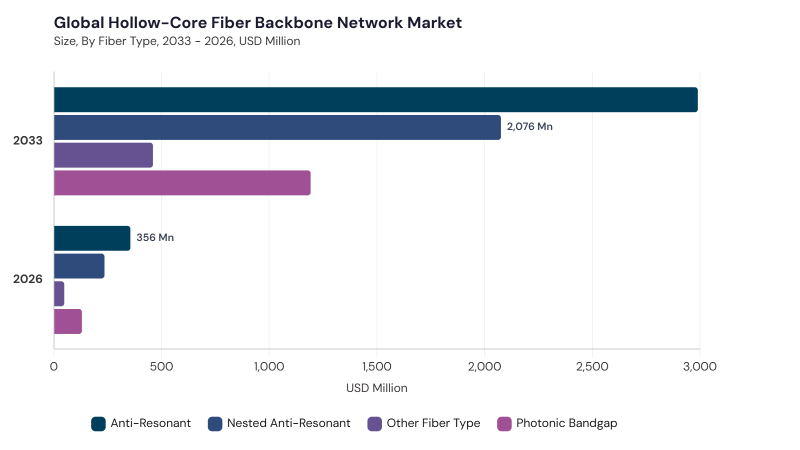
Based on Fiber Type, the market is segmented into Anti-Resonant, Nested Anti-Resonant, Photonic Bandgap, and Other Fiber Type. The Anti-Resonant market dominated the Global Hollow-Core Fiber Backbone Network Market by Fiber Type in 2025, and would continue to be a dominant market till 2033; thereby, achieving a market value of USD 2989.9 million by 2033, growing at a CAGR of 35.5 % during the forecast period. The Nested Anti-Resonant market is expected to witness a CAGR of 36.5% during (2026 - 2033). Additionally, The Photonic Bandgap market is expected to witness highest CAGR of 37.2% during (2026 - 2033).
Anti-Resonant leads due to strong optical performance, low transmission loss, and relatively practical manufacturability for backbone networks. Nested Anti-Resonant is gaining demand through improved light confinement, bandwidth capacity, and signal integrity for high-speed networks. Photonic Bandgap supports specialized communication and scientific applications, while Other Fiber Type includes experimental, hybrid, and emerging hollow-core designs for niche networking use cases.
Free Valuable Insights: Hollow-Core Fiber Backbone Network Market Size to reach $6718.3 Million by 2033
Region-wise, the Hollow-Core Fiber Backbone Network Market is analyzed across North America, Europe, Asia Pacific, and LAMEA. The North America market dominated the Global Hollow-Core Fiber Backbone Network Market by Region in 2025, and would continue to be a dominant market till 2033; thereby, achieving a market value of USD 2315.1 million by 2033, growing at a CAGR of 35.6 % during the forecast period. The Asia Pacific market is expected to witness a CAGR of 37% during (2026 - 2033). Additionally, The Europe market is expected to witness a CAGR of 36% during (2026 - 2033).
North America leads due to strong investments in advanced optical infrastructure, hyperscale cloud networks, AI data centers, and next-generation telecom deployments. Europe is supported by research initiatives, digital infrastructure modernization, and cross-border connectivity programs. Asia Pacific is gaining momentum through telecom expansion, hyperscale data center growth, and 5G and 6G investment, while LAMEA is developing through broadband expansion and digital transformation initiatives.
| Report Attribute | Details |
|---|---|
| Market size value in 2026 | USD 769.9 million |
| Market size forecast in 2033 | USD 6718.3 million |
| Base Year | 2025 |
| Historical Period | 2022 to 2024 |
| Forecast Period | 2026 to 2033 |
| Revenue Growth Rate | CAGR of 36.3% from 2026 to 2033 |
| Number of Pages | 644 |
| Tables | 750 |
| Report Coverage | Market Trends, Revenue Estimation and Forecast, Segmentation Analysis, Regional and Country Breakdown, Competitive Landscape, Market Share Analysis, Company Profiling, Companies Strategic Developments, SWOT Analysis, Product Life Cycle Analysis, Value Chain Analysis, Market Consolidation Analysis, Key Customer Criteria, Pandemic Impact Analysis, and Winning Imperatives |
| Segments Covered | Application, End User Industry, Fiber Type, and Geography |
| Country Scope |
|
| Companies Included | Furukawa Electric Co., Ltd. including OFS; Microsoft Corporation (Lumenisity); NKT Photonics A/S; Relativity Networks, Inc.; Linfiber Technology (Nantong) Co., Ltd.; GLOphotonics SAS; Yangtze Optical Fibre & Cable Joint Stock Limited Company; Corning Incorporated; Fujikura Ltd.; Heraeus Holding GmbH |
By Application
By End User Industry
By Fiber Type
By Geography
Expected to reach USD 6718.3 million by 2033, growing at 36.3% CAGR during 2026-2033.
Furukawa Electric, Microsoft, NKT Photonics, Relativity Networks, Linfiber Technology, GLOphotonics, Yangtze Optical, Corning, Fujikura, Heraeus.
Demand for low latency and high bandwidth in data-intensive applications boosts market growth.
Public cloud tops the chart, projected to hit $188.02 billion by 2033.
North America leads at $111.24 billion by 2033; Asia Pacific grows at 13.1% CAGR during 2026-2033.
Enhancement of network capacity and scalability via space-division multiplexing integration is a key growth driver.
Our team of dedicated experts can provide you with attractive expansion opportunities for your business.








 Unique Offerings