The sample copy of this report is available for access.
The Europe Hollow-Core Fiber Backbone Network Market is expected to reach USD 963.5 million by 2031, growing at a CAGR of 36% during (2026 – 2033).
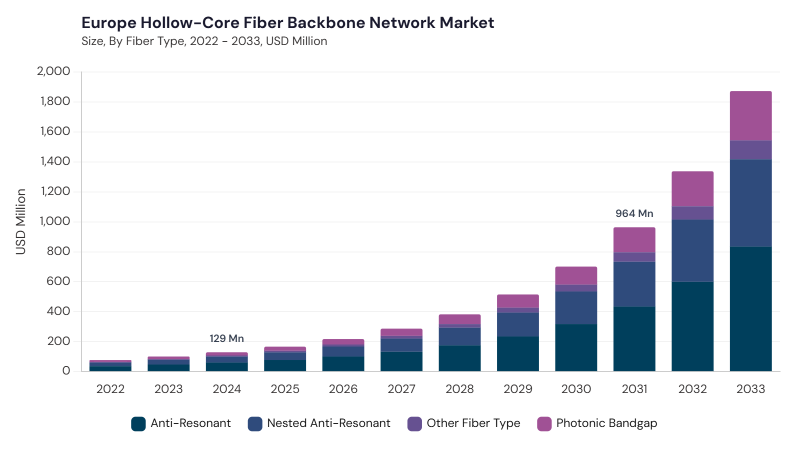
The Europe Hollow-Core Fiber Backbone Network Market developed from traditional solid-core silica fiber infrastructure toward advanced hollow-core fiber systems designed for faster optical transmission. Conventional fibers supported early backbone growth, but latency, dispersion, and attenuation limitations encouraged research into air-core transmission structures. Hollow-core fiber introduced a major step forward by guiding light through an air-filled core, reducing delay and improving signal behavior for next-generation networks. The market advanced from research trials and pilot projects toward practical backbone deployment readiness.
The Europe Hollow-Core Fiber Backbone Network Market is being shaped by digital infrastructure mandates, cross-border connectivity programs, hyperscale data center growth, AI workloads, and demand for energy-efficient backbone networks. Telecom operators, cloud providers, research institutions, defense organizations, enterprises, and financial institutions are adopting hollow-core fiber to improve latency, bandwidth, signal integrity, and long-haul transmission performance. Demand is supported by manufacturing improvements, splicing advancements, photonic component integration, policy support, and open-access network models.
Based on Application, the market is segmented into Telecom Backbone Networks, Data Center Interconnect, 5G and 6G Transport Networks, Quantum Networks, and Other Application. The Telecom Backbone Networks market dominated the Europe Hollow-Core Fiber Backbone Network Market by Application in 2025, and would continue to be a dominant market till 2033; thereby, achieving a market value of USD 347.6 million by 2031, growing at a CAGR of 35.1 % during the forecast period. The Data Center Interconnect market is expected to witness a CAGR of 35.8% during (2026 - 2033). The Other Application market is expected to witness a CAGR of 38.3% during (2026 - 2033).
Telecom Backbone Networks lead as European operators modernize cross-border and long-haul optical infrastructure to support high-capacity broadband, cloud services, and latency-sensitive communication. Hollow-core fiber enables lower signal delay, improved spectral efficiency, and stronger long-distance transmission for next-generation backbone routes. Data Center Interconnect remains significant as hyperscale facilities, sovereign cloud projects, edge computing, and AI workloads require faster links between distributed sites. 5G and 6G Transport Networks support advanced mobile fronthaul and backhaul, while Quantum Networks benefit from precise optical guidance for secure communication. Other Application includes aerospace, laboratories, industrial communication, defense, media, and specialized high-performance networks.
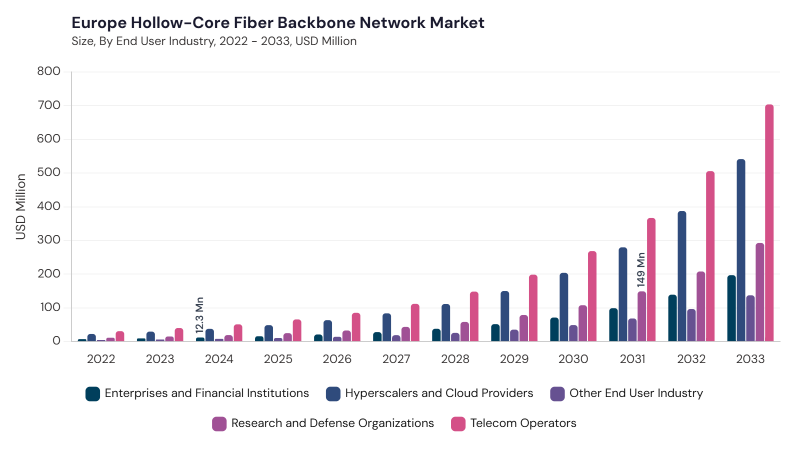
Based on End User Industry, the market is segmented into Telecom Operators, Hyperscalers and Cloud Providers, Research and Defense Organizations, Enterprises and Financial Institutions, and Other End User Industry. The Telecom Operators market dominated the Europe Hollow-Core Fiber Backbone Network Market by End User Industry in 2025, and would continue to be a dominant market till 2033; thereby, achieving a market value of USD 366.8 million by 2031, growing at a CAGR of 35.2 % during the forecast period. The Hyperscalers and Cloud Providers market is expected to witness a CAGR of 35.8% during (2026 - 2033). Additionally, The Research and Defense Organizations market is expected to witness highest CAGR of 36.6% during (2026 - 2033).
Telecom Operators lead due to rising broadband traffic, 5G expansion, digital sovereignty priorities, network resilience goals, and demand for ultra-low-latency backbone infrastructure. Hollow-core fiber supports telecom providers by improving transmission speed, reducing signal loss, and strengthening long-haul and metropolitan connectivity. Hyperscalers and Cloud Providers remain significant as cloud computing, AI training, distributed data centers, and edge platforms increase the need for high-bandwidth interconnects. Research and Defense Organizations use hollow-core fiber for quantum communication, secure data exchange, and advanced scientific networks. Enterprises and Financial Institutions adopt it for high-frequency trading, real-time analytics, cybersecurity, and mission-critical data transport.
Based on Fiber Type, the market is segmented into Anti-Resonant, Nested Anti-Resonant, Photonic Bandgap, and Other Fiber Type. Anti-Resonant fiber leads due to its strong transmission efficiency, reduced optical latency, lower signal attenuation, and suitability for next-generation backbone communication networks. Its commercial appeal is supported by fabrication improvements, better manufacturability, and use in latency-sensitive telecom, cloud, and financial networking environments.
Nested Anti-Resonant fiber remains significant due to stronger light confinement, broader bandwidth capability, improved attenuation control, and suitability for transnational and hyperscale network routes. Photonic Bandgap fiber supports quantum communication, precision sensing, and scientific applications requiring exceptional optical guidance. Other Fiber Type includes emerging hybrid structures and advanced hollow-core variants under evaluation for specialized European deployment needs.
Free Valuable Insights: The Worldwide Hollow-Core Fiber Backbone Network Market is projected to reach USD 6718.3 Million billion by 2033, at a CAGR of 36.3%
Based on Country, the market is segmented into Germany, UK, France, Russia, Spain, Italy, and Rest of Europe. The Germany market dominated the Europe Hollow-Core Fiber Backbone Network Market by Country in 2025, and would continue to be a dominant market till 2033; thereby, achieving a market value of USD 206.7 million by 2031, growing at a CAGR of 34.3 % during the forecast period. The UK market is expected to witness a CAGR of 34.9% during (2026 - 2033). Additionally, The France market is expected to witness a CAGR of 37.1% during (2026 - 2033).
Germany leads due to advanced telecom infrastructure, national digital transformation, 5G and future 6G planning, high-capacity backbone demand, and investments in energy-efficient network upgrades. The UK supports market growth through low-latency network needs, cloud expansion, edge computing, SDN and NFV integration, and sustainability-focused telecom modernization. France contributes through digital sovereignty priorities, resilient backbone development, photonic innovation, and ultra-low-latency demand from cloud and financial services. Russia, Spain, and Italy add momentum through backbone modernization, localized deployment strategies, high-speed connectivity targets, and hybrid fiber upgrades, while Rest of Europe benefits from cross-border links, rural connectivity programs, and research-led hollow-core fiber adoption.

By Application
By End User Industry
By Fiber Type
By Country
Set to reach $963.5 Million by 2031, growing at 36% CAGR during 2026-2033.
Germany leads with a market value of $206.7 million by 2031, growing at 34.3% CAGR during the forecast period.
Rising demand in Telecom Backbone Networks, reaching $347.6 million by 2031 at 35.1% CAGR during the forecast period.
Telecom Operators segment will reach $366.8 million by 2031, growing at 35.2% CAGR during the forecast period.
The UK market is expected to witness a CAGR of 34.9% during 2026-2033.
Data Center Interconnect is expected to witness a CAGR of 35.8% during 2026-2033.
Our team of dedicated experts can provide you with attractive expansion opportunities for your business.




 Unique Offerings