The sample copy of this report is available for access.
The North America Healthcare Business Intelligence Market is expected to reach USD 12.1 billion by 2032, growing at a CAGR of 13.4% during (2026 – 2033).
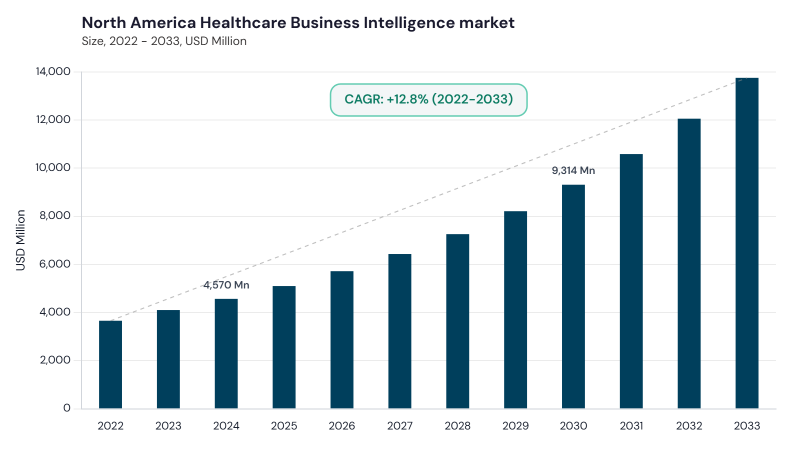
The North America Healthcare Business Intelligence Market developed from the growing need to convert complex healthcare data into actionable insights. Early adoption relied on data warehousing, reporting tools, and administrative dashboards used mainly for finance and operational tracking. As electronic health records, claims systems, population health platforms, and digital care technologies expanded, healthcare organizations began using more advanced analytics. The market shifted from retrospective reporting toward predictive, prescriptive, and AI-enabled decision support.
The North America Healthcare Business Intelligence Market is being shaped by AI-powered analytics, cloud-based delivery, self-service reporting, data governance, and growing pressure to improve care quality while reducing waste. Healthcare providers, payers, and manufacturers are adopting BI tools to manage claims, detect fraud, optimize revenue cycles, improve clinical outcomes, and support operational planning. Demand is supported by electronic health records, predictive modeling, natural language processing, population health analytics, and workflow automation.
Based on Component, the market is segmented into Software and Services. The Software market dominated the North America Healthcare Business Intelligence Market by Component in 2025, and would continue to be a dominant market till 2033; thereby, achieving a market value of USD 8.0 billion by 2032, growing at a CAGR of 13.2 % during the forecast period. The Services market is expected to witness a CAGR of 13.7% during (2026 - 2033).
Software leads because healthcare organizations rely on analytics platforms, dashboards, predictive models, visualization tools, and reporting systems to transform clinical, financial, and administrative data into usable insights. These platforms support decision-making across revenue cycle management, patient outcomes, quality improvement, and population health programs. Services remain significant as organizations require consulting, implementation, integration, customization, training, maintenance, and regulatory support. This segment benefits from complex healthcare data ecosystems, shortage of analytics expertise, cloud migration, AI adoption, and the need for continuous optimization of BI investments.
Based on Mode of Delivery, the market is segmented into Cloud-based, On-premise, and Hybrid. The Cloud-based market dominated the North America Healthcare Business Intelligence Market by Mode of Delivery in 2025, and would continue to be a dominant market till 2033; thereby, achieving a market value of USD 5.4 billion by 2032, growing at a CAGR of 12.8 % during the forecast period. The On-premise market is expected to witness a CAGR of 13.8% during (2026 - 2033). The Hybrid market is expected to witness a CAGR of 14% during (2026 - 2033).
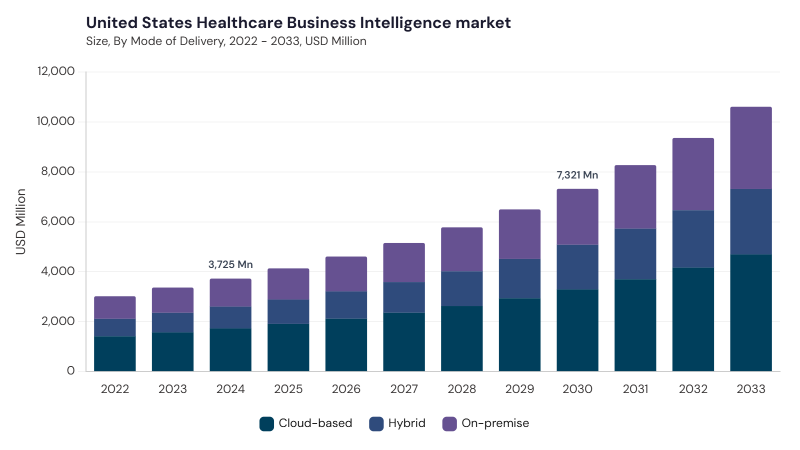
Cloud-based delivery leads due to its scalability, lower infrastructure burden, remote accessibility, real-time analytics capability, and support for collaboration across healthcare networks. It enables integration with EHRs, claims systems, remote monitoring platforms, and population health tools while supporting secure data sharing. On-premise solutions remain important for hospitals, academic medical centers, and organizations requiring direct control over sensitive data, customized environments, and internal governance. Hybrid deployment is also expanding as healthcare entities combine cloud flexibility with on-premise control for critical data, compliance, and advanced analytics workloads.
Based on Application, the market is segmented into Financial Analysis, Clinical Analysis, Operational Analysis, and Patient Care. The Financial Analysis market dominated the North America Healthcare Business Intelligence Market by Application in 2025, and would continue to be a dominant market till 2033; thereby, achieving a market value of USD 4.0 billion by 2032, growing at a CAGR of 12.5 % during the forecast period. The Clinical Analysis market is expected to witness a CAGR of 13.5% during (2026 - 2033). Additionally, The Operational Analysis market is expected to witness highest CAGR of 13.9% during (2026 - 2033).
Financial Analysis leads as healthcare organizations focus on revenue cycle optimization, reimbursement tracking, cost control, budgeting, claims review, and financial transparency. BI tools help providers and payers monitor expenditures, identify revenue leakage, improve audit readiness, and support value-based payment models. Clinical Analysis remains significant through evidence-based decision support, risk stratification, outcome monitoring, and quality improvement. Operational Analysis supports workforce planning, supply chain visibility, patient throughput, and resource utilization, while Patient Care applications advance personalized treatment, remote monitoring, care coordination, and patient engagement.
Based on End Use, the market is segmented into Payers, Healthcare Providers, and Healthcare Manufacturers. Payers lead due to extensive use of BI for claims management, fraud detection, risk assessment, cost containment, member engagement, and reimbursement strategy. These organizations use analytics to evaluate patient risk, monitor provider performance, manage care networks, and support value-based reimbursement.
Healthcare Providers remain significant as hospitals, clinics, and physician groups adopt BI to improve clinical decisions, patient outcomes, staffing, workflow efficiency, and regulatory reporting. Healthcare Manufacturers use BI for research and development planning, clinical trial analytics, supply chain intelligence, commercial performance, regulatory insights, and market strategy.
Free Valuable Insights: The Global Healthcare Business Intelligence Market will hit USD 30.7 Billion billion by 2033, at a CAGR of 13.8%
Based on Country, the market is segmented into US, Canada, Mexico, and Rest of North America. The US market dominated the North America Healthcare Business Intelligence Market by Country in 2025, and would continue to be a dominant market till 2033; thereby, achieving a market value of USD 9.4 billion by 2032, growing at a CAGR of 12.6 % during the forecast period. The Canada market is expected to witness a CAGR of 16% during (2026 - 2033). Additionally, The Mexico market is expected to witness a CAGR of 15.2% during (2026 - 2033).
The US leads due to advanced healthcare IT adoption, large-scale EHR usage, strong payer-provider analytics demand, AI innovation, cloud adoption, and value-based care initiatives. Canada supports market growth through public and private healthcare digitization, AI-driven analytics, interoperability efforts, cybersecurity investment, and province-specific healthcare modernization. Mexico is advancing through healthcare infrastructure expansion, digital health initiatives, regulatory compliance needs, and growing use of BI across medical device manufacturing and provider operations. Rest of North America benefits from self-service analytics, cloud-based BI, regulatory reporting needs, and demand for integrated platforms that support clinical, operational, and financial decision-making.

By Component
By Mode of Delivery
By Application
By End Use
By Country
Set to reach $12.1 Billion by 2032, growing at 13.4% CAGR during 2026-2033.
The US leads with $9.4 billion by 2032, growing at a CAGR of 12.6% during the forecast period.
Rising enterprise cloud adoption and AI-driven workloads are the main catalysts.
Cloud-based segment hits $5.4 billion by 2032, growing at a CAGR of 12.8% during the forecast period.
The Canada market is expected to witness a CAGR of 16% during 2026-2033.
Software segment to achieve a market value of $8.0 billion by 2032, growing at a CAGR of 13.2% during the forecast period.
Our team of dedicated experts can provide you with attractive expansion opportunities for your business.




 Unique Offerings