The sample copy of this report is available for access.
The Asia Pacific Healthcare Business Intelligence Market is expected to reach USD 4.8 billion by 2030, growing at a CAGR of 14.5% during (2026 – 2033).
The Asia Pacific Healthcare Business Intelligence Market developed as hospitals, public health agencies, payers, and healthcare networks began using digital tools to manage growing clinical and administrative data. Early adoption centered on electronic health records, basic analytics, and reporting systems designed to improve patient records and operational visibility. As cloud computing, big data analytics, AI, and interoperable platforms advanced, healthcare BI shifted from fragmented reporting to predictive and real-time decision support. Telehealth expansion, remote monitoring, and digital infrastructure upgrades further widened the role of analytics across the region.
The Asia Pacific Healthcare Business Intelligence Market is being shaped by rising healthcare digitalization, AI adoption, remote care expansion, disease management needs, and increasing pressure to improve healthcare accessibility and efficiency. Healthcare providers, payers, and manufacturers are using BI solutions to support claims analysis, clinical decisions, operational planning, revenue management, supply chain visibility, and population health programs. Demand is supported by EHR adoption, predictive analytics, telehealth data, wearable devices, cloud platforms, edge computing, and regulatory progress around privacy and data governance.
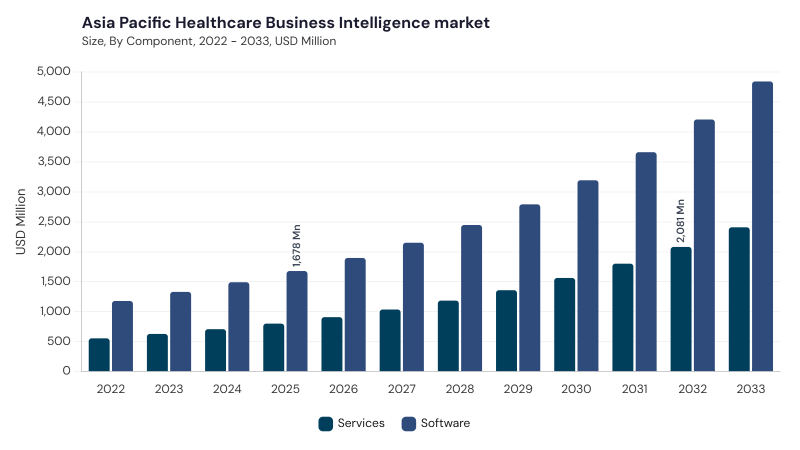
Based on Component, the market is segmented into Software and Services. The Software market dominated the Asia Pacific Healthcare Business Intelligence Market by Component in 2025, and would continue to be a dominant market till 2033; thereby, achieving a market value of USD 3.2 billion by 2030, growing at a CAGR of 14.3 % during the forecast period. The Services market is expected to witness a CAGR of 14.9% during (2026 - 2033).
Software leads because healthcare organizations depend on analytics platforms, dashboards, predictive models, reporting tools, and AI-enabled systems to manage large clinical, financial, and operational datasets. These solutions support EHR analytics, population health management, remote care monitoring, financial planning, and patient outcome improvement. Services remain significant as healthcare institutions need consulting, implementation, integration, customization, training, maintenance, and compliance support. This segment benefits from fragmented IT systems, shortage of in-house BI talent, cloud migration, AI deployment, and the need for tailored implementation across diverse Asia Pacific healthcare environments.
Based on Mode of Delivery, the market is segmented into Cloud-based, On-premise, and Hybrid. The Cloud-based market dominated the Asia Pacific Healthcare Business Intelligence Market by Mode of Delivery in 2025, and would continue to be a dominant market till 2033; thereby, achieving a market value of USD 2.2 billion by 2030, growing at a CAGR of 13.9 % during the forecast period. The On-premise market is expected to witness a CAGR of 14.9% during (2026 - 2033). The Hybrid market is expected to witness a CAGR of 15.2% during (2026 - 2033).
Cloud-based delivery leads as healthcare organizations seek scalable, flexible, cost-efficient, and remotely accessible analytics platforms across distributed care settings. Cloud BI supports real-time reporting, telehealth analytics, population health management, AI processing, and collaboration across hospitals, clinics, payers, and public health systems. On-premise deployment remains important for large hospitals, research organizations, and institutions requiring direct control over sensitive patient data and legacy system integration. Hybrid deployment is gaining traction as healthcare providers combine secure local data management with cloud-based analytics, phased modernization, and compliance-driven flexibility.
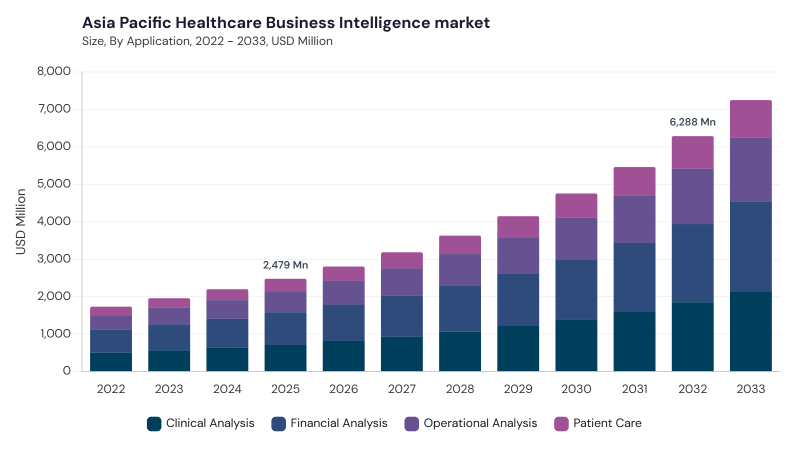
Based on Application, the market is segmented into Financial Analysis, Clinical Analysis, Operational Analysis, and Patient Care. The Financial Analysis market dominated the Asia Pacific Healthcare Business Intelligence Market by Application in 2025, and would continue to be a dominant market till 2033; thereby, achieving a market value of USD 1.6 billion by 2030, growing at a CAGR of 13.7 % during the forecast period. The Clinical Analysis market is expected to witness a CAGR of 14.7% during (2026 - 2033). Additionally, The Operational Analysis market is expected to witness highest CAGR of 15.1% during (2026 - 2033).
Financial Analysis leads as healthcare organizations focus on revenue management, budgeting, insurance claims, expenditure control, fraud detection, and financial transparency across varied funding models. BI tools help providers and payers monitor costs, improve reimbursement workflows, support audit readiness, and strengthen resource planning. Clinical Analysis remains significant through disease surveillance, diagnosis support, evidence-based treatment planning, predictive modeling, and clinical trial analytics. Operational Analysis supports workforce allocation, patient flow, inventory planning, and facility utilization, while Patient Care applications advance telehealth, remote monitoring, personalized medicine, engagement analytics, and population health management.
Based on End Use, the market is segmented into Payers, Healthcare Providers, and Healthcare Manufacturers. Payers lead due to expanding use of BI for claims administration, fraud detection, member risk assessment, healthcare cost management, reimbursement planning, and insurance analytics. These organizations use predictive tools to evaluate utilization patterns, identify high-risk groups, improve policy design, and support value-based care models.
Healthcare Providers remain significant as hospitals, clinics, diagnostic centers, and physician groups adopt BI for clinical efficiency, patient outcomes, operational visibility, and regulatory reporting. Healthcare Manufacturers use BI for pharmaceutical research, medical device development, regulatory planning, demand forecasting, production optimization, supply chain visibility, and market intelligence.
Free Valuable Insights: Healthcare Business Intelligence Market is Predicted to reach USD 30.7 Billion billion by 2033, at a CAGR of 13.8%
Based on Country, the market is segmented into China, Japan, India, South Korea, Singapore, Malaysia, and Rest of Asia Pacific. The China market dominated the Asia Pacific Healthcare Business Intelligence Market by Country in 2025, and would continue to be a dominant market till 2033; thereby, achieving a market value of USD 1.3 billion by 2030, growing at a CAGR of 12.5 % during the forecast period. The Japan market is expected to witness a CAGR of 13.9% during (2026 - 2033). Additionally, The India market is expected to witness a CAGR of 15.3% during (2026 - 2033).
China leads due to healthcare modernization, AI-led analytics, strong digital health initiatives, cloud adoption, hospital informatization, and growing use of BI in public health and clinical decision-making. Japan supports market growth through advanced healthcare infrastructure, aging population needs, predictive analytics, patient-centric data management, and cloud-based BI adoption. India is advancing through digital health platforms, telemedicine expansion, AI-enabled analytics, localized data solutions, and growing demand from hospitals and MedTech firms. South Korea, Singapore, and Malaysia add momentum through strong digital infrastructure, regulatory governance, smart healthcare programs, and secure BI platforms, while Rest of Asia Pacific benefits from cloud adoption, regional partnerships, and localized healthcare intelligence solutions.

By Component
By Mode of Delivery
By Application
By End Use
By Country
Set to reach $4.8 Billion by 2030, growing at 14.5% CAGR during 2026-2033.
China leads with a market value of USD 1.3 billion by 2030, growing at a CAGR of 12.5% during the forecast period.
Rising enterprise cloud adoption and AI-driven workloads are the main catalysts.
Software segment reaches USD 3.2 billion by 2030, growing at a CAGR of 14.3% during the forecast period.
The India market is expected to witness a CAGR of 15.3% during 2026-2033.
Cloud-based segment achieves USD 2.2 billion by 2030, growing at a CAGR of 13.9% during the forecast period.
Our team of dedicated experts can provide you with attractive expansion opportunities for your business.




 Unique Offerings