The sample copy of this report is available for access.
The LAMEA Healthcare Business Intelligence Market is expected to reach USD 1.4 billion by 2029, growing at a CAGR of 15.2% during (2026 – 2033).
The LAMEA Healthcare Business Intelligence Market emerged as healthcare systems across Latin America, the Middle East, and Africa began shifting from manual reporting toward structured data management. Early adoption was limited by fragmented data silos, legacy systems, and uneven healthcare digitization across the region. As hospitals, payers, and public health agencies started adopting electronic records, cloud platforms, and analytics tools, BI solutions became more relevant for operational and clinical decisions. The market gradually advanced from isolated dashboards to integrated intelligence platforms supporting population health, resource planning, and financial management.
The LAMEA Healthcare Business Intelligence Market is being shaped by AI-enabled analytics, digital health expansion, cloud-based access, population health needs, and rising pressure to improve healthcare quality within budget-sensitive environments. Healthcare providers, payers, and manufacturers are adopting BI tools to support claims processing, fraud detection, clinical decision-making, operational planning, supply chain visibility, and patient engagement. Demand is supported by telemedicine, mobile health platforms, electronic medical records, machine learning, real-time dashboards, and data governance initiatives. Vendors are focusing on localized platforms, secure data handling, multilingual interfaces, flexible pricing, and scalable cloud deployment.
Based on Component, the market is segmented into Software and Services. The Software market dominated the LAMEA Healthcare Business Intelligence Market by Component in 2025, and would continue to be a dominant market till 2033; thereby, achieving a market value of USD 916.7 million by 2029, growing at a CAGR of 15 % during the forecast period. The Services market is expected to witness a CAGR of 15.6% during (2026 - 2033).
Software leads because healthcare organizations increasingly rely on analytics platforms, dashboards, visualization tools, predictive models, and AI-enabled systems to consolidate clinical, financial, and operational data. These solutions support resource allocation, clinical performance monitoring, revenue management, patient risk analysis, and evidence-based healthcare planning. Services remain significant as organizations require consulting, implementation, data migration, system integration, customization, workforce training, and technical support. This segment benefits from limited in-house analytics expertise, fragmented IT systems, regulatory complexity, cloud migration, and the need for localized deployment across diverse healthcare settings.
Based on Mode of Delivery, the market is segmented into Cloud-based, On-premise, and Hybrid. The Cloud-based market dominated the LAMEA Healthcare Business Intelligence Market by Mode of Delivery in 2025, and would continue to be a dominant market till 2033; thereby, achieving a market value of USD 620.6 million by 2029, growing at a CAGR of 14.6 % during the forecast period. The On-premise market is expected to witness a CAGR of 15.6% during (2026 - 2033). The Hybrid market is expected to witness a CAGR of 15.9% during (2026 - 2033).
Cloud-based delivery leads as healthcare organizations seek scalable, lower-cost, remotely accessible analytics platforms that reduce the need for heavy local infrastructure. Cloud BI supports real-time reporting, claims analysis, patient monitoring, operational visibility, and collaboration across geographically dispersed healthcare facilities. On-premise deployment remains important for large hospitals, government health institutions, and research organizations requiring direct control over sensitive patient data and customized IT environments. Hybrid deployment is gradually expanding as providers combine local data security with cloud-enabled analytics, phased modernization, and flexible compliance management.
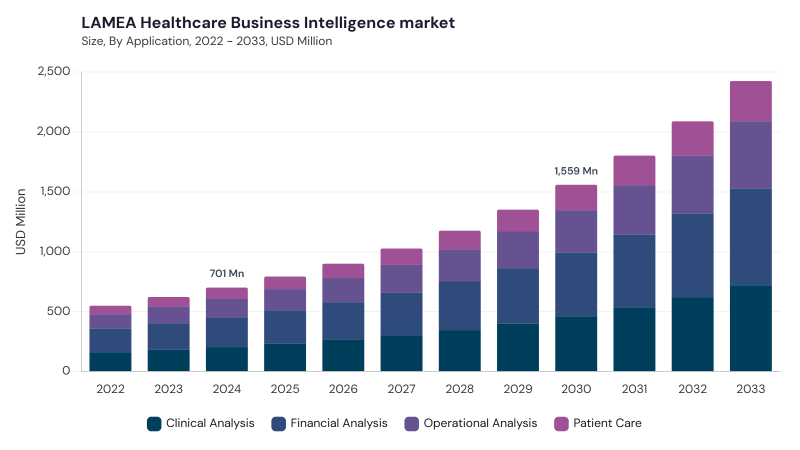
Based on Application, the market is segmented into Financial Analysis, Clinical Analysis, Operational Analysis, and Patient Care. The Financial Analysis market dominated the LAMEA Healthcare Business Intelligence Market by Application in 2025, and would continue to be a dominant market till 2033; thereby, achieving a market value of USD 462.4 million by 2029, growing at a CAGR of 14.4 % during the forecast period. The Clinical Analysis market is expected to witness a CAGR of 15.4% during (2026 - 2033). Additionally, The Operational Analysis market is expected to witness highest CAGR of 15.8% during (2026 - 2033).
Financial Analysis leads as healthcare organizations focus on cost control, budget forecasting, claims management, reimbursement monitoring, financial risk assessment, and revenue cycle optimization. BI tools help providers and payers improve billing accuracy, identify inefficiencies, detect fraud, manage expenditure, and strengthen financial sustainability. Clinical Analysis remains significant through diagnostic support, predictive analytics, evidence-based treatment planning, disease monitoring, and clinical outcome measurement. Operational Analysis supports workforce productivity, supply chain coordination, facility use, and workflow improvement, while Patient Care applications advance telemedicine, chronic disease management, engagement analytics, remote monitoring, and personalized care.
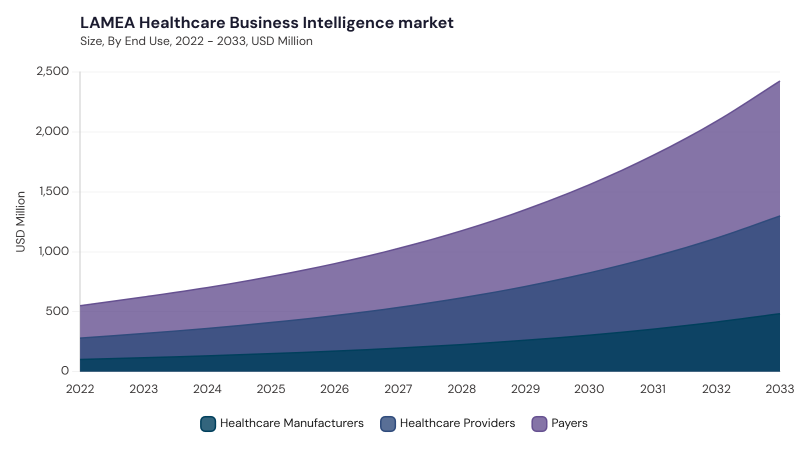
Based on End Use, the market is segmented into Payers, Healthcare Providers, and Healthcare Manufacturers. Payers lead due to increasing use of BI for claims adjudication, fraud detection, population risk management, reimbursement strategy, and healthcare cost control. These organizations use analytics to process large claims datasets, identify anomalies, assess high-risk groups, and support value-based reimbursement models.
Healthcare Providers remain significant as hospitals, clinics, and ambulatory care centers adopt BI for clinical decisions, patient flow, resource allocation, regulatory reporting, and quality improvement. Healthcare Manufacturers use BI for pharmaceutical production, medical device operations, market intelligence, inventory planning, regulatory monitoring, distribution optimization, and demand forecasting.
Free Valuable Insights: Healthcare Business Intelligence Market Size Worth USD 30.7 Billion billion by 2033
Based on Country, the market is segmented into Brazil, Argentina, UAE, Saudi Arabia, South Africa, Nigeria, and Rest of LAMEA. The Brazil market dominated the LAMEA Healthcare Business Intelligence Market by Country in 2025, and would continue to be a dominant market till 2033; thereby, achieving a market value of USD 313.7 million by 2029, growing at a CAGR of 13.6 % during the forecast period. The Argentina market is expected to witness a CAGR of 16.9% during (2026 - 2033). Additionally, The UAE market is expected to witness a CAGR of 14.1% during (2026 - 2033).
Brazil leads due to healthcare digitization, regulatory reforms, telemedicine expansion, cloud analytics adoption, and rising demand for transparent data-driven healthcare management. Argentina supports market growth through EHR adoption, AI-enhanced analytics, interoperability improvement, public health modernization, and growing focus on population health management. The UAE contributes through smart healthcare infrastructure, AI-led analytics, cloud deployment, strong data governance, and government-backed digital health transformation. Saudi Arabia, South Africa, and Nigeria add momentum through healthcare modernization, mobile health platforms, value-based care initiatives, local partnerships, and demand for cost-efficient analytics, while Rest of LAMEA benefits from cloud-based BI, localized solutions, and improving digital health connectivity.

By Component
By Mode of Delivery
By Application
By End Use
By Country
Set to reach $1.4 Billion by 2029, growing at 15.2% CAGR during 2026-2033.
Brazil leads with $313.7 million by 2029, growing at a CAGR of 13.6% during the forecast period.
Rising adoption of cloud-based solutions, reaching $620.6 million by 2029 at 14.6% CAGR.
Software segment hits $916.7 million by 2029, growing at a 15% CAGR during the forecast period.
The UAE market is expected to witness a CAGR of 14.1% during 2026-2033.
Financial analysis segment reaches $462.4 million by 2029, growing at a 14.4% CAGR during the forecast period.
Our team of dedicated experts can provide you with attractive expansion opportunities for your business.




 Unique Offerings