The sample copy of this report is available for access.
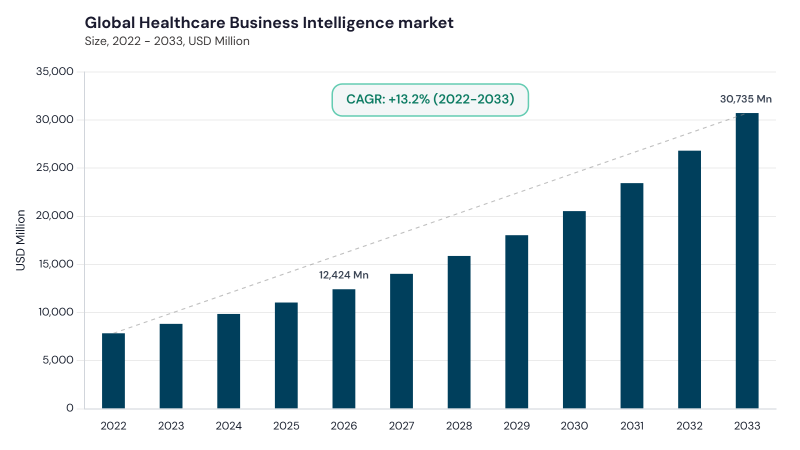
“Global Healthcare Business Intelligence Market to reach a market value of USD 30,735.36 Million by 2033 growing at a CAGR of 13.8%”
The Global Healthcare Business Intelligence Market is expected to reach USD 30.7 billion by 2033, growing at a CAGR of 13.8% during (2026 - 2033).
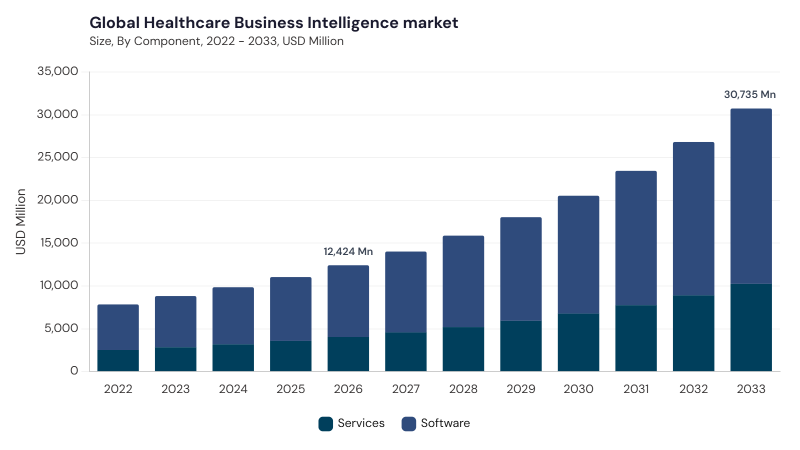
Healthcare business intelligence market is driven by the rising need for operational efficiency, data-driven decision making, revenue cycle optimization, enhanced patient outcomes, population health management, clinical performance tracking, and regulatory compliance. The market demand is also rising as clinics, hospitals, healthcare manufacturers, and pharmaceutical companies adopt dashboards, analytics platforms, predictive analytics, interoperable data systems, and cloud-based business intelligence. The market evolved from the need to convert large healthcare datasets into actionable insights across financial, clinical, and operational functions.
Healthcare business intelligence market is rising as healthcare enterprises shift from fragmented toward AI-enabled, unified, and real-time platforms, Business intelligence are largely used to combine data from imaging systems, administrative workflows, EHRs, and payer portals. The market benefits from the growing demand for compliance-ready reporting, predictive insights, cloud-native data ecosystems, patient-centered analytics, and workflow optimization.
Competitive landscape of market is healthcare data-driven, supported by healthcare specialized analytics companies, enterprise business intelligence vendors, cloud-based visualization providers, and HER-integrated intelligence platforms. Market players are positioning themselves ahead through clinical workflow alignment, real-time reporting, healthcare data integration, clinical workflow alignment, scalable cloud deployment, and self-service dashboards. Market competition is predicted to depend on predictive modeling, interoperability, embedded analytics, and the capability to convert segmented healthcare data into actionable intelligence.

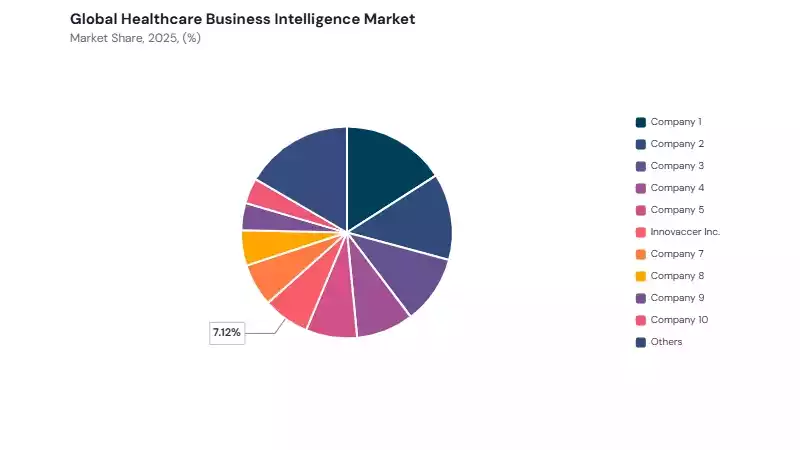
Healthcare business intelligence market represents a dynamic competitive landscape driven by healthcare-specialized business intelligence companies, broad enterprise analytics vendors, cloud-based visualization providers, and EHR-integrated platforms. Salesforce, Oracle Corporation, Microsoft Corporation hold strong positions through cloud infrastructure, enterprise analytics, interactive dashboard capabilities, and healthcare data platforms. SAP, SAS, Innovaccer, Health Catalyst, QlikTech, Epic, and Infor further strengthen competition through payer intelligence, clinical analytics, embedded reporting, population health management, embedded reporting, and healthcare-specific data integration.
Based on Component, the market is segmented into Software and Services. The Software market dominated the Global Healthcare Business Intelligence Market by Component in 2025, and would continue to be a dominant market till 2033; thereby, achieving a market value of USD 20.5 billion by 2033, growing at a CAGR of 13.6 % during the forecast period. The Services market is expected to witness a CAGR of 14.2% during (2026 - 2033).
Software leads the market as healthcare organizations rely on analytics platforms, data visualization tools, predictive modeling, AI-enabled decision support, and reporting systems. Services support consulting, implementation, integration, training, managed analytics, and ongoing optimization. Both segments are essential as healthcare organizations require strong BI technology along with expert support to manage complex data environments.
Based on Mode of Delivery, the market is segmented into Cloud-based, On-premise, and Hybrid. The Cloud-based market dominated the Global Healthcare Business Intelligence Market by Mode of Delivery in 2025, and would continue to be a dominant market till 2033; thereby, achieving a market value of USD 13.7 billion by 2033, growing at a CAGR of 13.2 % during the forecast period. The On-premise market is expected to witness a CAGR of 14.2% during (2026 - 2033). The Hybrid market is expected to witness a CAGR of 14.4% during (2026 - 2033).
Cloud-based deployment leads due to scalability, remote access, lower infrastructure burden, and easier integration with digital healthcare platforms. On-premise remains important for organizations requiring direct control over sensitive patient data and customized IT environments. Hybrid deployment is gaining adoption by combining on-premise security with cloud flexibility and analytics scalability.
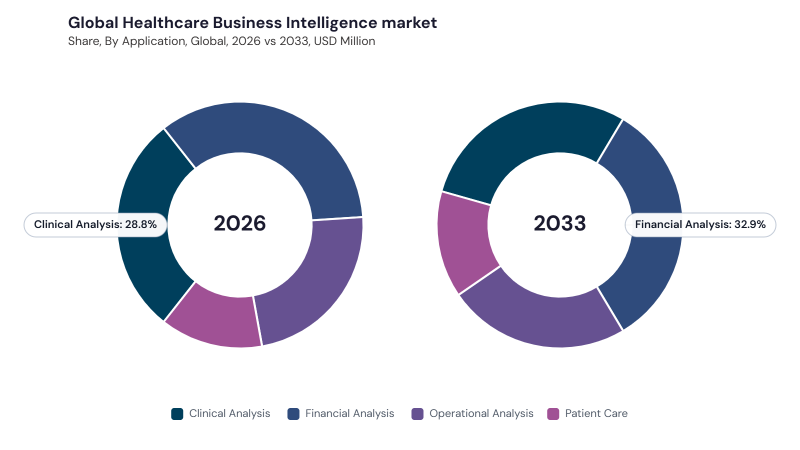
Based on Application, the market is segmented into Financial Analysis, Clinical Analysis, Operational Analysis, and Patient Care. The Financial Analysis market dominated the Global Healthcare Business Intelligence Market by Application in 2025, and would continue to be a dominant market till 2033; thereby, achieving a market value of USD 10.1 billion by 2033, growing at a CAGR of 13 % during the forecast period. The Clinical Analysis market is expected to witness a CAGR of 14% during (2026 - 2033). Additionally, The Operational Analysis market is expected to witness highest CAGR of 14.4% during (2026 - 2033).
Financial Analysis leads as healthcare organizations focus on revenue cycle management, cost control, claims review, and financial performance monitoring. Clinical Analysis supports evidence-based care, treatment outcome tracking, and decision support. Operational Analysis improves workflow efficiency and resource use, while Patient Care supports engagement, personalized care, and outcome-based management.
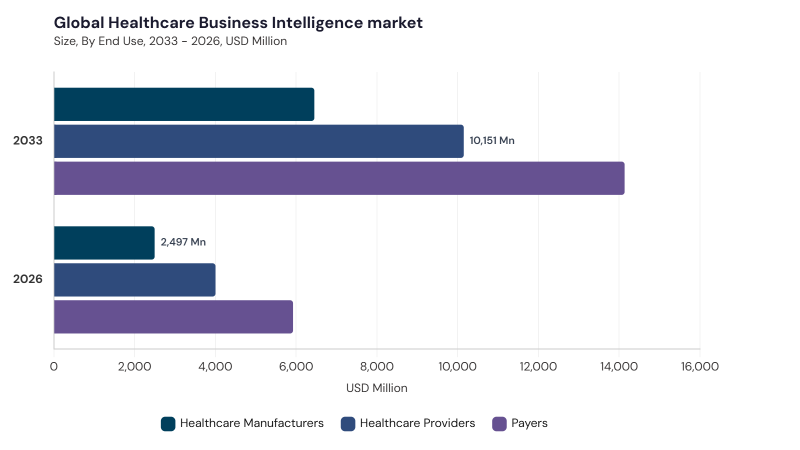
Based on End Use, the market is segmented into Payers, Healthcare Providers, and Healthcare Manufacturers. The Payers market dominated the Global Healthcare Business Intelligence Market by End Use in 2025, and would continue to be a dominant market till 2033; thereby, achieving a market value of USD 14.1 billion by 2033, growing at a CAGR of 13.2 % during the forecast period. The Healthcare Providers market is expected to witness a CAGR of 14.2% during (2026 - 2033).
Payers led the market through extensive use of BI for claims management, fraud detection, risk assessment, reimbursement optimization, and cost containment. Healthcare Providers use BI to improve clinical quality, operational efficiency, patient outcomes, and regulatory reporting. Healthcare Manufacturers adopt BI for supply chain optimization, product performance analysis, regulatory compliance, and market intelligence.
Free Valuable Insights: Healthcare Business Intelligence Market Size to reach $30.7 Billion by 2033
Region-wise, the Healthcare Business Intelligence Market is analyzed across North America, Europe, Asia Pacific, and LAMEA.
In 2025, the North America region held the largest share in the healthcare business intelligence market, by achieving a market share of USD 13.8 billion with a CAGR of 13.8% by 2033. The APAC region is predicted to grow at a CAGR of 14.5% during the forecast period. Moreover, the Europe region is anticipated to expand at a CAGR of 13.6% during 2026-2033.
North America market is supported by strong digital health adoption, advanced healthcare IT infrastructure, and high investment in data-driven healthcare decision making. Europe region is driven by healthcare digitization, electronic health record adoption, and strict regulatory needs. Asia Pacific is witnessing expansion cloud analytics adoption, healthcare infrastructure growth. Furthermore, LAMEA region is developing through enhancing digital infrastructure and healthcare modernization.
| Report Attribute | Details |
|---|---|
| Market size value in 2026 | USD 12.4 billion |
| Market size forecast in 2033 | USD 30.7 billion |
| Base Year | 2025 |
| Historical Period | 2022 to 2024 |
| Forecast Period | 2026 to 2033 |
| Revenue Growth Rate | CAGR of 13.8% from 2026 to 2033 |
| Number of Pages | 611 |
| Tables | 720 |
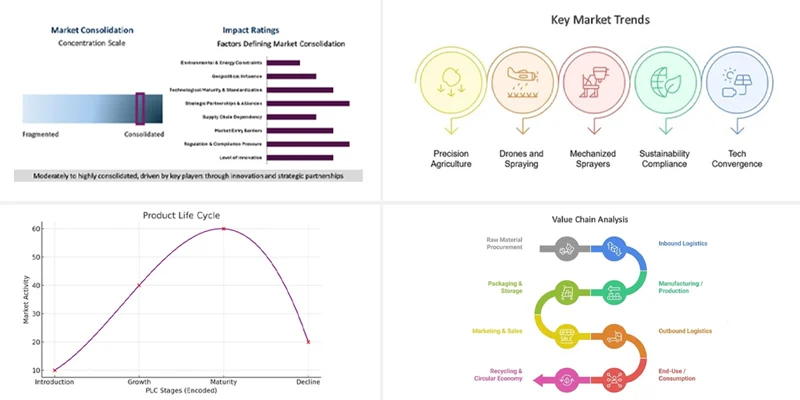
| Report Coverage | Market Trends, Revenue Estimation and Forecast, Segmentation Analysis, Regional and Country Breakdown, Competitive Landscape, Market Share Analysis, Company Profiling, Companies Strategic Developments, SWOT Analysis, Product Life Cycle Analysis, Value Chain Analysis, Market Consolidation Analysis, Key Customer Criteria, Pandemic Impact Analysis, and Winning Imperatives |
| Segments Covered | Component, Mode of Delivery, Application, End Use, and Geography |
| Country Scope |
|
| Companies Included | Microsoft Corporation; Oracle Corporation; Salesforce, Inc.; Health Catalyst, Inc.; QlikTech International AB; Innovaccer Inc.; SAP SE; SAS Institute Inc.; Infor, Inc.; Epic Systems Corporation |
By Component
By Mode of Delivery
By Application
By End Use
By Geography
The market is projected to reach USD 30.7 billion by 2033, growing at 13.8% CAGR during 2026-2033.
Software segment leads, expected to achieve USD 20.5 billion by 2033.
Microsoft, Oracle, Salesforce, Health Catalyst, QlikTech, Innovaccer, SAP, SAS Institute, Infor, and Epic Systems.
Cloud-based segment leads, projected to reach USD 13.7 billion by 2033.
North America leads, expected to achieve USD 13.8 billion by 2033.
Payers segment leads, projected to reach USD 14.1 billion by 2033.
Our team of dedicated experts can provide you with attractive expansion opportunities for your business.








 Unique Offerings