The sample copy of this report is available for access.
The Europe Healthcare Business Intelligence Market is expected to reach USD 5.6 billion by 2031, growing at a CAGR of 13.6% during (2026 – 2033).
The Europe Healthcare Business Intelligence Market originated from the gradual use of analytics tools for clinical reporting, administrative monitoring, and outcome tracking across healthcare institutions. Early systems mainly supported basic dashboards and retrospective reporting, but expanded EHR adoption and digital health infrastructure created broader data availability. Over time, big data analytics, AI, machine learning, cloud platforms, and interoperable systems transformed healthcare BI into a more strategic decision-support layer. Regulatory emphasis on GDPR, AI governance, medical data protection, and healthcare certification further shaped platform design and deployment.
The Europe Healthcare Business Intelligence Market is being shaped by AI-enabled analytics, regulatory harmonization, connected medical devices, cloud-based platforms, and rising pressure to improve care quality while managing healthcare costs. Healthcare providers, payers, and manufacturers are using BI solutions to support clinical governance, reimbursement management, operational planning, population health, patient engagement, and regulatory reporting. Demand is supported by interoperable EHR systems, IoT-enabled medical data, predictive modeling, privacy-preserving analytics, and cross-border health data exchange.
Based on Component, the market is segmented into Software and Services. The Software market dominated the Europe Healthcare Business Intelligence Market by Component in 2025, and would continue to be a dominant market till 2033; thereby, achieving a market value of USD 3.8 billion by 2031, growing at a CAGR of 13.4 % during the forecast period. The Services market is expected to witness a CAGR of 14% during (2026 - 2033).
Software leads because healthcare organizations rely on analytics platforms, reporting tools, visualization dashboards, predictive models, and AI-enabled systems to improve clinical, operational, and financial decisions. These platforms support outcome measurement, regulatory reporting, resource optimization, patient risk analysis, and value-based care initiatives. Services remain significant as healthcare institutions need consulting, system integration, migration, training, customization, compliance support, and managed BI assistance. This segment benefits from fragmented healthcare IT systems, regulatory complexity, legacy modernization, AI deployment, and the need for expert-led implementation.
Based on Mode of Delivery, the market is segmented into Cloud-based, On-premise, and Hybrid. The Cloud-based market dominated the Europe Healthcare Business Intelligence Market by Mode of Delivery in 2025, and would continue to be a dominant market till 2033; thereby, achieving a market value of USD 2.5 billion by 2031, growing at a CAGR of 13 % during the forecast period. The On-premise market is expected to witness a CAGR of 14% during (2026 - 2033). The Hybrid market is expected to witness a CAGR of 14.2% during (2026 - 2033).
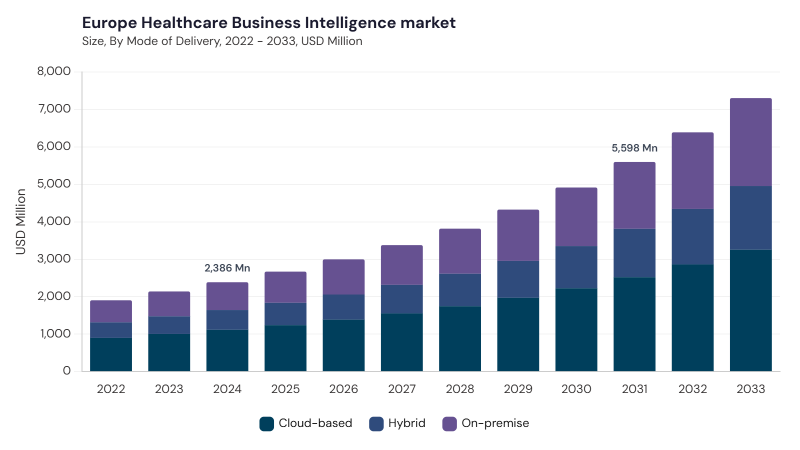
Cloud-based delivery leads as healthcare organizations seek scalable, flexible, and collaborative analytics infrastructure that supports real-time insights across multiple facilities. Cloud BI enables data integration, remote access, advanced analytics, and easier deployment while vendors improve security, encryption, compliance, and interoperability. On-premise deployment remains important for institutions requiring direct control over sensitive patient data, local processing, and customized governance environments. Hybrid delivery is expanding as providers combine on-premise data control with cloud-based scalability, AI processing, secure collaboration, and gradual modernization of legacy systems.
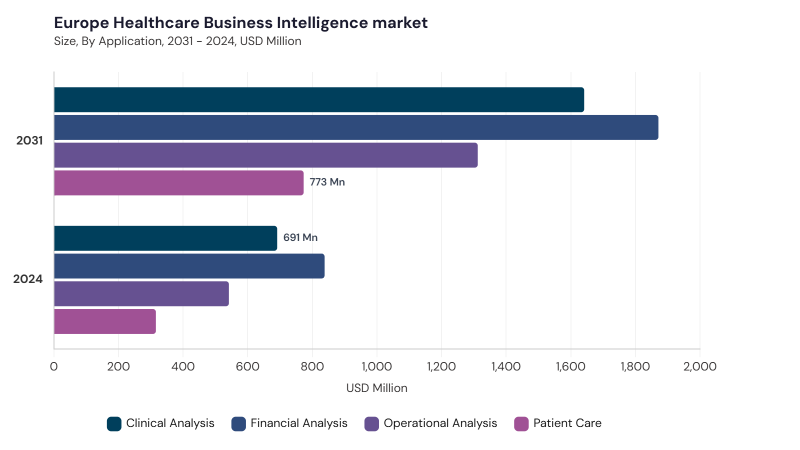
Based on Application, the market is segmented into Financial Analysis, Clinical Analysis, Operational Analysis, and Patient Care. The Financial Analysis market dominated the Europe Healthcare Business Intelligence Market by Application in 2025, and would continue to be a dominant market till 2033; thereby, achieving a market value of USD 1.9 billion by 2031, growing at a CAGR of 12.8 % during the forecast period. The Clinical Analysis market is expected to witness a CAGR of 13.8% during (2026 - 2033). Additionally, The Operational Analysis market is expected to witness highest CAGR of 14.1% during (2026 - 2033).
Financial Analysis leads as healthcare systems focus on budgeting, reimbursement management, cost containment, claims analytics, payment integrity, and fiscal sustainability. BI platforms help payers and providers improve financial transparency, reduce billing errors, manage expenditure, and support performance-based reimbursement models. Clinical Analysis remains significant through disease surveillance, clinical risk management, evidence-based decision support, quality monitoring, and outcome improvement. Operational Analysis supports staffing, capacity planning, supply chain, appointment scheduling, and facility use, while Patient Care applications strengthen personalized treatment, patient engagement, remote monitoring, and coordinated care.
Based on End Use, the market is segmented into Payers, Healthcare Providers, and Healthcare Manufacturers. Payers lead due to growing use of BI for reimbursement management, fraud prevention, policy evaluation, risk adjustment, cost optimization, and regulatory reporting. These organizations use analytics to assess claims, monitor healthcare expenditure, evaluate outcomes, and improve payer-provider coordination.
Healthcare Providers remain significant as hospitals, clinics, diagnostic centers, and physician groups adopt BI to improve clinical performance, patient safety, workflow efficiency, and compliance. Healthcare Manufacturers use BI for pharmaceutical research, medical device planning, supply chain visibility, post-market surveillance, commercial analytics, market forecasting, and regulatory decision-making.
Free Valuable Insights: The Worldwide Healthcare Business Intelligence Market is projected to reach USD 30.7 Billion billion by 2033, at a CAGR of 13.8%
Based on Country, the market is segmented into Germany, UK, France, Russia, Spain, Italy, and Rest of Europe. The Germany market dominated the Europe Healthcare Business Intelligence Market by Country in 2025, and would continue to be a dominant market till 2033; thereby, achieving a market value of USD 1.1 billion by 2031, growing at a CAGR of 12 % during the forecast period. The UK market is expected to witness a CAGR of 12.5% during (2026 - 2033). Additionally, The France market is expected to witness a CAGR of 14.3% during (2026 - 2033).
Germany leads due to strong healthcare digitization, advanced hospital infrastructure, AI investment, interoperable analytics platforms, and demand for outcome-based decision support. The UK supports market growth through NHS digitization, AI adoption, data governance initiatives, cloud platforms, and population health analytics. France contributes through national digital health priorities, patient-centric analytics, interoperability improvements, secure cloud adoption, and predictive decision-support tools. Russia, Spain, and Italy add momentum through healthcare IT modernization, regulatory reporting needs, AI-enabled analytics, cloud-based BI, and value-based care initiatives, while Rest of Europe benefits from localized BI deployments, compliance-focused platforms, and increasing demand for integrated healthcare intelligence.

By Component
By Mode of Delivery
By Application
By End Use
By Country
Set to reach $5.6 Billion by 2031, growing at 13.6% CAGR during 2026-2033.
Germany leads with $1.1 billion by 2031, growing at 12% CAGR during the forecast period.
Rising enterprise cloud adoption and AI-driven workloads are the main catalysts.
Software segment hits $3.8 billion by 2031 at 13.4% CAGR during the forecast period.
France market is expected to witness a CAGR of 14.3% during 2026-2033.
Cloud-based segment achieves $2.5 billion by 2031, growing at 13% CAGR during the forecast period.
Our team of dedicated experts can provide you with attractive expansion opportunities for your business.




 Unique Offerings