The sample copy of this report is available for access.
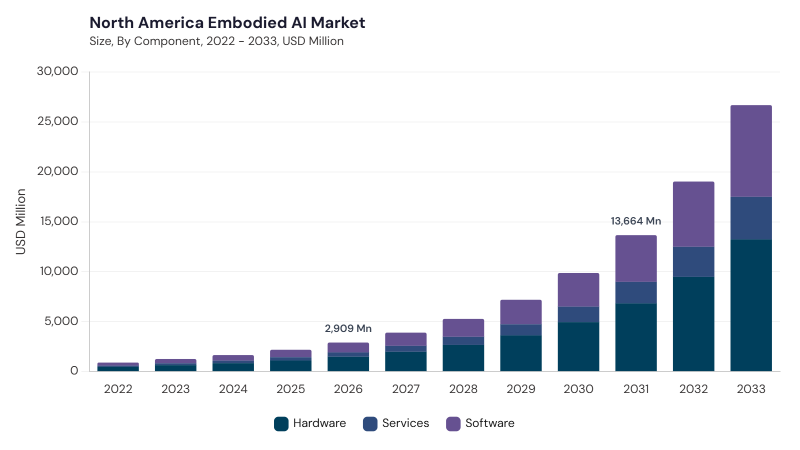
The North America Embodied AI Market is expected to reach USD 19.0 billion by 2032, growing at a CAGR of 37.2% during (2026 – 2033).
The North America Embodied AI Market evolved from early robotics research that focused on giving machines the ability to sense, interpret, and act within physical environments. Initial adoption was concentrated in laboratories, advanced manufacturing sites, and specialized industrial automation settings where AI-enabled robots performed controlled tasks. With improvements in sensors, machine learning, edge processors, actuators, and robotic control systems, embodied AI moved from experimental platforms into real-world production floors, hospitals, warehouses, and service environments. The market has gradually shifted from rule-based automation to adaptive physical intelligence capable of learning from surroundings and responding to changing conditions.
The North America Embodied AI Market is advancing through human-robot collaboration, edge intelligence, sensory processing, functional safety, and simplified deployment interfaces. Manufacturers and logistics operators are using embodied AI to automate repetitive, hazardous, and precision-driven tasks while improving workforce productivity and operational flexibility. Healthcare, defense, retail, education, and smart appliance applications are also widening as AI-enabled systems become more responsive, interactive, and context-aware. Vendors are focusing on modular designs, real-time diagnostics, drag-and-drop automation, and safer machine interaction to support broader enterprise adoption.
Based on Component, the market is segmented into Hardware, Software, and Services. The Hardware market dominated the North America Embodied AI Market by Component in 2025, and would continue to be a dominant market till 2033; thereby, achieving a market value of USD 9.5 billion by 2032, growing at a CAGR of 36.7 % during the forecast period. The Software market is expected to witness a CAGR of 37.5% during (2026 - 2033).
Hardware leads because embodied AI depends on physical components such as robotic platforms, sensors, cameras, LiDAR, tactile arrays, processors, actuators, and embedded computing units. These components allow intelligent machines to perceive space, move safely, manipulate objects, and operate in industrial or commercial environments. Software is expanding strongly as machine learning models, computer vision, motion planning, simulation tools, and decision-making platforms improve robot autonomy. Services are gaining traction as enterprises require consulting, integration, customization, maintenance, safety validation, and lifecycle support to deploy embodied AI systems within existing operations.
Based on Product, the market is segmented into Robots, Autonomous Systems, Smart Appliances, and Exoskeletons. The Robots market dominated the North America Embodied AI Market by Product in 2025, and would continue to be a dominant market till 2033; thereby, achieving a market value of USD 6.9 billion by 2032, growing at a CAGR of 35.7 % during the forecast period. The Autonomous Systems market is expected to witness a CAGR of 37.5% during (2026 - 2033). Additionally, The Smart Appliances market is expected to witness highest CAGR of 38.1% during (2026 - 2033).
Robots lead due to expanding use of collaborative robots, industrial robotic arms, mobile robots, humanoid systems, and service robots across manufacturing, healthcare, warehouses, and retail environments. These systems combine perception, movement, learning, and task execution to improve productivity and reduce dependence on manual work. Autonomous Systems are growing through applications in drones, autonomous vehicles, inspection platforms, defense systems, and industrial mobility solutions. Smart Appliances are expanding through connected homes and AI-enabled automation, while Exoskeletons are gaining adoption in rehabilitation, workplace safety, mobility support, and defense-related physical augmentation.
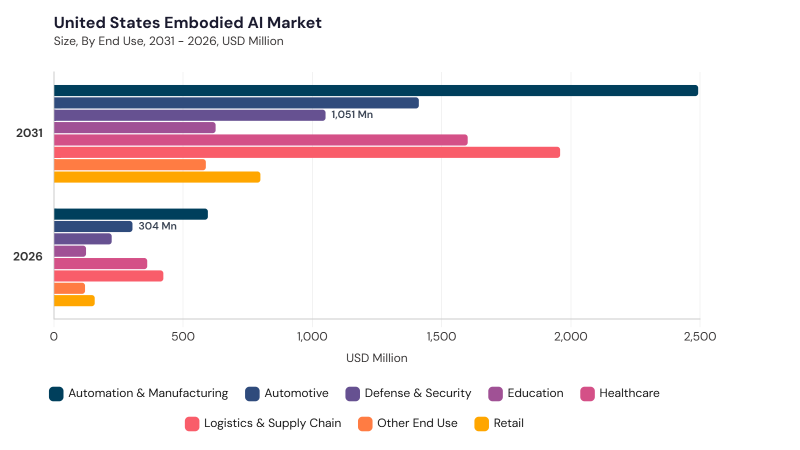
Based on End Use, the market is segmented into Automation & Manufacturing, Logistics & Supply Chain, Healthcare, Automotive, Defense & Security, Retail, Education, and Other End Use. Automation & Manufacturing lead as factories adopt intelligent robots, cobots, smart production lines, AI-guided inspection systems, and adaptive machines to improve precision, safety, and throughput. These applications help manufacturers manage labor gaps, reduce repetitive tasks, and create more flexible production environments.
Logistics & Supply Chain is expanding through warehouse robots, autonomous mobile robots, robotic sorters, inventory automation, and last-mile delivery systems. Healthcare, Automotive, and Defense & Security are strengthening adoption through surgical robotics, rehabilitation systems, autonomous mobility, surveillance platforms, and intelligent defense tools, while Retail, Education, and Other End Use add emerging demand through customer interaction and learning-based AI systems.
Free Valuable Insights: The Global Embodied AI Market will hit USD 71.3 Billion billion by 2033, at a CAGR of 37.9%
Based on Country, the market is segmented into US, Canada, Mexico, and Rest of North America. The US market dominated the North America Embodied AI Market by Country in 2025, and would continue to be a dominant market till 2033; thereby, achieving a market value of USD 14.6 million by 2032, growing at a CAGR of 36.4 % during the forecast period. The Canada market is expected to witness a CAGR of 40.7% during (2026 - 2033). Additionally, The Mexico market is expected to witness a CAGR of 39.5% during (2026 - 2033).
The US leads due to strong robotics innovation, large AI research ecosystems, advanced manufacturing automation, defense technology investments, warehouse robotics adoption, and early deployment of humanoid and collaborative robots. Canada contributes through AI research strength, robotics startups, healthcare automation, logistics applications, and partnerships between academic institutions and technology providers. Mexico supports growth through industrial digitization, automotive manufacturing automation, logistics modernization, and increasing interest in localized embodied AI solutions for factory and service operations. Rest of North America benefits from gradual adoption of cost-efficient embodied AI systems, edge intelligence, and physical automation across smaller industrial and commercial environments.

By Component
By Product
By End Use
By Country
Set to reach $19.0 Billion by 2032, growing at 37.2% CAGR during 2026-2033.
The US leads with $14.6 million by 2032, growing at 36.4% CAGR during the forecast period.
Rising demand for smart appliances with a 38.1% CAGR during 2026-2033 is a key growth driver.
Hardware segment will reach $9.5 billion by 2032, growing at 36.7% CAGR during the forecast period.
The Canada market is expected to witness a CAGR of 40.7% during 2026-2033.
Robots segment will achieve $6.9 billion by 2032, growing at 35.7% CAGR during the forecast period.
Our team of dedicated experts can provide you with attractive expansion opportunities for your business.




 Unique Offerings