The sample copy of this report is available for access.
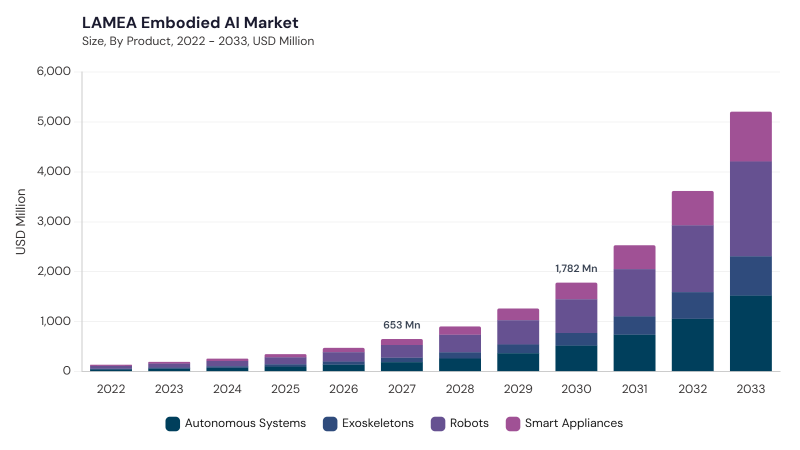
The LAMEA Embodied AI Market is expected to reach USD 1.3 billion by 2029, growing at a CAGR of 40.7% during (2026 – 2033).
The LAMEA Embodied AI Market has developed through the gradual movement of artificial intelligence from software-based decision systems into physical machines capable of sensing, moving, and responding to real surroundings. Early activity in the region was mostly linked to robotics trials, industrial automation projects, academic research, and sensor-based AI applications. As deep learning, edge computing, IoT networks, adaptive interfaces, and multi-modal sensors improved, embodied AI began finding practical use in manufacturing, healthcare, logistics, agriculture, public services, and security. The market’s development has been shaped by regional realities such as infrastructure gaps, resource constraints, uneven digital maturity, and the need for cost-efficient automation.
The current LAMEA Embodied AI Market is moving toward context-aware machines, connected physical intelligence, user-centric design, and locally adaptable AI systems. Companies are focusing on embodied AI that can work with limited connectivity, process data closer to the device, and support real-time decisions in factories, farms, hospitals, warehouses, and smart city environments. IoT integration is making robotic systems more responsive through predictive maintenance, remote monitoring, adaptive workflow automation, and better safety management. Open-source tools, regional startup activity, government partnerships, and international collaborations are also lowering entry barriers and encouraging experimentation.
Based on Component, the market is segmented into Hardware, Software, and Services. The Hardware market dominated the LAMEA Embodied AI Market by Component in 2025, and would continue to be a dominant market till 2033; thereby, achieving a market value of USD 646.5 million by 2029, growing at a CAGR of 40.2 % during the forecast period. The Software market is expected to witness a CAGR of 41% during (2026 - 2033).
Hardware leads because embodied AI requires physical systems such as robots, sensors, actuators, embedded processors, wearable robotic units, cameras, mobility platforms, and connected devices that allow AI to operate in real environments. Demand is supported by investments in intelligent robotics, automation infrastructure, AI-enabled sensing technologies, public-sector modernization, and smart industrial systems. Software is expanding as machine learning, computer vision, real-time analytics, edge AI, motion planning, and autonomous control platforms improve the intelligence layer of these systems. Services are gaining relevance as organizations need consulting, system integration, localization, training, maintenance, cybersecurity support, and lifecycle management to deploy embodied AI across fragmented regional markets.
Based on Product, the market is segmented into Robots, Autonomous Systems, Smart Appliances, and Exoskeletons. The Robots market dominated the LAMEA Embodied AI Market by Product in 2025, and would continue to be a dominant market till 2033; thereby, achieving a market value of USD 484.6 million by 2029, growing at a CAGR of 39.1 % during the forecast period. The Autonomous Systems market is expected to witness a CAGR of 40.9% during (2026 - 2033). Additionally, The Smart Appliances market is expected to witness highest CAGR of 41.7% during (2026 - 2033).
Robots lead the market as industries increasingly use AI-enabled machines for industrial automation, healthcare assistance, logistics handling, service operations, hazardous task execution, and public-facing support. These systems are gaining value where human-machine collaboration, adaptive decision-making, and operational resilience are important. Autonomous Systems are expanding through drones, unmanned mobile robots, autonomous vehicles, surveillance platforms, agricultural systems, and infrastructure monitoring tools. Smart Appliances are supported by rising interest in connected living, energy efficiency, and IoT-based automation, while Exoskeletons are developing through rehabilitation, industrial worker assistance, mobility support, and defense-related physical augmentation.
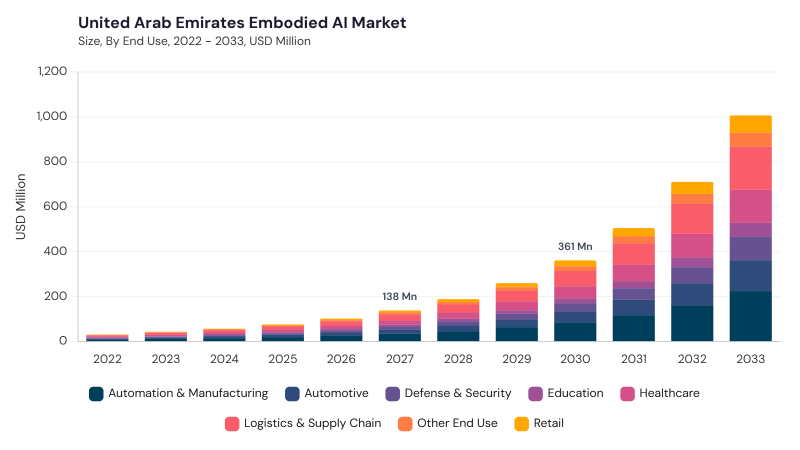
Based on End Use, the market is segmented into Automation & Manufacturing, Logistics & Supply Chain, Healthcare, Automotive, Defense & Security, Retail, Education, and Other End Use. Automation & Manufacturing lead as factories and industrial facilities adopt robotic assembly, quality inspection, autonomous material handling, smart production systems, and AI-supported process control. The segment benefits from industrial modernization efforts in markets such as Brazil, South Africa, and the UAE, where companies are seeking productivity gains, safety improvements, and lower dependence on repetitive manual work.
Logistics & Supply Chain is growing through warehouse automation, drone delivery trials, port automation, inventory robotics, and autonomous mobile units. Healthcare, Automotive, and Defense & Security are advancing through rehabilitation robots, robotic-assisted procedures, autonomous mobility, surveillance systems, and defense modernization, while Retail, Education, and Other End Use are expanding through customer interaction, teaching assistants, hospitality robots, agriculture, and public-service applications.
Free Valuable Insights: Embodied AI Market Size Worth USD 71.3 Billion billion by 2033
Based on Country, the market is segmented into Brazil, Argentina, UAE, Saudi Arabia, South Africa, Nigeria, and Rest of LAMEA. The UAE market dominated the LAMEA Embodied AI Market by Country in 2025, and would continue to be a dominant market till 2033; thereby, achieving a market value of USD 260.2 million by 2029, growing at a CAGR of 38.6 % during the forecast period. The Argentina market is expected to witness a CAGR of 41.7% during (2026 - 2033). Additionally, The Brazil market is expected to witness a CAGR of 39.6% during (2026 - 2033).
Brazil leads due to rising local AI research capacity, industrial automation demand, agriculture technology adoption, smart city activity, and growing interest in humanoid and service robotics. Argentina supports the market through intelligent agriculture, logistics automation, healthcare applications, connectivity improvements, and early embodied AI deployments adapted to local industrial needs. The UAE contributes through national AI strategies, smart city infrastructure, logistics automation, healthcare robotics, Arabic-enabled AI systems, and sustainability-linked technology investments. Saudi Arabia, South Africa, and Nigeria add demand through Vision 2030-driven digital transformation, mining and agriculture automation, localized AI model development, edge computing needs, and expanding startup ecosystems, while Rest of LAMEA benefits from low-cost sensors, IoT adoption, open-source AI frameworks, and growing public-private experimentation.

By Component
By Product
By End Use
By Country
Set to reach $1.3 Billion by 2029, growing at 40.7% CAGR during 2026-2033.
The UAE leads with $260.2 million by 2029, growing at 38.6% CAGR during the forecast period.
Rising demand for smart appliances, expected to grow at 41.7% CAGR during 2026-2033, is a key driver.
Hardware segment to reach $646.5 million by 2029, growing at 40.2% CAGR during the forecast period.
The Brazil market is expected to witness a CAGR of 39.6% during 2026-2033.
Robots segment to reach $484.6 million by 2029, growing at 39.1% CAGR during the forecast period.
Our team of dedicated experts can provide you with attractive expansion opportunities for your business.




 Unique Offerings