The sample copy of this report is available for access.
The Europe Embodied AI Market is expected to reach USD 9.0 billion by 2031, growing at a CAGR of 37.4% during (2026 – 2033).
The Europe Embodied AI Market has grown from the region’s long-standing work in robotics, machine perception, machine learning, and sensor-based automation. Early progress was concentrated in research labs, industrial robotics programs, and specialized startups that explored how AI could move beyond software into machines capable of physical interaction. As deep learning, computer vision, spatial computing, embedded processors, and compact sensors improved, embodied AI systems became more practical for factories, hospitals, mobility platforms, and service environments. Europe’s strong engineering base and public support for deep-tech innovation helped move the market from prototype activity toward scalable deployment.
Europe’s embodied AI growth is being guided by industrial modernization, responsible AI rules, data sovereignty priorities, and demand for safer human-robot collaboration. Companies are building systems that can perceive workspaces, interpret physical context, assist human operators, and perform adaptive tasks in manufacturing, healthcare, logistics, retail, and public-sector environments. Regional buyers are placing strong importance on transparency, cybersecurity, functional safety, explainability, and privacy-by-design because embodied AI directly interacts with people and physical infrastructure. At the same time, AI factories, research hubs, startup ecosystems, and university-industry partnerships are strengthening Europe’s ability to commercialize its own embodied AI platforms.
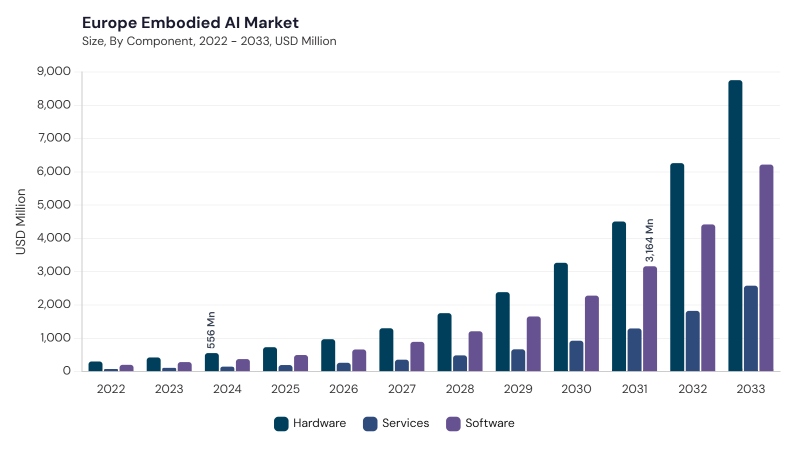
Based on Component, the market is segmented into Hardware, Software, and Services. The Hardware market dominated the Europe Embodied AI Market by Component in 2025, and would continue to be a dominant market till 2033; thereby, achieving a market value of USD 4.5 billion by 2031, growing at a CAGR of 36.9 % during the forecast period. The Software market is expected to witness a CAGR of 37.6% during (2026 - 2033).
Hardware holds the leading position because embodied AI depends on robotic bodies, sensors, actuators, embedded processors, cameras, LiDAR systems, tactile arrays, and edge computing units that allow machines to interact with real surroundings. Europe’s industrial robotics base, automotive automation, healthcare robotics, and smart factory programs continue to support demand for durable and precise hardware. Software is expanding as AI algorithms, digital twins, computer vision, simulation platforms, robotic operating systems, and safety-aware decision models improve system intelligence. Services are gaining relevance as enterprises require integration, compliance consulting, predictive maintenance, training, customization, and deployment support for complex embodied AI systems.
Based on Product, the market is segmented into Robots, Autonomous Systems, Smart Appliances, and Exoskeletons. The Robots market dominated the Europe Embodied AI Market by Product in 2025, and would continue to be a dominant market till 2033; thereby, achieving a market value of USD 3.3 billion by 2031, growing at a CAGR of 35.8 % during the forecast period. The Autonomous Systems market is expected to witness a CAGR of 37.6% during (2026 - 2033). Additionally, The Smart Appliances market is expected to witness highest CAGR of 38.2% during (2026 - 2033).
Robots lead the market as European industries increasingly deploy collaborative robots, industrial robots, healthcare robots, service robots, and intelligent robotic assistants to improve productivity, precision, and workplace safety. These systems are moving from repetitive automation toward context-aware task execution through sensor fusion, adaptive control, and human-robot interaction. Autonomous Systems are growing through use in transportation, drones, AGVs, defense platforms, logistics automation, and inspection systems that require independent navigation and real-time decisions. Smart Appliances are supported by connected homes and energy-efficient automation, while Exoskeletons are expanding through rehabilitation, worker assistance, mobility support, and occupational safety applications.
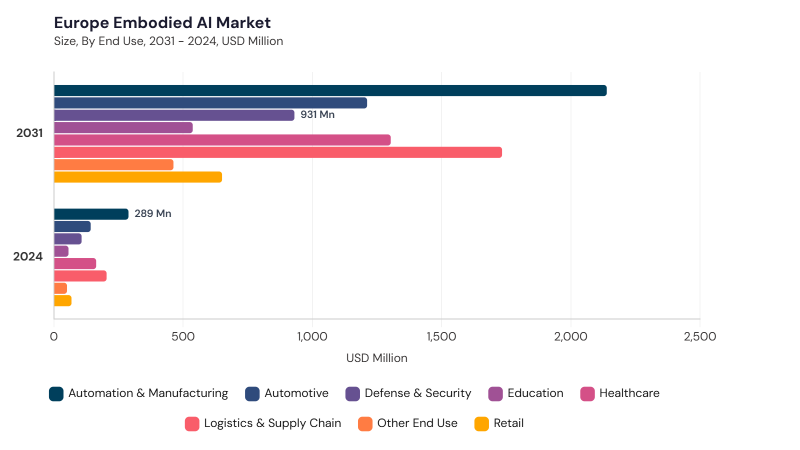
Based on End Use, the market is segmented into Automation & Manufacturing, Logistics & Supply Chain, Healthcare, Automotive, Defense & Security, Retail, Education, and Other End Use. Automation & Manufacturing lead due to Europe’s strong Industry 4.0 programs, smart factory investments, precision manufacturing base, and need for flexible production systems. Embodied AI supports cobots, robotic inspection, adaptive assembly, predictive maintenance, and safer human-machine cooperation across automotive, electronics, pharmaceuticals, and industrial equipment production.
Logistics & Supply Chain is expanding through autonomous mobile robots, robotic sorters, AGVs, warehouse automation, and AI-guided material handling. Healthcare, Automotive, and Defense & Security are gaining adoption through surgical support systems, rehabilitation devices, autonomous mobility, surveillance robots, and defense modernization, while Retail, Education, and Other End Use are emerging through customer-facing robots and interactive learning tools.
Free Valuable Insights: The Worldwide Embodied AI Market is projected to reach USD 71.3 Billion billion by 2033, at a CAGR of 37.9%
Based on Country, the market is segmented into Germany, UK, France, Russia, Spain, Italy, and Rest of Europe. The Germany market dominated the Europe Embodied AI Market by Country in 2025, and would continue to be a dominant market till 2033; thereby, achieving a market value of USD 2.1 billion by 2031, growing at a CAGR of 35.8 % during the forecast period. The UK market is expected to witness a CAGR of 36.1% during (2026 - 2033). Additionally, The France market is expected to witness a CAGR of 38.3% during (2026 - 2033).
Germany leads due to its engineering strength, industrial robotics ecosystem, automotive manufacturing base, smart factory adoption, and strong demand for sensor-fused robotic systems. The UK is advancing through AI hardware programs, robotics research, service automation, healthcare applications, and investment in safer edge-enabled embodied AI systems. France contributes through public-private AI initiatives, smart city applications, industrial automation, physical AI research, and strong emphasis on technological sovereignty. Russia, Spain, and Italy add demand through industrial digitization, humanoid and service robotics, healthcare automation, and localized AI infrastructure, while Rest of Europe benefits from research-led innovation, regional robotics startups, and adoption of human-centric embodied AI across specialized sectors.

By Component
By Product
By End Use
By Country
Set to reach $9.0 Billion by 2031, growing at 37.4% CAGR during 2026-2033.
Germany leads with $2.1 billion by 2031, growing at 35.8% CAGR during the forecast period.
Rising demand for smart appliances with a 38.2% CAGR during 2026-2033 fuels growth.
Hardware segment to reach $4.5 billion by 2031, at 36.9% CAGR during the forecast period.
France market is expected to witness a CAGR of 38.3% during 2026-2033.
Robots segment to achieve a market value of $3.3 billion by 2031, growing at 35.8% CAGR during the forecast period.
Our team of dedicated experts can provide you with attractive expansion opportunities for your business.




 Unique Offerings